Micronaut for Spring Boot Developers – The Complete Guide
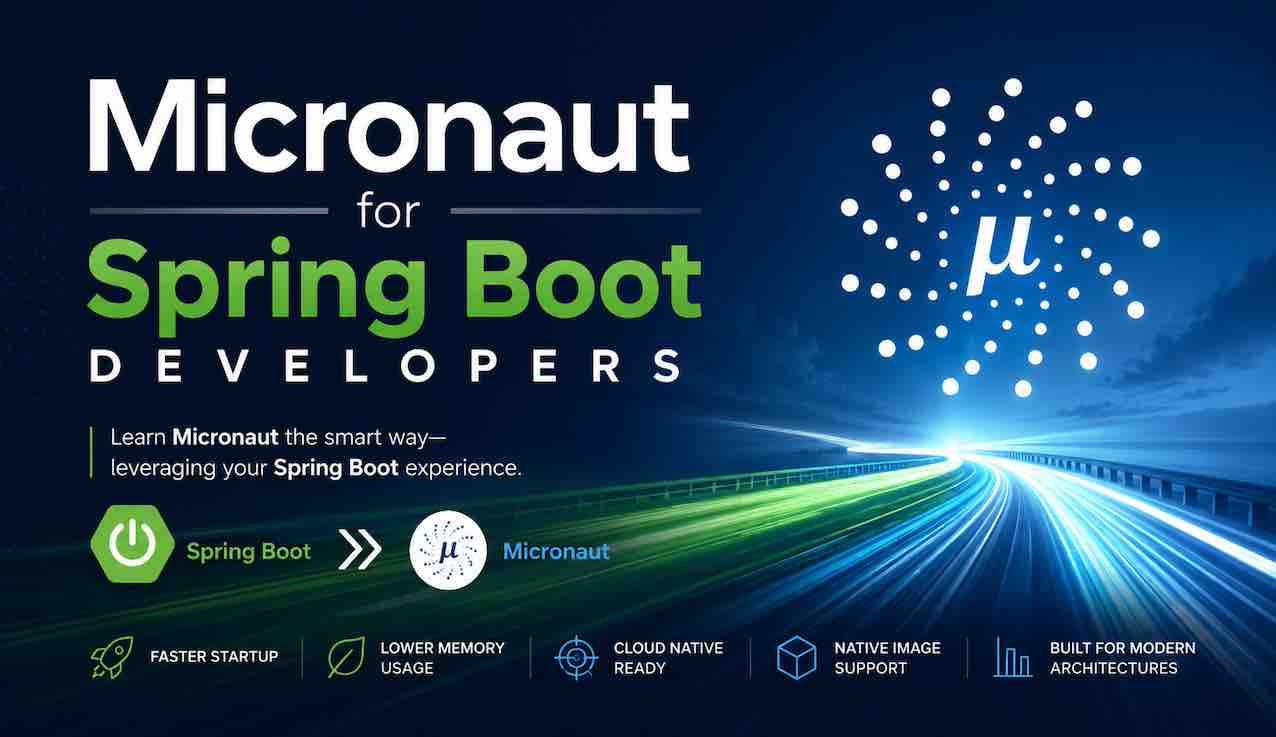
Learn Micronaut through the lens of Spring Boot — understand what stays the same, what changes, and how to build production-ready applications with confidence.
Micronaut has emerged as one of the most compelling JVM frameworks for cloud-native applications, offering fast startup times, low memory consumption, and first-class support for native image compilation. For developers coming from Spring Boot, the challenge is rarely learning concepts like dependency injection, REST APIs, configuration management, transactions, messaging, or observability. The challenge is understanding how Micronaut approaches those same concerns differently through compile-time dependency injection, annotation processing, ahead-of-time optimisations, and a framework architecture designed for modern cloud environments. This series is written specifically for Spring Boot developers. Rather than teaching backend development from first principles, it focuses on translating existing Spring knowledge into the Micronaut ecosystem. Along the way, you'll learn how Micronaut handles dependency injection, REST APIs, data access, transactions, Kafka integration, security, testing, observability, containerisation, and native image deployment. Whether you're evaluating Micronaut for a new project, exploring alternatives to Spring Boot, or preparing for a migration, this series provides the practical knowledge and architectural understanding needed to become productive quickly.
Articles
13
Total read time
~275 min
Last updated
May 2026
Difficulty
Beginner
How to read this series
Begin with the introductory articles explaining why Micronaut exists and how its architecture differs from Spring Boot. These tutorials establish the mental model that makes the rest of the framework easier to understand. Next, work through the core framework topics such as dependency injection, configuration, bean lifecycle, and application startup. Although the concepts will feel familiar, the implementation details are significantly different due to Micronaut's compile-time approach. Once comfortable with the fundamentals, move on to REST APIs, HTTP clients, persistence, transactions, and messaging. These represent the building blocks used in most real-world services. The security, observability, testing, and deployment sections can be read either sequentially or on demand as your projects require them. Every tutorial includes comparisons and migration notes for Spring Boot developers, making it easy to map familiar concepts to their Micronaut equivalents. While each article is self-contained, reading the series in order provides the smoothest learning experience.
Table of Contents
13 articles • 275 minutes total reading time
What Is Micronaut? A Practical Introduction for Spring Boot Developers
BeginnerLearn how Micronaut's compile-time architecture differs from Spring Boot and why it matters for cloud-native Java applications
Dependency Injection in Micronaut for Spring Boot Developers: A Practical Guide
BeginnerA practical introduction to Micronaut's compile-time dependency injection model, explained through Spring Boot equivalents
Micronaut Configuration Explained for Spring Boot Developers
BeginnerLearn how application.yml, environment variables, @Value, @ConfigurationProperties, validation, environments, and conditional beans work in Micronaut — and exactly how they compare to Spring Boot
Micronaut REST APIs Explained for Spring Boot Developers
BeginnerControllers, Validation, Filters, and Testing with Side-by-Side Comparisons
Micronaut OpenAPI & Swagger UI Explained for Spring Boot Developers
BeginnerLearn how Micronaut generates OpenAPI documentation at compile time, how it differs from Springdoc in Spring Boot, and how to build production-grade API specifications with Swagger UI, schema modelling, and contract testing
Micronaut Data JDBC and JPA: Database Access for Spring Boot Developers
BeginnerBuild PostgreSQL-backed Micronaut applications using Micronaut Data, Flyway migrations, repositories, and transactions — while understanding how Micronaut's compile-time approach differs from Spring Data
Micronaut @Transactional Explained: A Spring Boot Developer's Guide
BeginnerLearn how Micronaut handles @Transactional, propagation, rollback, and programmatic transactions — mapped directly to Spring Boot concepts you already know
Kafka in Micronaut: A Practical Guide for Spring Developers
BeginnerBuild message-driven microservices with Micronaut's compile-time Kafka integration — and see exactly how it compares to Spring Boot
Micronaut RabbitMQ Messaging for Spring Boot Developers: Producers, Consumers, and Testing Explained
BeginnerLearn how Micronaut handles RabbitMQ messaging using compile-time generation, and how its producer/consumer model compares with Spring Boot's runtime approach
Micronaut HTTP Clients Explained for Spring Developers
BeginnerLearn Micronaut's declarative @Client, low-level HttpClient, retries, circuit breakers, and filters through familiar Spring comparisons
Micronaut Testing Explained for Spring Boot Developers
BeginnerLearn unit testing, @MicronautTest, Testcontainers, WireMock, HTTP endpoint testing, Kafka testing, and configuration testing through familiar Spring Boot comparisons
Micronaut Security Explained for Spring Boot Developers
BeginnerLearn how Micronaut handles authentication, authorisation, JWT validation, and OAuth2 through a lightweight compile-time framework — with Spring Security comparisons throughout
Micronaut Observability for Spring Boot Developers: Metrics, Health Checks, and Distributed Tracing
BeginnerA practical guide to observability in Micronaut — concepts explained, implementation shown, and everything mapped to Spring Boot Actuator for developers making the switch
What You'll Learn
Prerequisites
- Working experience with Spring Boot
- Familiarity with dependency injection and inversion of control
- Experience building REST APIs
- Basic knowledge of databases and persistence
- Understanding of Java build tools such as Maven or Gradle
Frequently Asked Questions
Do I need prior Micronaut experience to follow this series?
No. The series assumes experience with Spring Boot but no prior knowledge of Micronaut. Concepts are introduced from a Spring developer's perspective throughout the series.
Is this series suitable for developers completely new to backend development?
Not ideally. The tutorials assume familiarity with concepts such as dependency injection, REST APIs, transactions, persistence, and application configuration. The focus is on learning Micronaut rather than teaching backend development fundamentals.
How different is Micronaut from Spring Boot?
The developer experience is intentionally familiar, but the underlying architecture is very different. Micronaut relies heavily on compile-time code generation and avoids much of the runtime reflection commonly associated with traditional Java frameworks.
Does the series compare Micronaut and Spring Boot directly?
Yes. Most tutorials include explanations of how Micronaut's approach differs from Spring Boot and what those differences mean for application design, startup performance, memory usage, and deployment.
Will the series cover GraalVM native images?
Yes. One of Micronaut's strongest areas is native image support, and dedicated tutorials explain how native compilation works, how to build native executables, and what trade-offs to consider.
Can I migrate an existing Spring Boot application using this series?
The series includes migration-focused guidance and comparison articles that help identify equivalent Micronaut features and common migration challenges. The goal is to make framework evaluation and adoption significantly easier.