Learning Paths
Last Updated: April 9, 2026 at 10:30
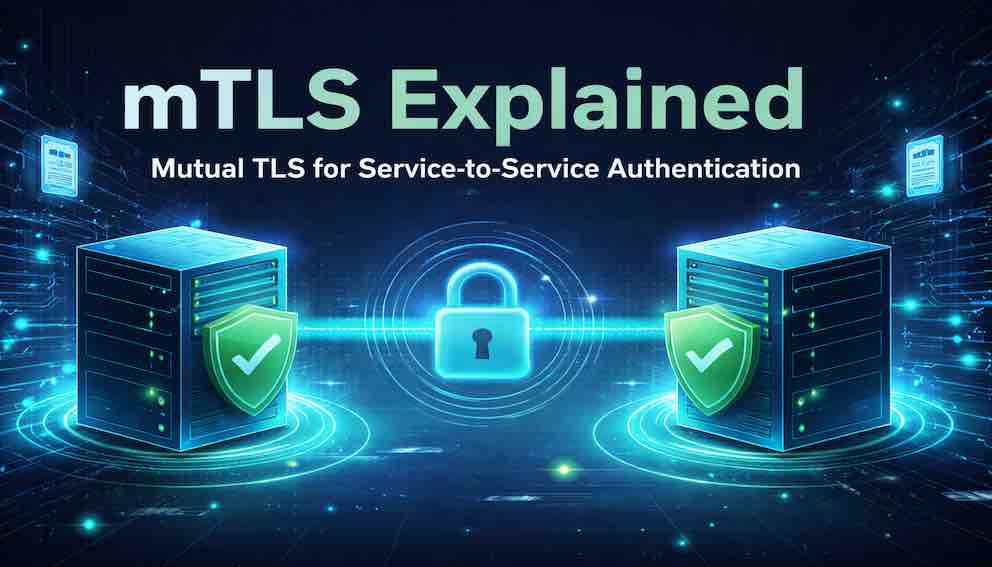
mTLS Explained: Mutual TLS for Service-to-Service Authentication
From one-way trust to mutual verification — how microservices and zero trust architectures authenticate each other
Standard TLS verifies only the server's identity. The client trusts the server's certificate, but the server has no idea who the client is. Mutual TLS (mTLS) changes that dynamic fundamentally: both sides present certificates, and both sides verify each other. This makes mTLS the standard authentication mechanism for service-to-service communication in microservices architectures, zero trust networks, and internal API gateways. This article explains how mTLS works, when to use it, and how it compares to other authentication methods like API keys and JWTs.
The Two-Way ID Check
Imagine you are visiting a secure government facility. You approach the guard at the entrance and show your ID badge. The guard checks it, verifies your photo, and scans the barcode. So far, so standard.
But now consider: the guard also needs you to trust them. Anyone could put on a uniform and pretend to be a guard. So the guard shows you their ID badge. You check it. You see their photo, their name, their badge number. You verify that they are an authorised guard. Both sides have proved their identity. You trust the guard. The guard trusts you. This is mutual authentication.
Standard TLS works like a one-way ID check. The server shows its certificate — the guard showing their badge. The client verifies it and trusts the server. But the server has no idea who the client is. The client could be a legitimate service, an attacker, or a compromised workload. Mutual TLS adds the second half of the check: the client also presents a certificate, and the server verifies it before any application data is exchanged.
This is mTLS — TLS with client authentication added.
What mTLS Actually Is
Mutual TLS is an extension of standard TLS where both the client and the server present and verify X.509 certificates. X.509 certificates are the standard digital identity documents used on the internet — the same kind that HTTPS websites use to prove they are who they claim to be. Think of them as a cryptographically signed ID card that a trusted authority has vouched for.
In standard TLS, the client initiates a connection, the server presents its certificate, the client verifies it, and an encrypted channel is established. The client's identity is handled separately — often via a password, API key, or JWT token after the TLS handshake completes.
The mTLS flow adds one critical step. After the client verifies the server's certificate, the server requests a client certificate. The client presents it. The server verifies it. Only then does the encrypted channel open. The client's identity is cryptographically proven by the certificate itself — no additional authentication step is required.
The result is a connection with four properties. First, mutual authentication: both sides know exactly who they are talking to. Second, encryption: all traffic is protected in transit. Third, integrity: any tampering with traffic is detected. Fourth, no shared secrets: there are no API keys to rotate, no passwords to leak. Each service holds its own certificate and private key.
The Handshake, Step by Step
Before diving into the details, it helps to understand what the handshake is trying to accomplish at a high level. It does three things in sequence: agree on how to encrypt the connection, verify the server's identity, and verify the client's identity. Everything below is in service of those three goals.
The client initiates by sending a Client Hello — essentially an opening message that says "here are the encryption methods I support, let's negotiate." The server responds with a Server Hello, selects the encryption parameters, and sends its certificate. Critically, the server also issues a CertificateRequest, asking the client to prove its own identity.
The client then sends its own certificate, along with a CertificateVerify message — a cryptographic signature that proves it holds the private key matching the certificate it just presented. Think of this as the client saying: "here is my ID, and here is proof I'm not just holding someone else's." The server then checks the certificate is valid, not expired, and was issued by a trusted authority. Both sides exchange final confirmation messages, and encrypted communication begins.
From this point, all traffic is encrypted. The client's identity is established before any application data flows — not after.
Note: The above describes the general mTLS flow. TLS 1.3, now the preferred version, compresses this handshake for performance. The mutual authentication semantics are the same, but the wire-level details differ from TLS 1.2.
Certificates in mTLS
A Certificate Authority (CA) is a trusted authority that issues certificates — think of it like a passport office. It verifies identity and then issues a document that others can trust because they trust the issuing authority. The CA's signature on a certificate is what makes it trustworthy. Without a CA, a certificate is just an unverified claim.
mTLS requires certificates for both servers and clients. Server certificates in mTLS are the same as standard TLS server certificates — they contain the server's domain name, which the client uses to verify it is talking to the right endpoint.
Client certificates are different. They do not need a domain name. Instead, they carry identifying attributes about the service, device, or user: a Subject field, an Organization (O), an Organisational Unit (OU), and a Common Name (CN) that is often used as the service identifier. The server is configured to trust certificates signed by a specific CA. When a client presents its certificate, the server checks the CA's signature and verifies the certificate against several criteria: it must trace back through a chain of trusted authorities to a root CA, it must not be expired, and it must not be revoked — meaning it must not have been invalidated before its expiry date, for example because the service it belonged to was decommissioned or compromised.
On revocation: modern deployments check this via OCSP (Online Certificate Status Protocol), where the server queries a live endpoint to confirm a certificate is still valid, or via a Certificate Revocation List (CRL), a published list of invalidated certificates. OCSP stapling — where the server pre-fetches and includes the revocation check result in the handshake — is the preferred approach as it avoids the latency of a live lookup at connection time.
mTLS vs Standard TLS
The critical difference between mTLS and standard TLS is who bears the burden of authentication. In standard TLS, the server authenticates to the client via its certificate. The client is not required to present any certificate at all — it might authenticate later via a username and password, an API key in a header, or a JWT in a bearer token. The TLS layer itself carries no client identity.
In mTLS, the TLS layer carries both identities. The handshake cannot complete unless the client presents a valid certificate trusted by the server. By the time application data starts flowing, both parties have already been cryptographically verified. There is no second authentication step, and there is no mechanism for an anonymous client to connect.
This distinction matters for threat modelling. Standard TLS protects against a compromised network — an attacker cannot read or tamper with traffic. But it does nothing to prevent an unknown client from reaching the server. mTLS raises the bar: even if an attacker has network access, they cannot establish a connection without a valid certificate issued by the trusted CA.
When to Use mTLS
mTLS is not the right choice for every situation. It adds operational complexity and requires certificate management for every client. It is best suited for specific use cases.
Microservices and service mesh. In a microservices architecture, services call each other constantly. Service A needs to know it is talking to the real Service B, not an impostor. Service B needs the same assurance. mTLS is the standard authentication mechanism in service meshes like Istio, Linkerd, and Consul Connect, which automatically provision certificates for every service and handle mTLS transparently. API keys or JWTs would require additional infrastructure and rotation logic that does not fit the ephemeral, auto-scaling nature of microservices.
Zero trust networks. Zero trust architecture assumes the network is compromised. Every request must be authenticated and authorised regardless of its source — there is no trusted internal network. mTLS is a core component of zero trust: every service authenticates every request using certificates, and the network itself is treated as untrusted.
Internal APIs and API gateways. An API gateway between the public internet and your internal services can use mTLS to authenticate requests from trusted partners or internal services. API keys can be stolen. JWTs can be forged if the signing key is compromised. Certificates are harder to steal because an attacker needs to extract a private key — not just copy a string — and they can be invalidated centrally if they are ever compromised.
IoT device authentication. IoT devices need to authenticate to cloud services, and the cloud needs to authenticate to the device to prevent impersonation attacks. mTLS is widely used for device identity: each device is provisioned with a unique certificate during manufacturing, valid for years, with the ability to revoke it centrally if the device is compromised.
Database authentication. PostgreSQL (with cert auth) and MongoDB (with x.509 auth) both support mTLS for client authentication. Instead of a password, the client presents a certificate — a credential that is harder to leak through logs or misconfiguration.
When Not to Use mTLS
Public-facing websites. Your bank's website uses standard TLS, not mTLS. The bank proves its identity to you via its server certificate. You prove yours via username and password. Distributing client certificates to millions of users is impractical, and managing expiration and revocation at that scale would be a significant operational burden.
Third-party API access. If you provide a public API for external developers, you will almost certainly use API keys or OAuth rather than mTLS. Requiring developers to generate, install, and manage certificates is a substantial barrier to adoption, and certificate expiration would silently break their integrations.
Small internal services. If you have a handful of internal services and a small team, mTLS may be overkill. The overhead of running a CA, provisioning certificates, and managing renewal may not be proportionate to the risk. Simpler authentication methods may be the right call.
mTLS Compared to Other Authentication Methods
mTLS vs API keys. An API key is a shared secret — a string that grants access to whoever holds it. It is easy to implement and easy to copy. mTLS replaces the shared secret with a certificate bound to a specific identity. Certificates require private key extraction to steal, which is meaningfully harder than copying a string. Revocation — that is, invalidating a credential before it naturally expires — works centrally via certificate management infrastructure, rather than requiring someone to manually delete or disable a key in an application database. The trade-off is operational overhead: API keys are simple to issue and store, while mTLS requires running a CA and managing certificate lifecycles. For simple, internal, non-critical use cases, API keys are often appropriate. For high-security or zero trust environments, mTLS is the stronger choice — and notably, API keys provide no mutual authentication, meaning the server does not prove its identity to the client.
mTLS vs JWT. JWTs are signed tokens that carry identity claims. They are well-suited for user-facing authentication: short-lived, self-contained, and easy to pass in a request header. Their weakness is revocation — cancelling a JWT before it expires requires maintaining a blocklist, which undermines the stateless design. mTLS handles revocation more naturally, and provides mutual authentication that JWTs do not. The practical split: use JWTs for user-facing authentication where tokens are short-lived. Use mTLS for service-to-service communication where certificates can be managed centrally and revocation matters.
mTLS vs OAuth 2.0 client credentials. OAuth's client credentials flow exchanges a client ID and secret for a bearer token. This is well-standardised and widely supported, making it a good fit for third-party access where you need scoped, delegated permissions. mTLS is a better fit for direct service-to-service communication where you control both endpoints and want authentication to happen at the transport layer rather than in application code. The two are not mutually exclusive — OAuth flows can themselves be secured with mTLS, binding tokens to the client certificate that requested them, as described in RFC 8705.
Implementing mTLS: What You Need to Know
It is worth understanding the four components you will need to think about at a high level.
A Certificate Authority. You need something to issue certificates. For internal service-to-service mTLS, this is almost always a private CA that you run yourself using tools like Cloudflare CFSSL or Smallstep CA, or a managed CA service from AWS, Azure, or Google Cloud.
Certificate distribution. Certificates need to reach your services. Service meshes like Istio, Linkerd, and Consul handle this automatically. For other environments, secrets management tools like HashiCorp Vault can issue short-lived certificates dynamically at service startup.
Certificate renewal. Certificates expire, and your system must handle this automatically. Expiration that is not managed in advance will cause authentication failures in production. SPIFFE/SPIRE — a vendor-neutral open standard for workload identity — is worth understanding as a foundation for this in cloud-native environments.
Authorisation after mTLS. mTLS authenticates. It does not authorise. A valid certificate proves the client is who they claim to be — it does not prove that client should be allowed to call a specific endpoint. After mTLS, you still need an authorisation layer: RBAC, ABAC, or service mesh authorisation policies.
mTLS in Service Meshes
Service meshes are the most common production deployment of mTLS, and they handle most of the operational complexity automatically.
Istio provisions certificates to every workload via its control plane, encrypts all service-to-service traffic with mTLS, and rotates certificates automatically. It supports a permissive mode that accepts both mTLS and plaintext during migration — useful for teams rolling out mTLS incrementally.
Linkerd takes a simpler approach. mTLS is enabled by default with no configuration required. It uses its own CA, automatically provisions certificates to every pod, and bases identity on Kubernetes service accounts.
Consul Connect provides mTLS via its built-in CA with Envoy proxy handling TLS termination. Intentions define which services are permitted to communicate, and certificate rotation is automatic.
Common mTLS Mistakes
Using self-signed certificates without a CA. A self-signed certificate has no trusted issuer. Every service would need to individually trust every other service's certificate, which does not scale. Run a private CA, trust its root certificate in your environment, and issue all client certificates from it.
Ignoring certificate expiration. Certificates expire. Without an automated renewal process, services will fail to authenticate in production — often without a clear error message pointing to the cause. Automate renewal and set expiration alerts before you need them.
Not validating the full certificate chain. The server must verify the client's certificate all the way back to a trusted root CA. Accepting any certificate that is merely cryptographically valid is not sufficient. Configure your server to validate the full chain against your trusted CA bundle.
Using mTLS without authorisation. mTLS proves who the client is. It does not determine what they are allowed to do. Implement an authorisation layer — RBAC, ABAC, or service mesh policies — after authentication.
Exposing mTLS to the public internet. Requiring client certificates for public endpoints is impractical for most use cases. Use mTLS for internal service-to-service communication, and other authentication methods for public-facing APIs.
Storing private keys insecurely. A private key stored in source code, an environment variable, or an unencrypted file is a liability. Use a secrets manager (Vault, AWS Secrets Manager), a hardware security module, or at minimum an encrypted file with tightly restricted permissions.
Disabling certificate verification during development. It is tempting to skip certificate verification to avoid "self-signed certificate" errors locally. This is a dangerous habit that can follow bad practices into production. Use a real private CA for development and configure your environment to trust it properly instead.
What to Take Away
mTLS is standard TLS with client certificate authentication added. Both sides present certificates. Both sides verify each other. The client's identity is established cryptographically at the transport layer — before any application data is exchanged, and without relying on passwords or shared secrets.
The right use cases are clear: microservices, service meshes, zero trust networks, internal APIs, IoT device authentication, and database authentication. The wrong use cases are equally clear: public websites, third-party developer APIs, and small internal services where the operational overhead is not justified.
Compared to API keys, mTLS is harder to steal and provides mutual authentication. Compared to JWTs, it handles revocation more naturally. Compared to OAuth, it suits direct service-to-service communication better, though the two can be combined.
mTLS adds complexity. That complexity is the price of mutual, cryptographic, verifiable trust. For service-to-service authentication in modern zero trust security architectures, it may be the right price to pay.
The Two-Way ID Check, Revisited
Return to the secure facility. The guard checks your ID. You check the guard's ID. Both sides know exactly who they are talking to. No impostors. No stolen badges that go unnoticed. No trust without verification.
This is mTLS. Not one-way trust. Not trust based on network location. Not trust based on a shared secret that can be leaked. Mutual, cryptographic, verifiable trust — established before a single byte of application data crosses the wire.
Your services are the guard and the visitor. The certificates are the IDs. The CA is the issuing authority that verified identity before issuing the badge. When Service A calls Service B, both sides present their certificates. Both sides verify. Both sides trust.
An attacker on the network can intercept traffic, but cannot read it. They cannot impersonate Service A, because they do not have its private key. They cannot impersonate Service B for the same reason.
This is the promise of mTLS: not just encryption, but identity. Not just a secure channel, but a verified one.
About N Sharma
Lead Architect at StackAndSystemN Sharma is a technologist with over 28 years of experience in software engineering, system architecture, and technology consulting. He holds a Bachelor’s degree in Engineering, a DBF, and an MBA. His work focuses on research-driven technology education—explaining software architecture, system design, and development practices through structured tutorials designed to help engineers build reliable, scalable systems.
Disclaimer
This article is for educational purposes only. Assistance from AI-powered generative tools was taken to format and improve language flow. While we strive for accuracy, this content may contain errors or omissions and should be independently verified.