
Learning Paths
Last Updated: May 28, 2026 at 16:30
Three Amigos in Agile: How Product, Dev, and QA Align to Prevent Rework
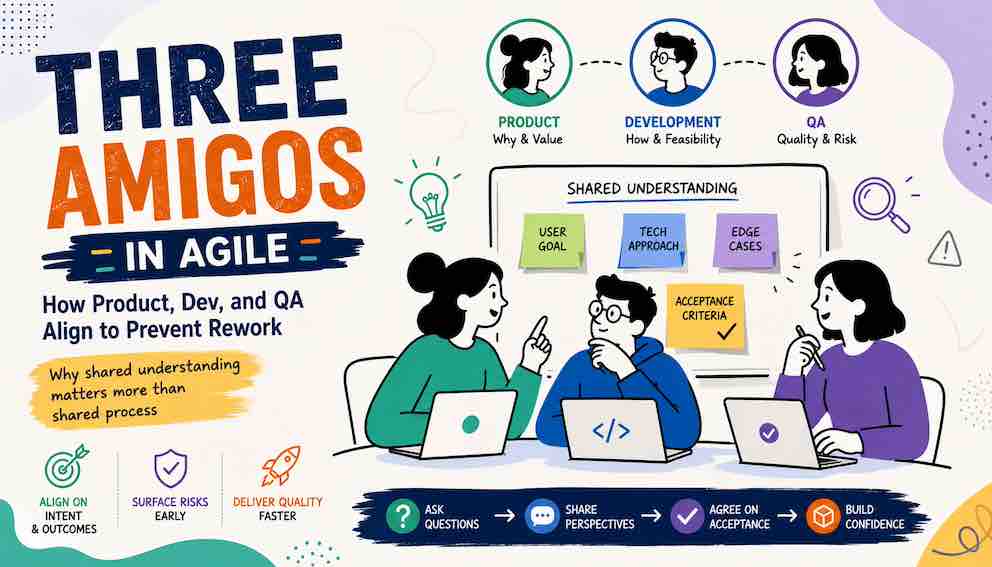
Why shared understanding matters more than shared process
Most rework in agile sprints doesn't come from bad code — it comes from different interpretations of the same requirement. Three Amigos is a lightweight collaboration practice that brings product, development, and QA together at the moment a story is picked up, before assumptions have a chance to diverge. The conversation is short, the format is informal, and the output is simple: shared acceptance criteria that everyone actually agrees on. Done consistently, it's one of the most effective ways a team can reduce defects, shorten QA cycles, and stop discovering requirements in production.
Effort Without Alignment
Most agile teams are not short of effort. Sprints get planned, standups happen, tickets move across the board. And yet rework is common, QA cycles stretch longer than they should, and features sometimes land differently than anyone intended.
A lot of that friction traces back to something simple: people doing the work held different mental models of what the work was. Not because the requirements were badly written — often they weren't — but because written requirements compress meaning. A sentence that seems clear to the person who wrote it can read three different ways to the people who have to act on it.
This isn't a process failure or a tooling problem. It's just how language works. The Three Amigos practice exists as a direct response to it: a lightweight habit of getting the right three perspectives in conversation before development begins, so assumptions get surfaced while they're still cheap to fix.
What Is Three Amigos in Agile?
Three Amigos is a collaborative requirement discovery technique used in agile teams to build shared understanding of a user story before development begins. The name refers to the three perspectives that matter most: product, development, and quality assurance.
The core idea is simple. Before a complex story is picked up for development, the three people most likely to interpret it differently sit down together and talk it through. Not to review a document. Not to assign tasks. To ask questions, surface assumptions, and agree on what the story actually means.
A working definition that captures the intent well: Three Amigos is a structured but informal conversation designed to align on intent, feasibility, and testability before a single line of code is written.
Those three perspectives belong to:
- The Product Owner or Product Manager — who understands why the feature exists and what business outcome it's meant to achieve
- A Developer — who understands how it will be built and where the technical complexity hides
- A QA Engineer — who thinks in edge cases, failure paths, and "what happens when things go wrong"
Each of them brings a genuinely different mental model to the same story. The product person is thinking about the user's goal. The developer is thinking about data flow and dependencies. The QA engineer is already asking: what if the user enters nothing? What if the token has expired? What if the network drops halfway through?
None of these perspectives is more correct than the others. The point is that when they don't talk before work starts, they each proceed under different assumptions — and those assumptions only collide when it's expensive to fix them.
It's worth being clear about what Three Amigos is not. It's not a formal ceremony with a defined agenda. It's not a meeting that happens on a fixed day. And it's definitely not a substitute for good story writing. It's a focused conversation, usually short, aimed at building shared understanding before work begins.
Why Ambiguity Survives Sprint Planning
Agile processes are generally good at moving stories through a pipeline. Backlog refinement grooms the work. Sprint planning commits it. But neither of those events is designed to surface deep ambiguity in a story's logic.
In sprint planning, the team is mostly answering: can we fit this work in? In backlog refinement, the question is: is this story ready? Both of those are useful, but neither one naturally creates the space for a developer to say, "Wait — when you say 'notify the user,' do you mean email, in-app, or both?" or for QA to ask, "What happens if someone submits this form twice in ten seconds?"
Those questions get answered eventually. The problem is when. If they surface during development, the developer has to stop, seek clarity, and often rework something already built. If they surface during QA, the cost is higher — there's likely a failing test and a re-open cycle. If they surface in production, the cost is highest of all.
Three Amigos shifts this discovery to the left. The conversation happens before any code is written, when the cost of changing course is essentially zero.
When the Three Amigos Session Happens
The most natural trigger for a Three Amigos session is the moment a developer picks up a story.
That moment matters for a specific reason: ownership has just been established. The developer is no longer looking at the story from a distance — they're about to build it, which means ambiguity is now their problem. That shift in stakes changes the quality of the conversation. Questions get asked with more urgency. Edge cases feel real rather than hypothetical. The product owner and QA aren't being asked to clarify something abstract; they're helping someone who is about to start work right now.
This is subtly different from running Three Amigos during backlog refinement, which many teams do. Refinement sessions can surface obvious gaps, and there's value in that — but they happen weeks before the story is picked up, when the developer assigned to it may not even be known yet. By the time the work is actually started, the session is a distant memory and the clarity it produced has often dissipated.
That said, refinement and pickup aren't competing. They're complementary passes at different levels of depth. Refinement is where a story gets basic readiness checks — is it sized, scoped, and clear enough to enter a sprint? Pickup is where the deeper alignment happens, with the person who is actually going to build it. The first pass catches obvious gaps. The second pass resolves interpretation.
Keeping that distinction clear also protects against a real failure mode: a developer picks up a story, the Three Amigos session reveals significant gaps, and now they're blocked mid-sprint waiting for the product owner or QA to resolve something that should have been caught earlier. Refinement should get the story ready enough to pick up. Three Amigos at pickup should get the team aligned enough to build.
Not every story needs a session. Some work is genuinely straightforward:
- Trivial UI copy changes or cosmetic fixes
- Well-understood CRUD operations on already-defined data models
- Work against standardised, documented APIs where the contract is clear
- Stories that are a genuine repeat of something the team has built before
The developer picking up the story is usually the right person to make that call. If they read it, understand it completely, and can anticipate how QA will test it — it probably doesn't need a session. If they feel any pull toward assumptions or have to fill in gaps themselves, that's the signal to get the other two in the room.
How a Three Amigos Session Works
The format is deliberately informal. A typical session might last twenty to forty minutes and follows a rough pattern.
The product owner explains the intent. Not just what the feature does, but why. What problem is the user trying to solve? What does success look like from a business perspective? This grounds the conversation in purpose rather than specification.
The developer explores the technical reality. How would this actually be built? What data does it touch? Are there dependencies that might affect behavior? This often surfaces constraints that the product owner hadn't considered — and it's an important counterweight to stories that look simple from the outside.
QA challenges the happy path. What happens when things don't go as expected? What are the edge cases? What should the system do if the user's session has expired, or if an upstream service is unavailable, or if the same action is submitted twice?
This is where the most valuable refinement usually happens. It's where assumptions become visible.
Together, the three align on acceptance criteria. By the end, the story should have a shared, concrete definition of what "done" means — ideally expressed as specific scenarios that can be tested.
A Three Amigos Example: User Story Before and After
Consider a user story that reads: "As a user, I want to reset my password so that I can regain access to my account."
On the surface, this seems complete. In practice, it hides a dozen unanswered questions.
Without a Three Amigos conversation, a developer might build a simple email-based reset flow. QA might test only the happy path. And the product owner might have assumed there would be rate limiting to prevent abuse — because their previous company did it that way.
After a Three Amigos session, the same story might produce something like this:
- The reset link is sent via email to the registered address only
- The link expires after 30 minutes
- If the email address is not found in the system, the UI shows a generic message — not a specific error — to prevent email enumeration
- No more than three reset requests are allowed per email address per hour
- If the user is already logged in, the reset flow is blocked
Each of these details came from someone asking a question the others hadn't thought of. The product owner flagged the security concern around email enumeration. The developer raised the rate limiting issue. QA asked what the system should do when someone requests a reset for an address that doesn't exist.
None of this is complicated. All of it would have caused rework if discovered after development began.
The Connection to BDD and Acceptance Criteria
Teams that practice Three Amigos often find that their conversations naturally produce scenarios in BDD format. A Three Amigos session and a BDD acceptance criteria conversation are, in many ways, the same thing.
Given a user has a registered account
When they request a password reset
Then they receive an email with a time-limited link
Given/When/Then becomes a shared language between product, dev, and QA — and that's the point. When acceptance criteria are written in this format, they serve double duty: they tell the developer what to build, and they give QA a ready-made test specification.
There's no room for "I thought you meant..." because the expected behavior is written down in plain language before anyone writes a line of code.
Why It Reduces Defects and Sprint Spillover
The outcome framing matters here, because the benefits are concrete and measurable over time.
Teams that run Three Amigos sessions consistently report fewer defects raised during QA — because QA's test cases and the developer's implementation were aligned from the start. They report faster QA cycles, because testers aren't uncovering logic gaps mid-test that require a developer to be pulled back in. And they see fewer sprint spillovers, because stories don't stall mid-development waiting for clarification on an edge case nobody thought to specify.
Beyond the metrics, there's a softer but equally real benefit: shared team ownership of quality. When QA is involved before development starts — not just after — the dynamic shifts from "find the bugs" to "prevent the bugs." That shift changes how a team thinks about stories, and it compounds over time.
Why Three Amigos Sessions Fail
Like most lightweight practices, Three Amigos is easy to misapply. There are a few patterns that come up often enough to be worth naming.
Turning it into backlog grooming 2.0. Some teams conflate Three Amigos with refinement itself — estimating, sizing, and reprioritising stories instead of going deep on a single story's logic. The result is a session that covers a lot of ground without actually resolving anything.
The developer dominates. When the developer drives the conversation toward technical design rather than shared understanding, product and QA become passive observers. The conversation becomes an architecture discussion, not a requirements alignment.
QA is excluded or arrives unprepared. This is the most common failure. Without a QA perspective in the room, nobody is systematically thinking about edge cases and failure paths. The session produces a happy-path story that passes development — and falls apart in testing.
Product dictates acceptance criteria alone. When the product owner writes acceptance criteria before the session and presents them as finished, the Three Amigos dynamic collapses. The session becomes a briefing, not a conversation. Developers and QA nod along, and the criteria never get challenged.
Treating it as optional for "small" stories. Over time, teams often start skipping sessions for stories that feel straightforward. Sometimes this is fine. But "straightforward" is a judgment made before anyone has looked closely — and the stories that cause the most rework are often the ones that looked simple.
Three Amigos vs Backlog Refinement vs Sprint Planning
It's worth being precise about how these three things relate, because they're often confused.
Backlog refinement is about keeping the backlog healthy — sizing stories, breaking down large epics, making sure there's enough prioritised, well-defined work ready for upcoming sprints. It's a pipeline management activity.
Sprint planning is about commitment — deciding what the team can reasonably deliver in the next sprint and aligning on how to approach it.
Three Amigos is neither of those. It's a focused alignment conversation about the specific logic, edge cases, and acceptance criteria of a single complex story — and it works best when it happens at the moment a developer picks it up, not weeks earlier when the work still feels abstract.
What It Looks Like When It Actually Sticks
Teams that have genuinely internalised Three Amigos don't just run better sessions. They communicate differently across the board.
The habit of surfacing assumptions early — which Three Amigos makes explicit and structured — starts to show up in other places. In refinement, people ask clarifying questions earlier and with less hesitation. In planning, developers are more likely to flag a story that looks deceptively simple. In standups, blockers get named sooner because the team has grown comfortable saying "I'm not sure we all mean the same thing here."
This is what communication maturity looks like in a delivery team. Not more meetings or more documentation, but a shared instinct that ambiguity is worth the thirty seconds it takes to name it — and that the cost of leaving it unnamed compounds quickly.
Three Amigos, at its best, is a training ground for that instinct. The practice is a container for a behaviour that eventually outgrows the container. Teams that have been doing it for a while often find they need fewer formal sessions, not more — because the questions that used to require a dedicated conversation now get asked naturally, in the flow of whatever conversation is already happening.
That's a reasonable definition of a mature agile team: one that has stopped needing reminders to align, because alignment has become the default.
Why This Practice Still Matters
Agile has matured a great deal since its early days. Teams have better tooling, better CI/CD pipelines, and better testing practices than they did ten years ago. But the fundamental human problem — that people reading the same sentence understand different things — hasn't changed at all.
The Three Amigos practice is a direct response to that problem. It doesn't require new tooling or a process overhaul. It just requires three people to have a conversation at the right time, before the cost of misunderstanding becomes the cost of rework.
That's a low bar. And it's remarkable how often it isn't cleared.
About N Sharma
Lead Architect at StackAndSystemN Sharma is a technologist with over 28 years of experience in software engineering, system architecture, and technology consulting. He holds a Bachelor’s degree in Engineering, a DBF, and an MBA. His work focuses on research-driven technology education—explaining software architecture, system design, and development practices through structured tutorials designed to help engineers build reliable, scalable systems.
Disclaimer
This article is for educational purposes only. Assistance from AI-powered generative tools was taken to format and improve language flow. While we strive for accuracy, this content may contain errors or omissions and should be independently verified.