
Learning Paths
Last Updated: May 28, 2026 at 16:30
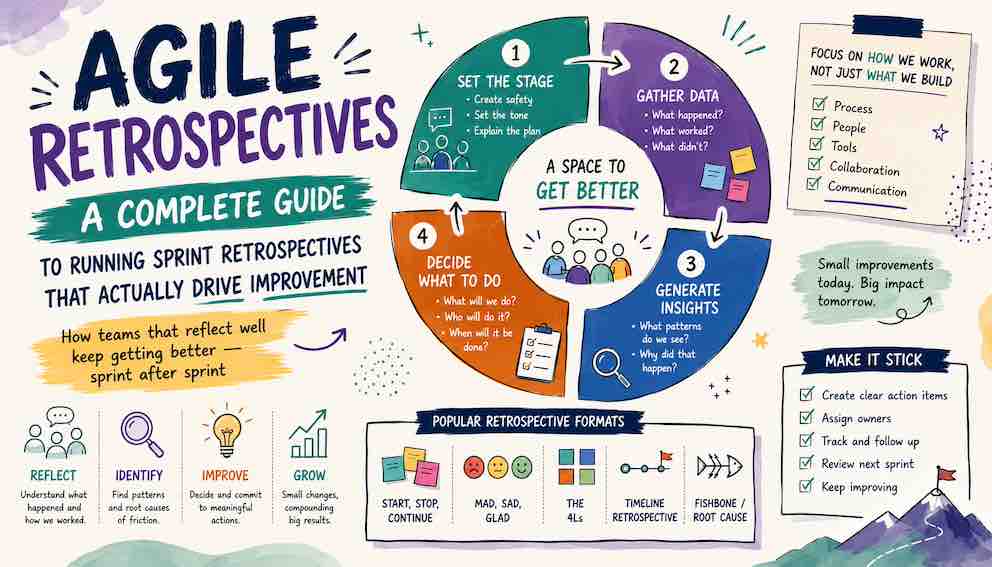
Agile Retrospectives: A Complete Guide to Running Sprint Retrospectives That Actually Drive Improvement
How teams that reflect well keep getting better — sprint after sprint
The sprint retrospective is the only meeting on an agile team dedicated entirely to getting better at the work itself. Done well, it compounds: small improvements in how a team collaborates, communicates, and removes friction accumulate into something dramatic over months and years. The difference between a team that plateaus and one that keeps growing is rarely talent — it's whether they've built a genuine habit of honest reflection and follow-through. This guide covers what that looks like in practice, and how to get there.
There's a meeting that happens at the end of almost every sprint on agile teams. It doesn't ship code. It doesn't produce a demo. It doesn't involve the customer. From the outside — and sometimes from the inside — it can feel like the least productive hour of the two-week cycle.
And yet, when it works, it's the most important meeting a team can have.
The agile retrospective is where teams learn. It's where the invisible friction that slows delivery gets named, examined, and addressed. It's where a group of smart people stop running long enough to ask: are we running in the right direction, and are we running well?
This guide is about how to run retrospectives that actually matter — not just the formats and frameworks, but the thinking behind them, the reasons they fail, and what it looks like when they're genuinely working.
What a Retrospective Actually Is
A sprint retrospective is a dedicated meeting at the end of each sprint where the development team reflects on how they worked together and identifies specific ways to improve. It's one of the five Scrum events, but the concept exists in some form across virtually all agile frameworks.
The important word in that definition is how. The retrospective is not about what was built — that's the sprint review, which happens just before and involves stakeholders and product feedback. The retrospective is internal. It's about the team's process, collaboration, tools, and dynamics.
In the Scrum Guide's framing, the retrospective is the last event of the sprint, happening after the review and before the next sprint planning. This positioning is intentional: you close the loop on what happened, then carry the lessons forward into how you'll plan and work next.
Why It Exists in the First Place
Agile emerged from a particular frustration: software teams kept making the same kinds of mistakes, and traditional project management gave them no good mechanism to correct course mid-flight. The retrospective is the correction mechanism.
Behind the practice is a simple but powerful idea — that a team capable of reflecting honestly on its own behaviour can get better over time, compounding improvements sprint after sprint. A team that runs good retrospectives for a year will be dramatically more effective than the same team would have been without them.
The things retrospectives surface are usually not dramatic. They're mundane: the code review process is creating a bottleneck nobody has formally acknowledged; the team's definition of "done" is interpreted differently by different people; pull requests sit for two days before anyone looks at them; standup has turned into a status report instead of a coordination meeting. None of these are crises. But left unaddressed, they compound and become the invisible ceiling on team performance.
Retrospectives also serve a social function that's easy to underestimate. They give the team a regular, legitimate space to say things that are difficult to say in other contexts. Without that outlet, frustration accumulates quietly and surfaces in worse ways — disengagement, attrition, or interpersonal tension that nobody addresses directly.
The Cadence Question: When and How Often
The standard answer is simple: run a retrospective at the end of every sprint. For most teams, that means every one or two weeks.
The most common justification for skipping is that "there's nothing to discuss" or "things went well this sprint." This is almost never valid. Even when a sprint goes smoothly, there are usually small improvements available. The absence of obvious problems doesn't mean the absence of growth opportunities.
The valid reasons to skip or shorten a retrospective are more specific: a very new team that hasn't had enough sprints for patterns to emerge, a team in crisis where a different kind of conversation needs to happen first, or an extremely short sprint where the overhead may not be proportionate.
One timing nuance worth being deliberate about: the retrospective should happen before the next sprint planning session. Any improvements the team identifies should be able to inform the next sprint immediately, not lag one cycle behind. When retrospective actions feed directly into planning, the feedback loop stays tight.
Who's in the Room
The core participants are the people doing the work: the developers, the Scrum Master (or equivalent), and typically the product owner. How teams handle the product owner varies — some include them fully, others ask them to observe, others exclude them to preserve psychological safety. All three can work depending on team dynamics.
The Scrum Master facilitates rather than participates — creating conditions for honest conversation, ensuring every voice is heard, and preventing discussion from collapsing into blame. A good Scrum Master in a retro is largely invisible; the team is doing the work.
Managers should generally not attend. Not because they're the enemy of good retrospectives, but because the presence of evaluation changes what people say. Teams self-censor around managers in ways that undermine the whole point. The exception is when a team has repeatedly hit a constraint genuinely beyond their authority to fix — in that case, including the relevant decision-maker can unlock action that would otherwise stall indefinitely. The distinction is between a manager as participant in solving a problem versus evaluator of the team. If there's any ambiguity about which role they'd play, they should receive the summary rather than the invitation.
A practice worth considering for more established teams is rotating the facilitator role. When the Scrum Master always facilitates, the retrospective can develop a subtle dependency on one person's framing. Rotation builds facilitation skills across the team and often surfaces different kinds of observations.
How a Retrospective Is Structured
Regardless of which specific format a team uses, effective retrospectives follow a consistent underlying structure.
Setting the stage. The opening minutes are about getting everyone into the right headspace. A simple prompt — "one word to describe how the sprint felt" — gets people speaking early and signals that honest input is welcome. A brief reminder of working agreements around confidentiality and respect reinforces that this is a different kind of conversation. The goal is to shift out of task-execution mode and into reflective mode.
Gathering data. Before the team can identify what to improve, they need a shared picture of what actually happened. This phase covers facts and observations: what did we ship, what got stuck, what surprised us, what felt harder than it should? Crucially, this phase should stick to observations rather than interpretations. "The deployment took six hours" is data. "Our deployment process is broken" is already an interpretation, and jumping there too early closes off other explanations.
Generating insights. This is where the team moves from what happened to why. What patterns do the observations suggest? What are the root causes of the friction points? This is the hardest part — it requires genuine curiosity and willingness to examine systemic causes rather than attributing problems to individual mistakes or bad luck. A useful technique here is the "five whys" — when a problem surfaces, ask why it happened, then ask why that is the case, and keep going until you reach something structural and addressable rather than a surface symptom. It rarely takes exactly five iterations, but the discipline of not stopping at the first explanation is what matters.
Deciding what to do. Insights without actions are just interesting conversations. This phase produces specific, assigned, achievable improvements to be completed before the next retrospective. The discipline is in specificity — "we should communicate better" is not an action item. "We'll add a five-minute async summary to the Slack thread after each design decision made on a call" is.
Closing. A brief close lets the team acknowledge what was discussed, confirm the action items, and often reflect on the retrospective itself — what was useful, what could be better next time.
What Good Facilitation Looks Like in the Room
Understanding the structure is one thing. Managing what happens inside it in real time is another, and it's where most facilitation falls short.
The most persistent problem is uneven participation. In almost every team, some people speak first, speak often, and speak with confidence — and others don't. Left unmanaged, the retrospective becomes a conversation between the dominant voices. The quieter participants often have the most useful observations, precisely because they've been watching rather than talking.
A few practical interventions help. Silent generation — giving everyone time to write down observations independently before any discussion — levels the playing field significantly. When input goes onto sticky notes or a shared board before anyone has spoken, the room isn't anchored to whoever spoke first. Dot voting on themes gives everyone an equal voice in what the team focuses on. Direct invitations ("I'd like to hear from people we haven't heard from yet") signal that all perspectives matter.
Timeboxing each phase is a discipline facilitators often skip but shouldn't. Without explicit time limits, data-gathering expands to consume most of the session, and the most important work — generating insights and deciding on actions — gets squeezed into the final ten minutes. A rough split for a 90-minute retrospective: ten minutes for stage-setting and reviewing previous actions, twenty minutes for data gathering, thirty minutes for insights and root cause exploration, twenty minutes for action item generation, and ten minutes for close.
One of the harder challenges is steering the room when it goes sideways — when the conversation becomes circular, when a single issue consumes disproportionate time, or when emotional temperature rises unproductively. Naming what's happening directly ("we've been on this point for fifteen minutes and I want to make sure we have time to turn it into something actionable") is usually more effective than trying to smoothly pivot around it.
Common Formats
The agile community has developed a wide variety of retrospective formats. They mostly share the same structural logic described above; what varies is the framing used to prompt reflection.
Start, Stop, Continue is the simplest and most widely used. Team members identify things to start doing (new practices), stop doing (things that aren't working), and continue doing (things working well). Its simplicity is its strength — even new teams can engage immediately. Its limitation is that it can become rote; teams who've done it fifty times often produce the same list they produced forty times ago.
Mad, Sad, Glad shifts the frame from process to emotion. What made you frustrated? What disappointed you? What went well? This format is particularly useful when team morale has been an issue, or when interpersonal dynamics need to surface. The emotional framing gives people permission to name how things felt, not just how they looked.
The 4Ls: Liked, Learned, Lacked, Longed For is a more structured reflection that tends to produce richer data. Liked captures positive observations. Learned surfaces new realisations. Lacked identifies what was missing — tools, information, support, clarity. Longed for expresses deeper desires that may not be immediately actionable but are worth acknowledging. Teams that want more granularity than Start/Stop/Continue often find the 4Ls more satisfying.
Timeline retrospective asks the team to map events from the sprint on a shared timeline, then annotate them with energy levels, emotions, or observations. It's particularly effective for longer sprints or complex releases, and for helping teams see patterns across time rather than just offering end-of-sprint impressions.
Fishbone / root cause analysis is a more structured technique borrowed from manufacturing quality improvement, useful when the team is trying to understand a specific problem in depth — a significant incident, a missed deadline, a recurring defect pattern. It organises potential causes into categories to systematically explore what contributed to an outcome. It works best when applied to a specific focused question rather than a general sprint review.
Choosing a format should be deliberate, not habitual. The right format for a team in week three is different from one in year two. More importantly: format matters far less than execution discipline. A team running Start/Stop/Continue with rigorous action tracking will outperform a team cycling through sophisticated formats with no follow-through. The format is the container; discipline is what fills it.
Psychological Safety: The Invisible Prerequisite
There is a factor that determines retrospective effectiveness more than any format, technique, or facilitation skill, and it's the hardest to manufacture: psychological safety.
Psychological safety refers to the shared belief that the team is safe for interpersonal risk-taking. In a retrospective context it means: will I be penalised, judged, or marginalised for saying something uncomfortable? Will my observation be taken seriously, or explained away?
Teams with high psychological safety run better retrospectives almost automatically. Teams without it can run every format in the textbook and still produce nothing of value, because the real observations never make it into the room.
Building psychological safety is a leadership and cultural challenge, not a facilitation technique. It's built over time through consistent behaviour: responding to difficult feedback constructively, following through on commitments made in retrospectives, and protecting people who raise uncomfortable truths. A single retrospective can't create it, but a bad response to honest feedback can destroy it quickly.
Format and structure can help create the conditions for psychological safety, even if they can't manufacture it. Anonymous input tools lower the cost of honest feedback. Working agreements around confidentiality signal that what's said in the retro stays there. Starting with low-stakes prompts before moving to difficult topics can warm the room. These techniques help, but they work against the grain when the underlying environment doesn't support honesty.
Why Retrospectives Fail
Running retrospectives well is genuinely hard, and most teams improve through trial and error. Understanding the patterns that most commonly undermine them is a good shortcut.
The action item graveyard. The team produces a list of action items. Nobody is clearly assigned ownership. There's no tracking mechanism. The next retrospective begins, and nobody mentions the previous one's actions. Over time, team members learn that retrospectives don't produce real change, and stop engaging seriously. This is the single most common failure mode.
The ownership ambiguity problem. The team generates good insights and produces a set of actions — but nobody explicitly owns them. There's a general sense that "we" will do this thing, which in practice means nobody does. Everyone leaves thinking someone else is driving the change. Effective retrospectives end with named owners, not collective intentions. "The team will improve the code review process" will not happen. "Joe will draft a code review checklist by Thursday and share it for feedback" has a real chance.
Blame over systems. Without careful facilitation, retrospectives can slide from examining processes to attributing fault. Even when an underlying observation is accurate, framing it as individual blame closes off systemic understanding and damages team cohesion. Focusing on processes and structures rather than people requires active facilitation effort, especially under stress.
The ritual without reflection. Some teams run retrospectives the way they attend mandatory training: present in body, absent in intention. They've learned the words without the thinking behind them. The same vague observations come up that came up last sprint. Action items are written down and forgotten. The box is checked.
Manager contamination. When evaluative managers attend, people don't say what they think — they say what they believe the manager wants to hear, or they say nothing. This is not a criticism of managers as people; it's a structural observation about how evaluation changes conversation.
Organisational immunity. When teams repeatedly identify structural problems that require organisational action — external dependencies, resource constraints, leadership decisions — and nothing changes, they stop believing retrospectives can help. The antidote is honesty about what is and isn't within the team's sphere of influence, combined with explicit mechanisms for escalating improvements that require broader action.
Making the Follow-Through Work: Closing the Loop
The gap between insight and improvement is where most retrospectives die. Closing it requires thinking about the retrospective not as a meeting but as a loop: the team observes what happened, identifies underlying patterns, commits to specific changes, confirms those changes were made, and assesses whether they actually helped. That learning feeds back into the next cycle. When any stage breaks, the loop is open and the retrospective's value leaks out.
The most important mechanism for closing the loop is also the simplest: start every retrospective by reviewing what the previous one decided. What actions were agreed? Were they completed? If not, why not? This creates accountability without being punitive — it signals that commitments made in retrospectives are real commitments, not aspirational notes.
Action items should be as specific as sprint backlog items: a clear description of what needs to happen, a single named owner, and a concrete deadline. "Improve our code review process" is not an action item. "By Wednesday, write a one-page code review checklist and share it with the team for feedback" is. Some teams add retrospective action items directly to the sprint backlog, which formally integrates process improvement into planning and gives it the same status as feature development.
The final element is verification: actually checking whether the change worked. Completing an action and improving the system are different things. If the team agreed to add a code review checklist and Joe wrote one, that's execution. Whether it actually reduced review cycle time is a separate question — and the answer shapes what the team does next.
Retrospectives as System Diagnostics
General retrospectives ask the same question every sprint: how did we feel about how things went? Over time this stops producing new information. The shift that changes this is dedicating an occasional retrospective to one specific area rather than a general sprint review — mapping a slow deployment pipeline step by step, analysing why estimates keep blowing out, running a blameless post-mortem after an incident. The question is never who made the mistake; it's always what made it possible.
The focused format also works beyond process and metrics. A culture retrospective sets aside delivery entirely and asks: how do we actually operate as a group? How are decisions made, how is disagreement handled, does everyone's voice carry equal weight? What tends to come out is qualitatively different from the usual output — things like certain voices consistently dominating technical discussions, or people being reluctant to ask for help. These observations require slower, more behavioural change, but ignoring them means optimising processes on top of a team that isn't functioning as well as it could. For teams that have never run one, it often feels different in the room: more candid, sometimes more uncomfortable, and more memorable than any format they've tried before.
Use focused retrospectives when a pattern keeps appearing without being resolved, or when a significant event warrants dedicated investigation.
How to Tell Whether Your Retrospectives Are Actually Working
Teams often have a vague intuition that their retrospectives aren't quite right but struggle to articulate what's wrong. The meeting happens. People talk. Something gets written down. It doesn't feel terrible — but it also doesn't feel like anything is changing.
A healthy retrospective has a particular texture. Disagreements happen without becoming defensive. Observations are specific: names of systems, particular pull requests that sat for three days, a specific meeting where the purpose was unclear. Action items reference earlier action items — "we tried the checklist approach last sprint and it helped with X but not Y, so we're adjusting it." Quieter team members contribute without being explicitly prompted. And there's an emotional signal, however low-level — some mild frustration, some genuine satisfaction — indicating that people are actually present rather than performing participation.
An unhealthy retrospective feels different. Agreement comes too fast. The language stays vague: "communication needs work," "we should be more proactive," "let's improve the process." These phrases are the linguistic equivalent of saying nothing — too abstract to act on, letting everyone feel they've addressed a problem without actually naming it. The same themes appear sprint after sprint with no observable change. And sometimes the opposite of emotional signal: a flat, dutiful atmosphere where people are clearly going through the motions.
Duration is also a signal worth paying attention to. Retrospectives that consistently wrap up in twenty minutes usually indicate a psychological safety problem — people aren't saying what they actually think. Ones that run indefinitely without converging on actions usually indicate a facilitation problem. Neither is about time management; both point to something deeper.
The most telling diagnostic is the simplest: look at the action items from the last five retrospectives. How many were completed? Of the ones completed, how many actually changed how the team works? If the honest answer is "very few" and "almost none," the retrospective is performing the ritual of improvement without producing it. That's not a reason to stop — it's a reason to change how they're being run.
How Retrospective Practice Matures Over Time
It can be useful to think about retrospective practice as something that matures through predictable stages rather than something teams either do or don't do correctly.
At the beginning, many teams don't run retrospectives at all, or run them so infrequently that they don't function as a genuine improvement mechanism.
As teams adopt retrospectives, the first version is often ritual-based. The meeting happens, the post-its get written, the conversation occurs, but there's no sustained follow-through. The retrospective exists as a form without a function.
Teams that start taking follow-through seriously move into a more action-oriented stage. Action items are tracked. Commitments are reviewed. Actual behaviour changes as a result. This is where many teams plateau — running reasonably effective retrospectives but still relying largely on subjective perception to identify what to work on.
The next stage brings data into the picture. Instead of relying entirely on team members' impressions, the team looks at metrics: cycle time, deployment frequency, defect rates, pull request age, incident frequency. Data surfaces patterns not always visible to individual experience and provides a more objective basis for improvement prioritisation.
The most mature stage is what might be called continuous system improvement: a team that has internalised the retrospective mindset not as a meeting but as a way of working. These teams don't wait for the retrospective to surface problems — they observe and discuss continuously. The formal retrospective is still valuable, but it operates on top of an ongoing culture of reflection and adaptation.
Most teams are somewhere in the middle of this spectrum, and that's fine. The point is to make visible the direction of travel — to help teams see where they are and what the next level of practice looks like.
The Shift That Matters Most
After everything else in this guide, the most important thing to say about retrospectives is probably the simplest: they only work if teams actually act on what they discover.
The path of least resistance in organisational life is to keep doing what you're doing. Change requires energy, attention, and willingness to be wrong about how things should work. The retrospective is only a machine for improvement if the team chooses to use it that way — chooses to be honest, chooses to follow through, chooses to revisit what they decided and reckon with whether it worked.
Teams that do this well, over time, become genuinely exceptional. Not because they're smarter or more talented than teams that don't, but because they've built a mechanism for learning that compounds. Every sprint is slightly better than the one before — not because everyone worked harder, but because the friction has been systematically reduced.
That's the quiet promise of the retrospective, done right: not a single dramatic breakthrough, but a slow, steady accumulation of improvements that changes what the team is capable of. Honest reflection, followed by action, followed by more honest reflection.
Not every meeting can claim that.
About N Sharma
Lead Architect at StackAndSystemN Sharma is a technologist with over 28 years of experience in software engineering, system architecture, and technology consulting. He holds a Bachelor’s degree in Engineering, a DBF, and an MBA. His work focuses on research-driven technology education—explaining software architecture, system design, and development practices through structured tutorials designed to help engineers build reliable, scalable systems.
Disclaimer
This article is for educational purposes only. Assistance from AI-powered generative tools was taken to format and improve language flow. While we strive for accuracy, this content may contain errors or omissions and should be independently verified.