
Learning Paths
Last Updated: April 17, 2026 at 13:30
Why Reliable Systems Still Fail: The Gap Between Design and Reality
Why microservices fail in production: retries, latency, and cascading failures in distributed systems
This article explains why microservices that look perfectly healthy and green on a dashboard can still feel broken to users—and why adding retries, circuit breakers, and redundancy can make things worse. Reliability matters because when systems fail, they rarely crash outright; instead, they get slow, serve stale data, or hide failures behind latency, eroding user trust without triggering a single alarm. The central insight is that systems are designed assuming independent failures, but they fail through interactions—a timeout here, a retry there, and a slightly slow database can collapse an entire architecture. You cannot add reliability like a library; you can only create conditions under which it might emerge, and the goal is not perfect uptime but boring, unsurprising failure.
The Illusion of Reliability
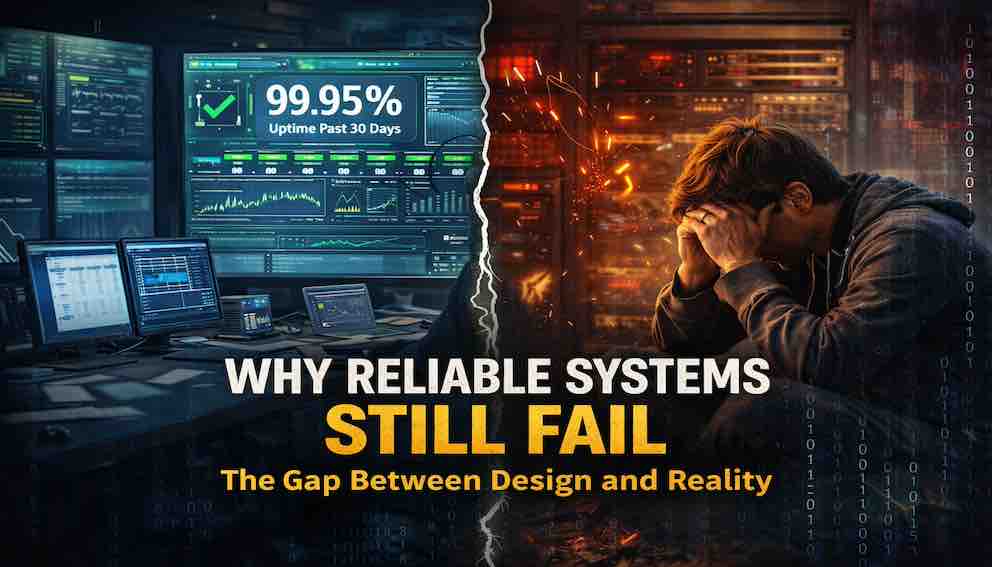
You are looking at a dashboard. It shows 99.95 percent uptime over the past thirty days. Green lights everywhere. The operations team is happy. The manager puts the number in a slide deck.
At the exact same time, users are closing your app in frustration. They are tapping buttons that do nothing. They are waiting five seconds for a page that should load in half a second. They are seeing yesterday's data and assuming your service is broken.
Here is the contradiction this entire article is built on: both the dashboard and the users are correct.
The system really is up 99.95 percent of the time. Requests really do get responses. And yet the system feels unreliable to the people who matter most.
Reliability failures are rarely binary. They are slow, partial, and misleading — and that is exactly why they are dangerous.
This article is not a checklist. We will not add retries and circuit breakers and call it done. Instead, we will see why reliable systems still fail, sometimes spectacularly, and why even experienced engineers keep getting this wrong. By the end, you will see reliability differently: not as a property you add, but as something that emerges from how your system behaves when things go wrong.
What Reliability Actually Means
A reliable system does what it is supposed to do, under stated conditions, within an expected time. That is it. If your payment service processes a transaction in under one second for ninety-nine out of every hundred requests, it is reliable for that ninety-nine percent of traffic. If it starts taking five seconds, it is no longer reliable, even if every request eventually succeeds.
This matters because many people confuse reliability with availability. Availability just means the service is up and accepting requests. You can have one hundred percent availability and terrible reliability. Imagine a search service that responds to every request but takes ten seconds to return results. It is available. It is not reliable.
Reliability is what users experience, not what dashboards report.
A user does not care about your uptime percentage. They care whether their request succeeded, how long it took, and whether the data was correct. If any of those three things fails, your system is unreliable to that user, regardless of what your monitoring says.
This distinction between system-reported metrics and user-perceived experience is the seed of every problem we will discuss.
Dashboards aggregate. Users experience individual events. An average hides the painful tail. Ninety-nine fast requests and one slow request give you a great average, but that one slow request was a real user waiting ten seconds. The average smooths over the failure. The dashboard stays green. The user does not.
A success count hides the slow response by treating a request that took ten seconds the same as one that took ten milliseconds. Both return 200 OK, but only one of them delivered a good user experience.
The Deceptive Case of "Working" Systems
A system can be fully functional and still be unreliable. Every service can be running. Every request can return a 200 OK. And the system can still fail its users.
Consider a product catalog service. Every request returns successfully. But a bug in the caching layer means users see products that were removed three hours ago. The database is healthy. The cache is responding. The API returns 200 every time. But the data is wrong. Your users are trying to buy items that do not exist. Is the system reliable? No. But your dashboards show all green.
Or consider an order processing system that accepts every request and queues it for later processing. Under normal load, orders complete in two seconds. Under heavy load, the queue grows. The system continues accepting requests — every one getting a 202 Accepted — but orders now take ten minutes to process. Nothing crashes. But from the user's perspective, the system is broken.
These are called invisible failures: systems that are technically correct but experientially broken.
The techniques we use to improve reliability can actually create invisible failures. Retries hide failures behind latency. Caches hide database load but serve stale data. Queues absorb traffic spikes but delay processing. Each tool is valuable. Each can also produce a failure mode that looks like success.
The Gap Between Design Time and Runtime
When you design a microservices architecture, you make assumptions. You have to — you cannot design without them. The problem is not that you make assumptions. The problem is that many are wrong, and the ways they are wrong only become visible when the system runs under real conditions.
Failures are independent. When you add redundancy, you assume three instances of a service will not fail at the same time. In reality, failures often have shared causes. The network partition affects all three instances simultaneously.
Dependencies fail cleanly. In reality, databases often get slow before they fail. They accept connections but take five seconds to return results. This is much worse than a clean failure, because your retries and timeouts interact badly with slowness in ways they never would with an outright refusal.
Retries help. Under load, retries can make everything worse. Imagine a service already struggling at ninety percent capacity. A brief slowdown causes timeouts. Clients retry. Now the service receives twice the load. It slows down further. More timeouts. More retries. This is a retry storm, and it has taken down systems that were perfectly healthy moments before.
Timeouts are safe. Your service times out after one second, but the downstream service it called does not know that. That service continues processing the request for another five seconds, consuming database connections and memory — all for a result that will be discarded. Timeouts without cancellation propagate failure downstream.
These assumptions are not signs of incompetence. They are the only way to make progress when designing complex systems. The problem is that we forget we made them. The diagram on the wall shows clean boxes connected by straight lines. The reality is a chaos of timeouts, retries, partial failures, and cascading effects.
Systems are designed assuming independent failures. They fail through interactions.
A single server crashing is rarely the real problem. The problem is what happens next: retries from five different services all hitting the struggling database at once; a circuit breaker opening and closing repeatedly as health checks oscillate; a cache stampede where a thousand requests all miss simultaneously and hammer the database.
These are interaction failures. They emerge from the relationships between components, not from the components themselves. And they are nearly impossible to predict during design.
Reliability as an Emergent Property
You do not add reliability to a system. You create conditions under which it is more likely to appear.
When you add a retry library, you have not added reliability. You have added a mechanism that might contribute to reliability under certain conditions. Under other conditions, that same library will make your system less reliable.
Think about a city's traffic system. You can add traffic lights, roundabouts, speed limits, and lanes. None of these individually creates reliable traffic flow. Flow emerges from how all these elements interact with driver behaviour, weather, accidents, and time of day. You can design for reliability. You cannot manufacture it directly.
This explains why checklists fail. A pattern that works in one context can destroy reliability in another. A retry combined with a circuit breaker can keep the breaker open too long. A timeout combined with a retry can fire after the original request already succeeded. The patterns are not wrong. They just cannot be copied without understanding how they interact.
The paradox: every technique that improves reliability can, under different conditions, destroy it.
Retries help when a failure is a brief glitch, not a sign of deeper trouble. They destroy reliability when failures are caused by overload. Redundancy improves reliability when failures are independent. It destroys reliability when redundant instances share a hidden dependency that fails for all of them simultaneously.
This is not a reason to avoid these techniques. It is a reason to understand them deeply, test them under failure conditions, and accept that reliability is never fully solved. It is managed.
Invisible Failures: When the System Succeeds at Failing
The most dangerous failures are those that do not trigger alarms because the system continues returning success responses.
Retries that hide failures. Your service calls a downstream dependency. The dependency fails. Your retry logic fires and the second attempt succeeds. The user gets a successful response. Your dashboard shows one hundred percent success. What you do not see is that the request took three times longer than usual. Users feel the slowness. The success count hides it.
Caches that serve stale data. Your cache returns responses quickly. But the underlying data changed an hour ago and the cache did not invalidate. Every request gets a fast, successful, wrong response. Your monitoring shows excellent latency and zero errors. Your users see incorrect information and make decisions based on it.
Queues that defer processing indefinitely. Your system accepts requests and queues them. Under normal load, processing takes seconds. Under high load, the queue grows. Your monitoring shows no rejected requests — but the oldest item in the queue is now twenty minutes old. Users who expected immediate confirmation wait in silence. Some of them retry, adding duplicates.
Circuit breakers that fail open. Your circuit breaker detects that a dependency is unhealthy and opens the circuit. This is good. But if the health check that closes the circuit is too aggressive, the dependency recovers while the breaker keeps rejecting requests between checks. The system is successfully failing fast — but failing healthy requests.
All of these failures share something: they convert one type of problem into another. Retries convert failures into latency. Caches convert correctness into fast wrong answers. Queues convert overload into delay.
This is why experienced reliability engineers are suspicious of clean success metrics. A one hundred percent success rate with no latency spikes is not a sign of health. It is a sign that your failure detection may be blind to something important.
The Measurement Problem
If reliability is what users experience, how do you measure it? This turns out to be surprisingly difficult — and most teams are not just measuring imperfectly, they are actively optimising in ways that make the problem harder to see.
Start with the most important insight: failure appears first as latency, not errors. Before a service starts returning errors, it gets slow. Before a database fails, its query times increase. Before a cache degrades, its hit ratio drops. This means error rate — the metric almost every team monitors first — is a lagging indicator. By the time your error rate rises, users have already been suffering through slow responses for minutes or longer. If you monitor latency percentiles, you see failures approaching. If you monitor error rates, you learn about them after the damage is done.
Teams often optimise their metrics in ways that mask user experience. A team under pressure to reduce error rates adds aggressive retries. Error rate drops. Latency doubles. The dashboard looks better. The user experience got worse due to the increased latency. A team targeting uptime keeps a slow, degraded service running rather than restarting it and risking a brief outage. Uptime stays high. Users wait. A team that uses average latency to measure performance hits its target while a growing tail of slow requests — the p99, the p99.9 — goes unnoticed.
Averages hide the tail. You need percentiles. A service with ten-millisecond average latency can still be delivering ten-second responses to one in every hundred users. At scale, that one percent is a lot of frustrated people.
Synthetic health checks are not real traffic. A health endpoint that returns 200 OK tells you the process is alive. It does not query the database. It does not call dependencies. You can have a green health check and a completely broken service.
Know what you are not measuring. The metrics you trust shape the decisions you make. If your metrics are blind to latency tails, you will optimise for throughput at the expense of the slowest users. If your metrics are blind to data correctness, you will optimise for uptime while serving wrong answers. That blind spot is where your next outage lives — already happening, just not yet visible.
Principles for Improving Reliability
Improving reliability is not about adding more resilience patterns. Retries, caches, and circuit breakers are not solutions by themselves—they only amplify whatever system behavior already exists. Reliability comes from how a system behaves under stress, not from the number of techniques applied to it.
The first principle is to make failure visible before attempting to recover from it. Many systems hide failure behind retries, caching, or success responses, turning errors into latency or staleness. If failure cannot be observed clearly, it cannot be understood or fixed.
The second principle is to focus on tail latency rather than averages. Reliability is experienced at the extremes, not in the mean. A system that is fast on average but slow for a small percentage of users is still unreliable at scale.
The third principle is to reduce blast radius before increasing redundancy. Additional replicas do not improve reliability if they share hidden dependencies. True resilience comes from limiting how far a single failure can propagate.
The fourth principle is to prefer predictable degradation over silent correctness or hidden failure. It is better for a system to slow down or throttle in a visible way than to continue returning fast but incorrect or delayed results without signalling stress.
The fifth principle is to treat latency as an early failure signal. Systems rarely fail suddenly; they degrade first. If latency is not treated as seriously as errors, most failures will only be detected after users are already affected.
The sixth principle is to design for human operability under stress. A system is not reliable if it cannot be understood during an outage. Clear observability, consistent tracing, and simple service boundaries matter as much as runtime behavior.
Finally, reliability is not a one-time design goal but an ongoing property. Systems drift over time as traffic, dependencies, and assumptions change. Without continuous correction, reliability naturally degrades.
Reliability Anti-Patterns
These are mistakes that feel like good ideas at the time. Only after an outage do you realise they were making things worse.
Redundancy solves everything. Running three instances protects against a single server failure. It does not protect against a software bug that crashes all three simultaneously, or a database failure that affects all instances equally. Worse, adding redundant instances can introduce failure modes that did not previously exist — cache invalidation becomes a distributed coordination problem, deployment windows multiply, and when something does go wrong, more moving parts means a harder debugging job. Redundancy protects against independent failures. The failure modes that take systems down are usually not independent.
Monitoring equals observability. Monitoring tells you what you thought to ask about. You set up dashboards for error rate, latency, and CPU. When something outside those metrics breaks, you have no idea what happened. Observability is different — it means your system exposes enough structured data that you can ask questions you did not anticipate. Distributed tracing, structured logs with consistent fields, and high-cardinality metrics all contribute to observability. Monitoring tells you what is wrong. Observability lets you discover what you did not know was wrong. Most teams have the first and none of the second.
Copying patterns from blog posts without understanding them. A team reads about circuit breakers and adds one. They set a failure threshold and a timeout they never tested. They never inject a partial recovery to see how the breaker behaves. They never ask what happens when the circuit opens during a traffic spike. The circuit breaker becomes a black box that occasionally causes mysterious failures. Every pattern is a bet that it will behave well under your specific conditions. That bet requires testing, not assumption.
Reliability Decays Over Time
There is one failure mode that rarely appears in system design articles: reliability is not a destination. It decays.
The system you carefully designed six months ago is not the same system running in production today. Configuration values drift as people make quick fixes under pressure. Dependencies release new versions with different performance characteristics. Traffic patterns shift as the product grows. The database query that ran in ten milliseconds at launch now runs in two seconds under a larger dataset.
Most dangerously, the assumptions you made at design time expire silently. Nobody updates the architecture diagram. Nobody reruns the load tests. The system continues to look healthy on the dashboard while its actual behaviour quietly diverges from what you built and tested.
This is why reliability requires ongoing attention, not just good initial design. Regularly test your timeouts and retries under realistic load. Review your alert thresholds as traffic grows. Revisit your capacity assumptions when usage patterns change. The gap between design and reality widens with time if you do not actively work to close it.
The Human Boundary
A system that cannot be understood under failure is not reliable in practice.
Imagine you are woken at 3 AM. An alert says the error rate is elevated. Service A is timing out when calling Service B. Service B looks healthy. Traces show it is taking two seconds to respond, within its three-second timeout. Service A has a one-second timeout, so it times out. Service B's logs show it is waiting on a database query that usually takes ten milliseconds but is now taking two seconds. The database looks healthy — CPU low, disk fine, connection pool fine.
Forty minutes later, you still do not know why. The time and cognitive load required to find the root cause mean your recovery is measured in hours. Your system is not reliable in practice because the humans responsible cannot understand what is failing.
Alert fatigue is the most common human boundary failure. Your team has fifty alerts. Most fire constantly. After a few weeks, everyone ignores all of them. When a real outage happens, no one notices. You have built a monitoring system that is technically correct but humanly useless. Every alert should require action. If an alert fires and no one acts, remove it.
Debugging complexity follows from unclear system boundaries. A request touches eight services. Tracing it requires correlating eight sets of logs in different formats with different timestamp precisions. By the time you reconstruct what happened, the outage is over. You learned nothing because the system provided data but not insight. Standardise your log formats. Propagate a trace ID across every service boundary.
Blameful postmortems are the final failure. An outage happens. The postmortem asks who made the change, who approved it. The answer is a name. That person feels blamed. Future changes slow down. The system does not improve because the real problem — a missing timeout, a misconfigured circuit breaker — was never addressed.
A system you cannot debug under stress is already failing. You just have not noticed yet.
A reliable system is not just one that stays up. It is one that can be understood, debugged, and operated by human beings who need sleep and have limited attention.
Closing: A Mental Model for Reality
Reliability is not a feature you add. It is not a number on a dashboard. It is the result of how your system behaves when reality violates your assumptions.
You assume the network is reliable. Reality partitions it. You assume failures are independent. Reality cascades them. You assume retries help. Reality amplifies load with them. You assume timeouts are safe. Reality propagates them downstream. You assume dashboards tell the truth. Reality hides latency and staleness behind green lights.
You cannot eliminate the gap between design and reality. It is permanent. It is the cost of building distributed systems. What you can do is manage it.
Test your assumptions by injecting failures. Measure what users experience, not what your system reports. Design for understanding so your humans can debug what breaks. Accept that reliability decays and requires active maintenance over time.
The goal is not perfect reliability. The goal is boring failure.
When a service goes down and no one panics. When a database gets slow and users do not notice. When an outage happens and a postmortem identifies a system change, not a person to blame.
Reliability is not about preventing failure. It is about making failure predictable, visible, and survivable.
The gap between design and reality will always exist. But you can understand it, test against it, and build systems that fail in predictable, observable, recoverable ways.
And when you are woken at 3 AM — as you eventually will be — you will have the tools to understand what broke, why it broke, and how to make it break less badly next time.
That is what reliability looks like in practice. Not perfect. Not guaranteed. Just a little less surprising than yesterday.
About N Sharma
Lead Architect at StackAndSystemN Sharma is a technologist with over 28 years of experience in software engineering, system architecture, and technology consulting. He holds a Bachelor’s degree in Engineering, a DBF, and an MBA. His work focuses on research-driven technology education—explaining software architecture, system design, and development practices through structured tutorials designed to help engineers build reliable, scalable systems.
Disclaimer
This article is for educational purposes only. Assistance from AI-powered generative tools was taken to format and improve language flow. While we strive for accuracy, this content may contain errors or omissions and should be independently verified.