
Learning Paths
Last Updated: July 5, 2026 at 10:00
Test Smells in Code: A Field Guide to Fragile, Untrustworthy Test Suites
What makes test suites fail when the software works—and how to fix the design problems behind the noise.
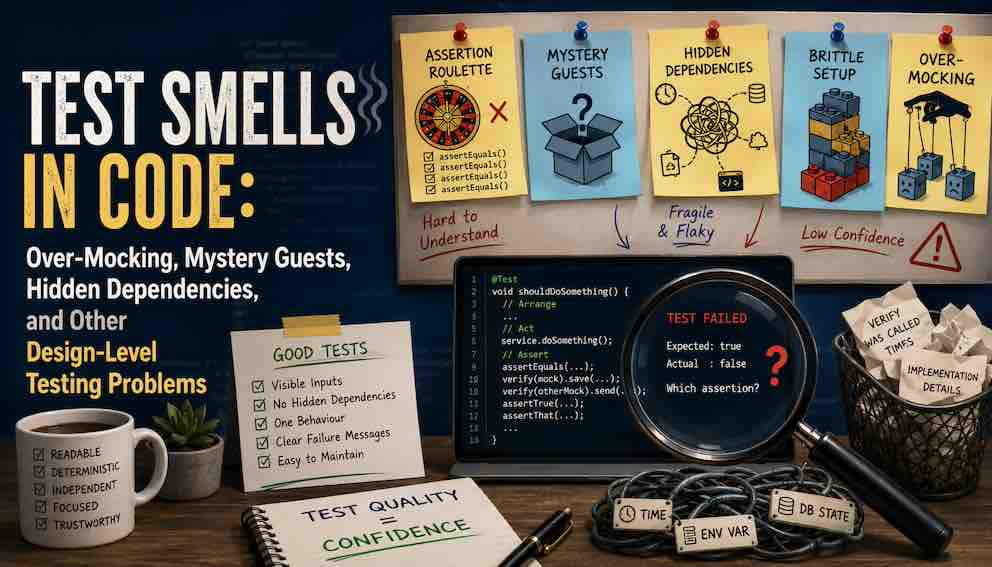
Every engineering team eventually encounters the same mystery: the software still works, yet the tests keep failing. The problem isn't the code—it's the tests themselves. This guide explores the design mistakes that quietly make test suites fragile, noisy, and difficult to trust, from over-mocking and hidden dependencies to mystery guests and brittle setup. More importantly, it explains what each smell is really telling you about your tests—and often about your production code. The central idea is simple: a test earns trust not by existing, but by telling the truth when it fails.
When Tests Become the Problem
Broken tests are more frustrating than broken software. At least broken software tells you something is wrong. Broken tests just make noise.
A developer refactors an internal method, reorganizes a class, renames a variable — and a dozen tests turn red. The software still works. The tests just couldn't keep up.
At first glance, this looks like a testing problem. It isn't. It's a design problem, and it's exactly the kind of problem quality engineering exists to address.
The difficulty is that these problems rarely announce themselves immediately. A brittle test still passes until the next refactor. A hidden dependency works until the test runs in a different environment. An over-mocked unit test looks thorough until an internal redesign causes it to fail even though the software's behavior hasn't changed. By the time a team starts questioning whether it can trust its test suite, the underlying problems have often been accumulating for months or years.
Most conversations about testing focus on quantity: what percentage of lines is covered, how many tests exist, whether unit tests outnumber integration tests. These are useful questions, but they're not the ones that determine whether a test suite is valuable. A codebase can carry ninety percent coverage and still have a suite nobody trusts. Another with far fewer tests can give engineers the confidence to refactor aggressively because the tests consistently tell them when something has genuinely broken.
The missing ingredient is quality, not quantity. Like production code, tests accumulate design debt. They become harder to understand, harder to maintain, and increasingly unreliable as guides to whether the software still works. The patterns behind that decline are known as test smells.
What Is a Test Smell, and Why Does It Matter?
A test smell is a pattern in test code that suggests trouble ahead. It doesn't mean the test is broken now — it means the test is likely to become a problem later.
Test smells aren't bugs. They're warning signs. A smell suggests a test may be difficult to understand, fragile under change, or less trustworthy than it first appears.
Most test smells don't come from carelessness. They emerge from perfectly reasonable decisions made under real-world constraints: deadlines that reward getting tests written quickly, legacy systems that are difficult to isolate, copy-and-paste that spreads existing patterns, or coverage targets that reward hitting lines of code rather than writing maintainable tests. The cost usually isn't immediate. It appears gradually, as the test suite becomes harder to read, harder to change, and less reliable during refactoring.
The sections that follow group the most common test smells into four categories: readability smells, which make tests hard to understand; stability smells, which make tests fail unpredictably; maintainability smells, which make tests resist change; and a performance smell, which makes tests slow enough to change how a team works. Treat this as a field guide — a reference to return to when a specific test is giving you trouble, not necessarily something to read start to finish.
Part 1: Readability Smells
Assertion Roulette: When One Test Checks Too Much at Once
A test ends with a dozen assertions, checking a user's name, address, email, account status, preferences, and more. When it fails, you're left asking a simple question: what was this test actually trying to prove?
That's assertion roulette. A single test tries to verify too many things at once, making its intent difficult to understand and its failures harder to diagnose.
The number of assertions isn't the problem by itself — sometimes one behavior naturally requires several related checks. Trouble starts when a single test validates multiple behaviors instead of one. A failure then tells you only that something went wrong, not which behavior actually broke.
What to look for:
- A test whose assertions check several unrelated behaviors rather than one
- A test named generically, such as
shouldUpdateEverything - A failure message that doesn't tell you what's wrong
The fix is to make each test answer one question. Instead of a test named shouldUpdateEverything, write focused tests such as shouldUpdateCustomerAddress and shouldUpdateCustomerContactDetails. Each test has a clear purpose, and when it fails, the reason is immediately obvious.
Two related patterns are worth watching for. An eager test chains several actions in sequence — creating a user, updating it, deleting it — asserting after every step. If one action fails, the rest of the behavior never gets exercised, so each behavior deserves its own test instead. A lazy test performs an action but barely verifies the outcome, sometimes checking only that no exception was thrown:
@Test
void testMethodDoesNotThrow() {
    service.doSomething();
}
A test that only proves code didn't crash tells you very little about whether it behaved correctly. It isn't a safety net — it's just code that runs.
A third pattern, the redundant assertion, repeats information another assertion already guarantees:
User user = userService.getUser(1);

assertThat(user).isNotNull();
assertThat(user.getName()).isNotNull();
assertThat(user.getName()).isEqualTo("John");
The final assertion already proves the name isn't null, making the earlier check unnecessary.
Mystery Guest: The Test Data You Can't Actually See
A mystery guest is data a test depends on without showing you. A common example is loading a fixture such as customer_123.json and asserting on the result without revealing what's inside the file. To understand the test, you first have to leave it.
External files are the most obvious form, but they're not the only one. Shared database fixtures, setup methods, seed scripts, and global constants all become mystery guests when they hide information the test relies on.
The problem isn't that the data lives elsewhere. It's that the test no longer explains itself. Every hidden dependency forces the reader to jump between files before they can understand what behavior is being verified. Shared fixtures create another risk too: changing one to support a new test can unexpectedly break another test that silently depended on the same data.
What to look for:
- A test that loads a file
- A test that depends on global setup
- A test that uses data defined in another file
The simplest fix is making important inputs visible: create test data directly in the test body, or use a test data builder.
Customer customer = CustomerBuilder.aCustomer()
    .withName("John", "Smith")
    .withCity("London")
    .build();
A reader now understands the scenario before reaching a single assertion. Test data builders are often the cleanest solution, since they keep the setup readable while making only the details relevant to the test explicit.
External fixtures still have an important place. Large JSON documents, XML payloads, realistic API responses, and complex datasets are often easier to maintain as files than to construct in code. The goal isn't eliminating fixtures — it's eliminating surprises. Even when the data lives elsewhere, a few habits keep a fixture's relevant details visible instead of buried.
Extracting the critical fields into named variables before asserting on them makes the dependency explicit at the point of use:
@Test
void testCustomerDiscount() {
    Customer customer = loadCustomer("premium_customer.json");

    String customerName = customer.getName();
    int orderCount = customer.getOrderHistory().size();

    assertThat(customerName).isEqualTo("Premium Customer");
    assertThat(orderCount).isGreaterThan(10);
}
Naming the fixture file for what it represents rather than a generic identifier does similar work: premium_customer_with_ten_orders.json tells a reader what to expect before they open it, where customer.json tells them nothing. A small helper method that wraps the load call — premiumCustomerWithManyOrders() — gives the same intent a permanent home in the test code itself. And where a specific field is what the assertions actually hinge on, a one-line comment pointing at it in the fixture saves a reader from searching:
// The fixture contains a user with email "[email protected]"
Response response = loadResponse("user-registration-success.json");
A useful rule of thumb: a reader should understand what a test is verifying, and why it might fail, without needing to inspect another file.
Irrelevant Information: Setup That Has Nothing to Do With the Test
Brittle setup happens when necessary scaffolding grows too large. Irrelevant information is a related but distinct problem: the setup contains data that was never necessary in the first place.
@Test
void testUserRegistration() {
    Address address = new Address("123 Main", "Springfield", "12345");
    PaymentMethod paymentMethod = new PaymentMethod("visa", "4111111111111111");

    User user = userService.register("[email protected]");
    assertThat(user.getEmail()).isEqualTo("[email protected]");
}
Nothing about a user's address or payment details bears on whether registration correctly captures an email address. A reader encountering this test has to work out, usually by trial and deletion, which parts of the setup actually matter and which are leftover from a copy-paste or an earlier version of the test that covered more ground. That extra weeding is a tax paid every time someone touches the test, and it compounds as irrelevant details pile up across the suite.
What to look for:
- Setup code that doesn't relate to the assertion
- Variables declared but never used
- Code that appears to be copied from another test
The fix is closer to editing than redesigning: remove what the test doesn't use. If a builder is already in place, this often means dropping fields the test never asserts on rather than specifying them out of habit. A test that constructs only what its assertions actually check tells a reader, correctly, that everything present in the test matters.
Magic Values in Tests: When a Number Carries Meaning Nobody Explains
A magic value is a literal in a test that means something specific, without the test ever saying what.
assertThat(discount.calculate(order)).isEqualTo(0.2);
Reading this in isolation, nothing explains why 0.2. Is it the premium customer rate? A seasonal promotion? A number that happened to make the test pass? The reader has to go dig through the discount logic to find out, and the next person who changes that rate has no way of knowing this test is watching it.
What to look for:
- Unexplained numbers or strings in assertions
- Values that would change if the business rules changed
The fix is naming the value instead of just using it:
private static final double PREMIUM_DISCOUNT_RATE = 0.2;

assertThat(discount.calculate(order)).isEqualTo(PREMIUM_DISCOUNT_RATE);
A named constant, a comment, or a more descriptive assertion turns an arbitrary-looking number into a stated expectation. It's a small fix, but it closes a real gap: a test's job is to make intent visible, and an unexplained number is intent left out.
Part 2: Stability Smells
Hidden Dependencies: The Root Cause of Flaky Tests
A hidden dependency is anything that influences a test's outcome without being controlled by the test itself. Common examples include the system clock, environment variables, shared database state, caches, network resources, and even the order in which tests happen to run.
Consider a test that calls LocalDate.now() to verify date-related logic. It passes today, and probably tomorrow. Then it reaches the end of the month, a leap year, or some other boundary condition, and starts failing — even though the code hasn't changed. The test depends on something it doesn't control: today's date.
Hidden dependencies are one of the biggest causes of flaky tests. A test that sometimes passes and sometimes fails without a code change quickly loses credibility. Engineers rerun the pipeline, chalk the failure up to "CI being flaky," and move on. Once that happens often enough, the suite stops acting as a safety net and starts becoming background noise.
Shared resources create a particularly stubborn version of this problem. Gerard Meszaros named it the Test Run War: two tests compete over the same database row, file, or cache entry, and the outcome depends on which one happens to run first. In a sequential suite, this can go unnoticed for months. In a parallelized pipeline, it surfaces immediately and loudly.
The environment a test runs in is itself a hidden dependency. A test that passes on a developer's laptop and fails on CI, or passes in one timezone and fails in another, is usually leaking an assumption about where it runs — a locale-specific date format, an operating system's path separator or line ending, a container's clock, or a timezone the author never considered. These failures are especially costly because they often can't be reproduced locally, which turns debugging into guesswork.
What to look for:
- Tests that fail on CI but pass locally
- Tests that pass in one timezone but fail in another
- Tests that fail when run in a different order
- Tests that call
LocalDate.now()orSystem.currentTimeMillis()
The fix is to make every external dependency explicit and controllable. Instead of calling the system clock directly, inject a Clock and provide a fixed time during the test:
Clock fixedClock = Clock.fixed(Instant.parse("2024-01-15T00:00:00Z"), ZoneOffset.UTC);
service.setClock(fixedClock);
Instead of relying on shared database state, create only the data the test needs:
@Test
void testOrderTotal() {
    Order order = OrderBuilder.anOrder()
        .withItems(3)
        .withUnitPrice(10.00)
        .build();

    assertThat(order.getTotal()).isEqualTo(30.00);
}
And instead of reading environment variables directly, inject configuration rather than calling System.getenv(...) from inside the code under test. The same principle applies everywhere: if something can influence the outcome of a test, the test should control it.
A useful standard: a test should produce the same result every time it runs, regardless of when it runs, where it runs, or what ran before it. If changing the date, the machine, or the execution order changes the result, you've almost certainly found a hidden dependency.
Sleepy Tests: Guessing at Time Instead of Waiting for Conditions
Asynchronous code creates a specific temptation: pause the test long enough for the async operation to finish, then check the result.
@Test
void testAsyncProcessing() throws Exception {
    service.processAsync(data);
    Thread.sleep(5000);
    assertThat(result.get()).isEqualTo(expected);
}
This is a sleepy test, and it fails in both directions depending on the number chosen. Too short, and the test turns flaky on a slower machine or a busier continuous integration (CI) runner, failing not because the code is wrong but because it didn't finish in time. Too long, and every run pays the full wait even when the operation actually finishes in milliseconds — multiplied across a full suite, that adds real minutes to every build.
What to look for:
Thread.sleep()calls- Any fixed delay chosen to be "long enough"
- Tests that pass locally but flake on CI
The fix replaces a fixed wait with a condition. Libraries like Awaitility let a test poll for the actual outcome:
@Test
void testAsyncProcessing() {
    service.processAsync(data);

    Awaitility.await()
        .atMost(5, SECONDS)
        .until(() -> result.isReady());

    assertThat(result.get()).isEqualTo(expected);
}
The test proceeds the moment the condition is true rather than waiting out a guess.
Sometimes the timing dependency can be removed entirely by replacing the asynchronous mechanism with a synchronous one inside the test. Consider an application that processes invoices in the background:
class InvoiceProcessor {
    private final ExecutorService executor;

    public void processInvoice(Invoice invoice) {
        executor.submit(() -> {
            invoiceService.markAsProcessed(invoice);
            invoiceService.sendConfirmation(invoice);
        });
    }
}
Most tests here aren't testing whether the executor works — that's the executor's responsibility. They're testing whether the invoice is marked as processed and the confirmation is sent. Swapping in an executor that runs tasks immediately removes the asynchronous behavior from the test entirely:
@Test
void testInvoiceProcessing() {
    InvoiceProcessor processor = new InvoiceProcessor(
        Runnable::run // runs tasks immediately in the calling thread
    );

    Invoice invoice = new Invoice("INV-123");
    processor.processInvoice(invoice);

    assertThat(invoice.getStatus()).isEqualTo(PROCESSED);
    verify(invoiceService).sendConfirmation(invoice);
}
No waiting is needed, because the work is already done by the time the assertion runs. The rule of thumb: remove timing from a test entirely whenever possible, and where that isn't possible, wait for conditions rather than for time.
Ignored Tests: What @Disabled Is Really Telling You
A test marked @Disabled or commented out is a decision deferred, not a decision made.
@Test
@Disabled("Works locally but not on CI - fix later")
void testDatabaseConnection() {
    // ...
}
That single annotation usually means one of three things: the test covers something the code no longer does and should be deleted, the test has found a real problem that hasn't been fixed, or the test needs work that never made it back onto anyone's list. Each of those is a legitimate reason to skip a test temporarily. None of them is a reason to leave it skipped indefinitely.
What to look for:
@Disabled,@Ignore, or commented-out tests- Tests that have been disabled for more than a sprint
- Comments that say "fix later" without a linked ticket
The risk compounds quietly. A suite with one disabled test looks fine. A suite with forty, accumulated over two years, has forty gaps in its safety net that nobody can name from memory anymore, and forty lines of clutter that make the suite's actual coverage harder to judge at a glance. The comment explaining why usually ages out of relevance long before anyone circles back to act on it.
Treating a disabled test as a ticket rather than a permanent state keeps this from happening. Every @Disabled annotation should carry a reason and, ideally, a link to the issue tracking the fix — and a recurring audit, quarterly is reasonable for most teams, should ask, for each one, whether it's still worth keeping disabled or whether it's time to fix it, delete it, or rewrite it.
Part 3: Maintainability Smells
Brittle Setup: When the Setup Becomes the Test
Some tests spend far more effort arranging the scenario than verifying the behavior. You scroll through dozens of lines creating objects, wiring relationships, and configuring mocks before finally reaching the two lines that actually matter.
Organisation org = createOrganisation();
Team team = createTeam(org);
Project project = createProject(team);

User user = createUser();
Role role = createRole();

assignRole(user, role, project);

// the actual test finally begins here
boolean canEdit = permissionService.canEdit(user, project);

assertTrue(canEdit);
This is brittle setup. The behavior being tested is almost hidden beneath the scaffolding needed to reach it. The test becomes harder to read because it's difficult to distinguish essential setup from incidental detail. It also becomes harder to maintain: a small change to the domain model can force updates across dozens of tests, even though the behavior under test hasn't changed.
What to look for:
- Setup code that's longer than the test itself
- Many lines of object creation before the first assertion
- The same setup pattern repeated across many tests
The usual cause is a complex object graph. Creating the one object you care about requires creating five others first, and every test ends up repeating the same construction logic.
The fix is to move incidental construction into builders or factory methods, leaving the test to describe only what matters.
User user =
    UserBuilder.anEditorOn(ProjectBuilder.aProject().build())
               .build();

assertTrue(permissionService.canEdit(user, user.getProject()));
Now the behavior stands out immediately. The builder hides the construction details while allowing the test to specify only the information that's relevant. When the domain model changes, you update the builder once instead of fixing dozens of nearly identical setup blocks.
A useful rule of thumb: the setup should explain the scenario, not overshadow the behavior. If what's being tested isn't visible without scrolling past the setup, the test needs refactoring.
Test Duplication: When Many Tests Quietly Repeat the Same Logic
This is a different problem from a duplicate test that checks the exact same scenario twice. Test duplication is the same setup-and-assertion structure copied across many tests, each covering a scenario that's genuinely different from the others.
@Test
void testStandardDiscount() {
    User user = createStandardUser();
    Order order = createOrder(100);
    assertThat(discount.calculate(user, order)).isEqualTo(10);
}

@Test
void testGoldDiscount() {
    User user = createGoldUser();
    Order order = createOrder(100);
    assertThat(discount.calculate(user, order)).isEqualTo(15);
}

@Test
void testPlatinumDiscount() {
    User user = createPlatinumUser();
    Order order = createOrder(100);
    assertThat(discount.calculate(user, order)).isEqualTo(20);
}
Each test earns its place — three tiers really are three different behaviors, and none of them should be deleted. But the identical scaffolding around them has been copied three times over. Change how orders are constructed, and all three tests need the same edit. Add a fourth tier, and someone copies the pattern a fourth time rather than questioning whether it should be data instead of code.
What to look for:
- Three or more tests with identical structure
- Tests that differ only in the data they use
- The same setup code repeated across test files
The fix is usually a parameterized or table-driven test: express the varying input and expected output as data, and let one test method run once per row.
@ParameterizedTest
@CsvSource({
    "STANDARD, 10",
    "GOLD, 15",
    "PLATINUM, 20"
})
void appliesDiscountForTier(String tier, int expectedDiscount) {
    User user = createUserWithTier(tier);
    Order order = createOrder(100);
    assertThat(discount.calculate(user, order)).isEqualTo(expectedDiscount);
}
One method, one assertion, three scenarios — and a fourth tier means adding a row, not writing a new test. The distinction from a duplicate test matters: there, two tests describe the same scenario and one should simply go. Here, every scenario is legitimate; only the repetition of scaffolding around it is the smell.
Over-Mocking: When Tests Verify Implementation Instead of Behavior
Over-mocking is a test that knows too much. It knows which methods were called, in what order, with which arguments — but it doesn't know whether the system actually worked.
A typical over-mocked test might assert that a repository was called, an event was published, a logger was invoked, and a metrics counter was incremented. Each check confirms that something happened internally — but none of them confirm whether the behavior itself was correct.
verify(repository).save(order);
verify(eventPublisher).publish(any(OrderCreatedEvent.class));
verify(logger).info("Order created");
verify(metrics).increment("order.created");
The problem is subtle but important: the test is describing how the method works, not what it achieves.
What to look for:
- Tests with more than two or three mocks
- Tests that verify interactions rather than state
- Tests with
verify(...)calls for internal collaborators - Tests that break when internal implementation is refactored
The immediate cost is tight coupling to implementation. If the internals get refactored — combining two method calls, moving logic into another class, changing how events are published — the test breaks even though the external behavior is unchanged. Instead of supporting refactoring, the test actively resists it.
At a deeper level, over-mocking often comes from a misunderstanding of what a unit test is for. A unit test isn't a script of internal interactions. It's a check that, given certain inputs, the system produces the correct outputs or observable effects.
Mocks are still useful, but only at true boundaries: payment gateways, email providers, message brokers, and third-party APIs are slow, unreliable, or outside anyone's control, so replacing them is reasonable. Inside the system itself, real collaborators are often the better choice — a repository, a domain service, or a helper class stays more useful as a real collaborator, because a test built on real collaborators stays valid after internal refactoring.
A useful question before introducing a mock: is this replacing something genuinely external and expensive, or just something convenient? If it's the second, the test is probably drifting toward over-mocking. In many cases, this is also a symptom of a deeper issue — slow or awkward integration tests push engineers toward heavily mocked unit tests instead. Fixing that imbalance does more for test quality than any amount of mock discipline ever will.
Overspecified Tests: Asserting Structure Instead of Outcome
An overspecified test checks how a result is built rather than what it actually is. It's a broader problem than over-mocking — a test can be overspecified with no mocks in sight, simply by asserting on internal structure or ordering that nobody actually depends on.
assertThat(order.getItems()).containsExactly(itemA, itemB, itemC);
If nothing in the order's contract guarantees that sequence, this assertion is checking an implementation detail rather than a real requirement, and it will fail the moment someone reorders the items for an unrelated reason.
What to look for:
- Assertions on the exact order of items
- Assertions on internal state rather than observable outcome
- Assertions that would break if the implementation changed but the behavior stayed the same
The fix is asserting on what actually matters:
assertThat(order.getItems()).containsExactlyInAnyOrder(itemA, itemB, itemC);
Now the test checks the presence of the right items without locking in an arbitrary order. The same instinct applies anywhere a test is tempted to check internal state, exact call sequences, or a full object graph instead of the specific value or effect the code is meant to produce. A test should describe the contract, not the implementation that happens to satisfy it today.
Conditional Test Logic: When a Test Branches Instead of Asserting
A test with an if statement, a loop, or a switch inside it is usually testing more than one scenario while pretending to be one test.
@Test
void testDiscount() {
    if (user.isPremium()) {
        assertThat(discount.calculate(order)).isEqualTo(0.2);
    } else {
        assertThat(discount.calculate(order)).isEqualTo(0.1);
    }
}
This test never actually exercises both branches in a single run. Whichever branch the fixture data happens to trigger is the only one that gets checked, and the other sits unverified until someone happens to run the test with different data. Worse, if the premium-discount logic breaks, the failure message just says the assertion inside the if block failed, with no hint that the branch itself was masking half the coverage the test appeared to promise.
What to look for:
iforswitchstatements inside test methods- Loops that iterate over multiple test cases
The fix mirrors the one for assertion roulette: split by scenario. A shouldApplyPremiumDiscount test and a shouldApplyStandardDiscount test each construct their own fixture, run the calculation once, and assert once. Neither test needs to reason about the other's path, and a failure in either one points directly at the scenario that broke. Production code branches because it has to handle different inputs; a test should already know which input it's using, which means it never needs to branch at all.
Part 4: Performance Smells
Slow Tests: When Every Run Costs More Than It Should
A test doesn't need Thread.sleep() to be slow. Some tests are just inherently expensive — hitting a real database, making real network calls, or loading large fixtures on every run.
@Test
void testReportGeneration() {
    seedFullProductionSnapshot(); // loads 50,000 rows
    Report report = reportService.generate();
    assertThat(report.getTotalRevenue()).isEqualTo(expectedRevenue);
}
A single slow test is rarely the problem. The problem compounds: a suite with hundreds of tests like this turns a feedback loop that should take seconds into one that takes minutes, and one that should take minutes into one that takes an hour. Slow feedback changes behavior — engineers stop running the suite locally before pushing, lean on CI to catch failures instead, and start skipping tests selectively to save time, which is exactly the habit that lets real regressions slip through.
What to look for:
- Tests that take more than a few seconds each
- Tests that hit real databases or make real network calls
- Tests that load large fixtures
- A full suite that takes more than a few minutes to run
The fix usually isn't writing less thorough tests. It's separating concerns: keep fast, isolated unit tests running on every save, and move genuinely expensive scenarios into a smaller, separately scheduled integration suite. A unit test standing in for a full database round trip almost always runs faster, and just as usefully, with an in-memory fake or a handful of representative rows instead of a full snapshot.
How Test Smells Combine Into an Untrustworthy Suite
Test smells rarely appear in isolation. A mystery guest often hides a dependency, since external fixtures usually encode assumptions about environment or state. Brittle setup can lead to assertion roulette, as large setup blocks tempt developers to assert on everything "just in case." Over-mocking and hidden dependencies also reinforce each other, since heavily mocked tests often rely on fragile, implicit state that is easy to misuse.
At a glance, grouped by category:
- Readability — assertion roulette (too many unrelated checks), mystery guest (hidden test data), irrelevant information (setup unrelated to the assertion), and magic values (unexplained literals)
- Stability — hidden dependencies (clocks, environment, shared data), sleepy tests (
Thread.sleep()instead of real conditions), and ignored tests (disabled code with no plan to restore it) - Maintainability — brittle setup (excessive arrangement), test duplication (the same structure copied across tests), over-mocking (verifying interactions instead of behavior), overspecified tests (asserting structure instead of outcome), and conditional test logic (
ifstatements splitting what should be separate tests) - Performance — slow tests (real databases, networks, or large fixtures on every run)
Some of these patterns reinforce each other. The clearest example is brittle setup and over-mocking. When a domain model is hard to construct, developers often replace it with mocks. Setup becomes smaller, but interaction checks multiply. The test may look simpler, but it is now tightly coupled to implementation details instead of behavior. Both approaches fail during refactoring — just in different ways.
Ignored tests are often the end state of this accumulation. A flaky test gets disabled instead of fixed. A complex test gets left alone because splitting it feels expensive. In each case, the smell is not removed — it is hidden.
The result is a suite that feels unpredictable rather than incorrect. Tests fail intermittently, engineers rerun pipelines instead of investigating, and trust slowly erodes. The cost is subtle but significant: the suite stops acting as a safety net and starts acting as background noise, which defeats its core purpose entirely.
Test Smells Are Often a Signal About Production Code
There's a deeper point worth making before closing, one central to quality engineering as a discipline: test smells frequently signal problems in production code, not just in the tests.
Brittle setup that requires constructing half the domain model to test one method is often telling you the production code concentrates too many responsibilities in one place, or that the domain model carries excessive coupling. The test isn't the root cause — it's the canary. Writing a builder is the right tactical move; the strategic question is whether the domain model itself needs refactoring.
Over-mocking that ends up verifying every internal call a method makes often reflects the same coupling problem from a different angle. When a class depends on six collaborators and its tests need to mock all six to run, that's a signal about the class's design, not just its tests. A class that's hard to test in isolation is usually a class that's hard to change in isolation too.
Hidden dependencies tied to global state or the system clock often mean the production code was written without dependency injection, making external concerns difficult to control or replace. The hidden dependency in the test mirrors the hidden dependency in the implementation.
Slow tests that require a real database or real network calls often signal that the production code lacks proper boundaries. If a database can't be swapped for an in-memory fake in a unit test, the production code probably doesn't have a clean repository interface behind it. Conditional test logic tends to appear for a similar reason: when production code carries too many branches, tests inherit that complexity and try to cover every path in one test rather than writing a focused test for each scenario.
This is part of why test-driven development has long advocated writing tests before production code: the pain of testing poorly designed code becomes feedback that arrives early, when it's cheap to act on, instead of arriving late, once the design has already calcified. Reading test smells through this lens turns cleanup into something bigger than tidying test files — the tests become signals about where the system's design actually needs attention.
Where to Start Fixing an Already-Damaged Test Suite
Everything above assumes a team building new tests from scratch. Most teams reading this are staring at a suite that's accumulated smells for years, and the real question is where to begin. Prioritize by cost, in four steps.
Start with what erodes trust. Tests that fail most often without a matching code change — flaky tests caused by hidden dependencies, sleepy tests guessing at timing, tests that sometimes pass and sometimes fail for no visible reason — are actively eroding trust right now. A single ignored intermittent failure trains an entire team to ignore test failures generally, which is more dangerous than the flakiness itself. This is also the moment to clear the backlog of ignored tests: each @Disabled test is either a fix, a deletion, or a rewrite, and leaving the decision unmade is what got the suite here in the first place.
From there, move to what blocks refactoring: over-mocking, overspecified tests, and brittle setup. These aren't immediately painful, but they slow down every structural change to the codebase, and fixing them is what unlocks the ability to improve production code without triggering a cascade of test failures. Test duplication belongs in this pass too — it's usually discovered while untangling brittle setup, since both come from the same instinct to copy an existing test rather than question its structure.
Slow tests deserve their own lane. They don't erode trust the way flaky tests do, but they erode the habit of running tests at all — worth addressing whenever the suite's runtime starts changing how the team works, rather than after skipping local runs has already become normal.
Readability fixes — mystery guests, assertion roulette, conditional test logic, irrelevant information, magic values — come last, addressed as each test gets touched for other reasons. A full readability pass across a large suite in one sitting rarely works in practice. Attaching the improvement to other work keeps the suite functional throughout and lets the cleanup accumulate naturally.
The principle holding this together: the suite has to stay functional at every step. Test refactoring isn't a rewrite. It's continuous, incremental improvement, following the same discipline as refactoring production code.
Making Test Quality a Habit, Not a Cleanup Sprint
Test smells are warning signs, not verdicts. A mystery guest might be entirely adequate for a stable, rarely-touched corner of the codebase. Complex setup might be unavoidable in certain domains. Spotting these patterns isn't about mandating their elimination — it's about understanding the tradeoffs they carry and making deliberate calls about when they're acceptable.
What they should never be is invisible. Teams that accumulate test smells without noticing tend to discover the cost only when something breaks: a refactor grinds to a halt because every test turns red, a flaky suite stops being trusted, a new engineer can't tell what the tests are even doing.
Quality engineering applies the same rigor to tests that it applies to production code. Tests aren't a secondary concern, written fast and forgotten. They're the mechanism a team uses to keep confidence in its software over time. Assertion roulette, mystery guests, hidden dependencies, sleepy and slow tests, brittle setup, test duplication, magic values, over-mocking, overspecified assertions, conditional test logic, and the ignored tests that pile up around all of them are among the most common ways that confidence erodes quietly. Naming them and addressing them is part of the job.
The most durable way to keep smells from piling back up is folding the check into code review itself: does this test show all its inputs, or are there mystery guests? Does it depend on anything not set up right here, or are there hidden dependencies? Would it survive a refactor of the method's internals, or is it over-mocked and overspecified? Can a reader understand it without leaving the file? Ask those questions on every pull request, and test quality stops being a periodic cleanup project. It becomes something the whole team maintains without thinking about it.
A test suite nobody trusts is worse than no test suite at all — it gives false confidence rather than none. The goal was never perfection. The goal is a suite that tells the truth, every time it runs.
About N Sharma
Lead Architect at StackAndSystemN Sharma is a technologist with over 28 years of experience in software engineering, system architecture, and technology consulting. He holds a Bachelor’s degree in Engineering, a DBF, and an MBA. His work focuses on research-driven technology education—explaining software architecture, system design, and development practices through structured tutorials designed to help engineers build reliable, scalable systems.
Disclaimer
This article is for educational purposes only. Assistance from AI-powered generative tools was taken to format and improve language flow. While we strive for accuracy, this content may contain errors or omissions and should be independently verified.