Learning Paths
Last Updated: May 6, 2026 at 16:30
Microservices API Versioning Explained: Why Version Numbers Fail and the Real Problem Behind Service Evolution
A practical deep dive into microservices versioning, contract evolution, and why the real challenge isn’t versioning APIs—but managing change, time, and distributed ownership without breaking systems
Most microservices teams assume API versioning solves compatibility problems, but version numbers only manage symptoms—not the underlying complexity of distributed change. The real issue is not how to version services, but how to prevent change from turning into long-running coordination failure across teams and time. This article breaks down the four types of change, the three service contracts, and why semantic and behavioral changes cannot be solved with versioning at all. You’ll learn why versioning is often a signal of leaked invariants—and how to design systems where migration, not versioning, becomes the real focus.
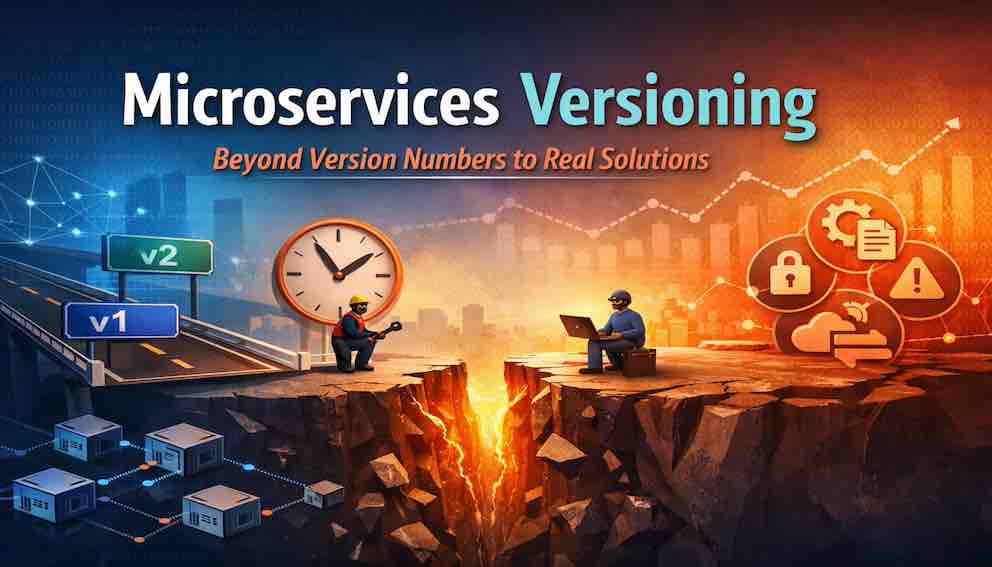
Microservices Versioning Challenge: Why Changes Break Systems
Here is the core difficulty.
In a monolith, change is atomic. When you modify a function, you deploy every caller at the same time. At any given moment, exactly one version of the truth exists across the entire system. There is no ambiguity.
Microservices break this property.
Because services deploy independently, they inevitably drift apart in time. Service A upgrades to version 2 of an API on Tuesday. Service B, which depends on that same API, is scheduled to migrate next quarter. From Tuesday until migration day, both versions must coexist in production. Service A must answer requests from consumers still on version 1 while also serving those on version 2. Meanwhile, an event written under version 1 sits in a message queue for three days. When Service C finally reads it, the schema has moved on.
This creates the fundamental versioning problem: producers and consumers evolve at different speeds, but data and dependencies persist across those timelines.
The gap between independent deployment (what each team controls) and shared dependency (what services jointly rely on) is what versioning attempts to manage. Version numbers do not eliminate this gap. They only make it visible and, ideally, controllable.
What Versioning Actually Is
Most discussions treat versioning as a set of implementation tactics: URL patterns (/v1/orders), header strategies (Accept: application/vnd.example.v2+json), or query parameters (?version=2). These are useful tools, but they mistake the mechanism for the problem.
A more precise definition: Versioning is a mechanism for managing incompatible state divergence across time under distributed ownership.
This definition matters because it shifts attention from how to put a number on an API to why a number is needed at all. Versioning does not resolve the fundamental tension of microservices—services must be independently deployable yet still interoperate through stable contracts.
Versioning only makes that tension tolerable for a period of time. It is not a solution. It is a controlled delay mechanism.
What This Article Will Do
You will learn:
- The four types of changes in a microservices system and why versioning only works for one of them
- The three contracts every service has—and why versioning ignores most of them
- Why time, not technology, is the hidden enemy of versioning
- A two-gate framework for deciding whether to version at all
- Why every versioning event is evidence of a leaked invariant
By the end, you will see why the most effective versioning strategy is often the one you design your system to avoid in the first place.
A Simple Failure Story: The Status Field That Broke Everything
Before diving into frameworks and strategies, here is a real example to make the theory concrete.
The setup. An Order Service returned a status field with three values: pending, paid, and shipped. A Fulfillment Service read this field. Its rule was simple: if status is paid, ship the order.
The change. The Order team needed a new state: confirmed (payment received, but not yet ready to ship). They added it to the status field. This seemed harmless—just one more value.
The break. The Fulfillment Service did not recognise confirmed. Its code treated unknown values as pending. Orders sat unshipped for days.
The fix. The team introduced versioning. v1 kept the original values. v2 included confirmed. The Fulfillment Service stayed on v1. The Order Service now translated between versions.
The aftermath. Six months later, the Order Service maintained three versions: v1 for Fulfillment, v2 for a new reporting service, and v3 for a mobile app. The team spent 20% of its time on version compatibility.
The real problem. The issue was not a missing version number. The issue was that the rule "status determines when to ship" had leaked from the Order Service into every consumer. When that rule changed, every consumer had to change with it. Versioning did not solve this. It only delayed and multiplied the pain.
The Four Types of Change Pressure
Before deciding how to version, you must understand what kind of change you are making. Most versioning strategies treat all changes as the same category. That is a mistake.
Type 1: Additive Change
Adding new fields, new endpoints, or new optional parameters. Existing consumers ignore the new data and continue working.
Versioning needed? No. If your system cannot handle additive changes without versioning, your contract design is too rigid.
Risk: Low. The main risk is response bloat accumulating over time.
Type 2: Structural Change
Renaming fields, splitting one field into many, changing a field's type, or removing a field entirely. Existing consumers break because they expect a shape that no longer exists.
Versioning needed? Yes. This is precisely what most versioning strategies are designed for.
Risk: Moderate. Structural changes cause hard failures that are detectable and reproducible.
Type 3: Semantic Change
The structure stays the same. The fields stay the same. But what they mean changes. This is an interpretation problem, not a schema problem.
Example: the status field used to mean "payment status." Now it means "fulfillment status." Same field name, same type, different meaning.
Versioning needed? No — and this is critical to understand. Version numbers do not solve semantic change. The meaning of data is not in the schema. A version header on the request cannot tell a consumer what a field now means.
Risk: High. Semantic changes cause silent corruption. The system appears to work. The data is wrong.
Type 4: Behavioral Change
The API contract — request and response shapes — stays identical. The business logic changes in a way that matters to consumers.
Example: GET /products used to return products in stock first. Now it returns products by popularity. Same request, same response shape, different outcome.
Versioning needed? No, for the same reason. Version numbers do not capture behavior.
Risk: Very high. This is where most silent production bugs originate.
Most versioning systems handle structural change. Most real failures come from semantic and behavioral change.
The Three Contracts Every Service Has
When we talk about versioning, we usually mean the API contract. But every service actually has three contracts, and versioning only addresses one of them.
Contract 1: The API Contract
Endpoints, request bodies, response shapes, and status codes. This is what version numbers track.
What versioning protects: structural changes. What versioning cannot protect: semantic drift or behavioral changes.
Contract 2: The Data Contract
The shape and meaning of data as it moves through events, message queues, and shared storage. When an event sits in a queue for three days while schemas change, the data contract spans time. A consumer reading that old event must understand what it meant when it was written, not what the current schema says.
What versioning protects: schema evolution with explicit transformation. What versioning cannot protect: events written by old producers being read by new consumers without a migration strategy.
Contract 3: The Behavioral Contract
The unwritten, unversioned contract. Ordering guarantees, idempotency promises, consistency levels, retry behaviour, and the meaning of every field in context. This is what the Order Service story violated — not the schema, but the implied meaning of a value.
What versioning protects: nothing. Version numbers do not capture behavior.
Versioning handles syntax. It does not handle semantics. It never has.
Why Versioning Fails — The Hidden Enemy Is Time
Versioning fails not because the techniques are wrong, but because of a fundamental property of distributed systems: producers and consumers evolve at different speeds.
Producers evolve at one speed. Consumers evolve at another. Data persists across versions. The result is version overlap — a state where multiple versions of the same contract coexist in production simultaneously.
But version overlap is not just about API endpoints. It is about storage, state, and infrastructure.
When a New Version Means a New Database Table
Consider what actually happens when a team creates v2 of an API. They rarely modify the existing orders table in place. That would break v1 consumers still writing to and reading from the old schema. Instead, they create a new table: orders_v2.
Now consider the operational reality:
- Two versions of the Order Service are running simultaneously — one compiled against the v1 codebase, another against v2. They may be deployed on different days, by different engineers, with different dependencies.
- Two database tables exist — orders (for v1) and orders_v2 (for v2). They have different schemas, different indexes, different constraints.
- Two caching layers exist — v1 populates its Redis cache with v1 shaped data. v2 populates a separate cache (or uses different keys). A cache invalidation in v1 does not affect v2, and vice versa.
- Two message queue consumers may be active — events written by v1 producers go to one topic or partition. v2 events go elsewhere. Or worse, they go to the same queue, and consumers must distinguish them by schema version.
This is not theoretical. This is what versioning looks like on a Tuesday afternoon.
The Overlap Timeline, Now With Storage
Here is what that looks like in practice:
Week 1: Service A deploys v2 of its API. It creates orders_v2 table. It runs v2 code alongside v1 code. Both versions write to their respective tables. The v1 code continues to serve existing consumers. The v2 code serves new consumers. The team now maintains two database schemas, two sets of migration scripts, and two caching strategies.
Week 3: Service C migrates to v2. It now reads from orders_v2. But Service B remains on v1, still writing to the old orders table. Data is now split across two storage systems. Reports that need the full picture must query both tables and reconcile.
Week 12: Service B finally migrates. The team can now consider deprecating v1. But they cannot simply drop the orders table. Old events in message queues may still reference v1 data. Backup and restore procedures must account for both schemas. Compliance audits require retaining v1 data for fixed periods.
The hidden cost. Versioning at the API layer forced versioning at the storage layer. Every new version added:
- A new database table (or at least new columns with complex migration logic)
- A new cache namespace or separate cache cluster
- New queue consumers or topic partitioning logic
- Dual write logic during migration windows
- Reconciliation jobs for cross-version reporting
This is the hidden cost of versioning. It is not the version number. It is the duration of overlap multiplied by every storage and infrastructure component that touches that data.
The longer versions coexist, the more complexity accumulates — and that complexity compounds across databases, caches, queues, and deployment pipelines.
The Three Costs of Versioning
Versioning has three distinct costs:
Producer Cost
Maintaining multiple behaviours, multiple code paths, multiple test suites, and multiple documentation sets in parallel. Every new version adds conditional logic. Every old version that remains alive is a liability that grows over time.
Consumer Cost
Migration effort. Moving from v1 to v2 requires understanding what changed, updating code, testing, and deploying. For internal consumers with responsive teams, this is manageable. For external consumers or teams with competing priorities, it can stretch for months or never happen at all.
Time Cost
The duration of version overlap. This is the most important cost and the least discussed.
A version that lives for one week costs almost nothing. A version that lives for two years costs everything. The time cost is not linear — it compounds. Every week of overlap increases the probability of a bug, a misunderstanding, a missed migration, or an incident traced back to an assumption that no longer holds.
Most systems fail not because versioning was chosen incorrectly, but because overlap time was never managed.
The Five Versioning Strategies as Trade-Offs
Do not read this as a menu. Read it as a set of trade-offs in who pays the three costs (producer, consumer, time), and for how long.
There is no best versioning strategy. There are only trade-offs in who pays the cost of change and for how long.
Strategy 1: No Versioning (Strict Backward Compatibility)
What it is: You never introduce a version number. Every change is backward compatible. All consumers continue working without modification. There is only ever one version of the API in production.
How to implement it:
- All new fields are optional. Old consumers ignore them.
- Fields are never removed. They may be deprecated but remain present.
- Field types never change. A string stays a string.
- Default values handle missing data.
- The API grows but never breaks.
When to use it: Internal services with full control over all consumers. Small systems where coordination is trivial. Short-lived services that will be retired before breaking changes become necessary.
Who pays: The producer pays through API bloat over time. Consumer cost is zero. Time cost is zero because only one version ever exists.
The risk: When a genuinely breaking change becomes unavoidable (you must remove a field or change a type), you have no mechanism. Your only options are to break all consumers at once or introduce versioning reactively under pressure.
Strategy 2: Backward Compatible Evolution (Active Contract Design)
What it is: Similar to Strategy 1 — no version numbers. But unlike the passive approach of simply "never breaking things," this strategy actively designs the contract for long-term evolvability. The goal is to delay or eliminate the need for breaking changes through intentional contract structure.
How to implement it:
- Use extensible message formats (Protocol Buffers, Avro) where fields are identified by tags or field numbers that never change. Adding a new field does not break old consumers.
- Wrap response data in generic containers like map<string, any> or JsonObject to absorb new fields without schema changes.
- Avoid required fields entirely. Every field should have a sensible default or be optional.
- Treat the contract as a living document with explicit evolution rules agreed upon by all teams.
Example: An order response contains a map<string, object> called extensions. New data can be added inside extensions without changing the top-level schema. Old consumers ignore it. New consumers read it.
When to use it: Long-lived systems where breaking changes are genuinely rare. Teams with the discipline to maintain evolvable contracts,
Who pays: Producer pays through ongoing design discipline and contract governance. Consumer cost is zero for compatible changes. Time cost is zero because no versioning exists.
The risk: A genuinely breaking change still becomes unavoidable at some point. When that happens, you have no versioning mechanism. Strategy 2 does not eliminate this risk — it postpones it.
Strategy 3: Dual Version Support (Parallel Coexistence)
What it is: You deploy both versions simultaneously. The producer maintains multiple code paths, multiple database schemas (or migration layers), and multiple test suites. Consumers choose which version to call. Old consumers stay on the old version. New consumers use the new version. Overlap continues until all consumers migrate.
How to implement it:
- URL path versioning: /v1/orders and /v2/orders as separate endpoints.
- Header versioning: Same URL, different Accept header or custom version header.
- Internal routing: A router or API gateway directs requests to the appropriate service instance or code path based on version.
- Storage: New version may mean a new database table (orders_v2) or new columns with complex migration logic. Old and new tables coexist during overlap.
- Caching: Separate cache namespaces or prefixes for each version to avoid cache poisoning.
- Deprecation signalling: Use the HTTP Sunset header (RFC 8594) to communicate end-of-life dates in responses.
When to use it: You have external consumers you cannot force to migrate. You have a public API. You need to maintain stability for old consumers while evolving for new ones.
Who pays: Producers pay operational complexity (multiple code paths, dual storage, dual caching, extended testing). Consumers pay migration effort when they choose to upgrade. Time cost is the duration of overlap — determined by the slowest consumer to migrate.
The risk: Overlap can stretch indefinitely if consumers never migrate. Version explosion occurs when multiple versions accumulate over years.
Strategy 4: Consumer-Driven Versioning (Per-Consumer Contract)
What it is: Each consumer tells the producer which version of the contract it expects. The producer inspects this declaration and serves the appropriate response for that specific consumer. Unlike Strategy 3, versions are not exposed as separate endpoints — the producer internally maps each consumer to a version.
How to implement it:
- Consumer registry: The producer maintains a mapping of consumer_id → version. This can be a configuration file, a database table, or a service discovery lookup.
- Request identification: Consumers include an identifier in each request, such as an API key, client ID, or a custom header like X-Client-Id.
- Version declaration: Consumers may also declare their version explicitly via header (X-API-Version: 2) or accept header.
- Internal dispatch: The producer reads the consumer identifier, looks up the assigned version, and formats the response accordingly. This may involve transformation layers, different database queries, or entirely separate code paths.
- Registry management: Adding a new consumer means registering them with a version. Migrating a consumer means updating the registry entry.
When to use it: Small, known sets of internal consumers where you control the registry. Teams within the same organisation with clear communication channels. Situations where you need different consumers to see different versions simultaneously without changing their call patterns.
Who pays: Producers pay registry maintenance, per-request version lookup, and testing of N versions. Consumers pay the overhead of including an identifier and coordinating registry updates. Time cost is determined by the slowest consumer to upgrade — one stagnant consumer blocks deprecation forever.
Where it breaks down: External consumers you do not know about. Consumers that change their identifier. A registry that becomes stale. The number of distinct versions exceeds the team's ability to test them all before deployment. A bug affects only one consumer, and you cannot reproduce it because you lack their environment.
Better alternatives for external consumers: Strategy 3 (Dual Version Support) or Strategy 5 (Hard Cutover). Both remove the producer's need to track individual consumers.
When Versioning Is the Right Tool
Versioning is not always wrong. It is the right tool in exactly three situations.
Situation 1: Irreversible Structural Break
You must remove a field. You must change a field's type. You must split a contract that was incorrectly merged. These changes cannot be made backward compatibly. Versioning is the only safe path.
Situation 2: Unknown Consumer Base
You have external customers. You have a public API. You do not know who all your consumers are and cannot coordinate migration with them. Versioning allows you to evolve while leaving old consumers working.
Situation 3: Regulated Stability Contracts
Financial systems, legal compliance, healthcare. Some contracts are legally required to remain stable for fixed periods. Versioning lets you introduce new versions while keeping the regulated version frozen.
Outside these three situations, versioning is often compensating for poor contract design. Narrower contracts, additive evolution, and consumer coordination would have avoided the need.
Versioning is a tool for specific constraints. Use it only when those constraints actually exist.
The Illusion of Safe Evolution
Versioning gives the illusion that change is safe because it is labelled.
But systems still break. Meaning still drifts. Consumers still misinterpret. Versioning only moves failure from the runtime layer to the coordination layer.
Before versioning: a breaking change caused an immediate runtime failure. You saw the error. You fixed it.
After versioning: a breaking change causes no immediate failure. The old version still works. The new version works. The failure is delayed until a consumer tries to understand what the new version means, or until a migration is attempted badly, or until an old version is finally retired and something falls over unexpectedly.
Versioning does not eliminate failure. It hides it. It turns runtime errors — fast, loud, detectable — into coordination errors that are slow, quiet, and hard to trace.
Versioning does not make change safe. It makes change's failure modes invisible until they become expensive.
Migration Is the Real System Design Problem
The hard problem is not defining versions. The hard problem is getting consumers to stop using the old one.
You can design the cleanest versioning scheme imaginable. It will fail if consumers do not migrate. And consumers do not migrate because migration is work, work competes with other priorities, and the team that owns the consumer has different incentives than the team that owns the producer.
Migrations fall into three categories in practice.
Fast Migration (hours to days): The consumer team is responsive. The change is small. The benefit is clear. Version overlap lasts days. Cost is low.
Slow Migration (weeks to months): The consumer team has competing priorities. The change requires significant effort. Multiple rounds of communication are needed. Overlap lasts months. Risk of divergence grows with every week.
Unknown Migration (indefinitely): You do not know who the consumers are. You cannot contact them. They may not even exist anymore. Overlap lasts forever. This is how version explosion happens — a museum of API versions that no one is willing to delete because no one knows if anything still depends on them.
The Decision Framework — Two Gates
Use this framework when you face a change decision.
Gate 1: Can We Avoid Versioning Entirely?
Ask four questions in order:
Is this change additive? If yes, stop. Deploy. No versioning needed.
Can we fix the problem without changing the contract? If the issue is semantic drift, versioning will not help. Fix the documentation, talk to consumers, rename the field if necessary. No versioning.
Can we coordinate with all consumers? If you know every consumer and can migrate them within days, make the breaking change, migrate the consumers, remove the old behaviour. No versioning.
Is this a leaked invariant that should be internal? If yes, fix the design. Keep the invariant inside the service. No versioning.
If you answered yes to any of these, do not version. Versioning adds cost without solving your problem.
Gate 2: If Versioning Is Unavoidable, Minimise Overlap Time
You need versioning, if the change is structural, you cannot coordinate consumers, or you have a regulated contract.
If you have external consumers with unknown migration timelines — use dual version support with a formal deprecation window. Use the HTTP Sunset header to communicate end-of-life dates in responses. Accept that overlap will be long. Plan for it explicitly.
If you have internal consumers you can coordinate — use a hard cutover with a short deprecation window. Force migration. Keep overlap short.
If you have a regulated contract that cannot change — use dual version support indefinitely. Accept this as a permanent, known cost.
Gate 1 asks "can we avoid versioning?" Gate 2 asks "given that we must version, how do we minimise overlap time?"
Summary
Versioning is a mechanism for managing incompatible state divergence across time under distributed ownership.
The four types of change pressure are additive (safe, no versioning needed), structural (versioning is the right tool), semantic (versioning cannot help), and behavioral (versioning cannot help). Most real failures come from the last two.
Every service has three contracts: API, data, and behavioral. Versioning only addresses the first.
The three costs of versioning are producer cost, consumer cost, and time cost. The time cost — the duration of overlap — is the most important and the least managed.
The four versioning strategies are trade-offs in who pays these costs and for how long. Versioning is the right tool in three situations: irreversible structural breaks, unknown consumer bases, and regulated stability contracts.
Versioning gives the illusion of safe evolution. In reality, it converts runtime failures into coordination failures that are harder to detect and more expensive to fix. Every versioning event is a post-mortem of a leaked invariant. The hard problem is not defining versions — it is migrating consumers.
Use the two-gate framework: first ask whether versioning can be avoided entirely; only then choose a containment strategy that minimises overlap time.
And remember: the best versioning strategy is the one you never needed to use.
About N Sharma
Lead Architect at StackAndSystemN Sharma is a technologist with over 28 years of experience in software engineering, system architecture, and technology consulting. He holds a Bachelor’s degree in Engineering, a DBF, and an MBA. His work focuses on research-driven technology education—explaining software architecture, system design, and development practices through structured tutorials designed to help engineers build reliable, scalable systems.
Disclaimer
This article is for educational purposes only. Assistance from AI-powered generative tools was taken to format and improve language flow. While we strive for accuracy, this content may contain errors or omissions and should be independently verified.