
Learning Paths
Last Updated: March 21, 2026 at 15:30
When Domain-Driven Design Fails (And When You Should Actually Use It)
A practical guide to avoiding overengineering and knowing when Domain-Driven Design is truly worth the effort
Domain-Driven Design is often praised as a powerful approach to building complex software systems—but in many real-world projects, it fails. Teams overcomplicate simple applications, misuse patterns, and lose sight of actual business needs. This article explores why DDD goes wrong, when it becomes unnecessary overhead, and how to decide if it's the right approach for your system. If you've ever wondered whether DDD is worth it, this guide will help you think clearly and avoid costly mistakes
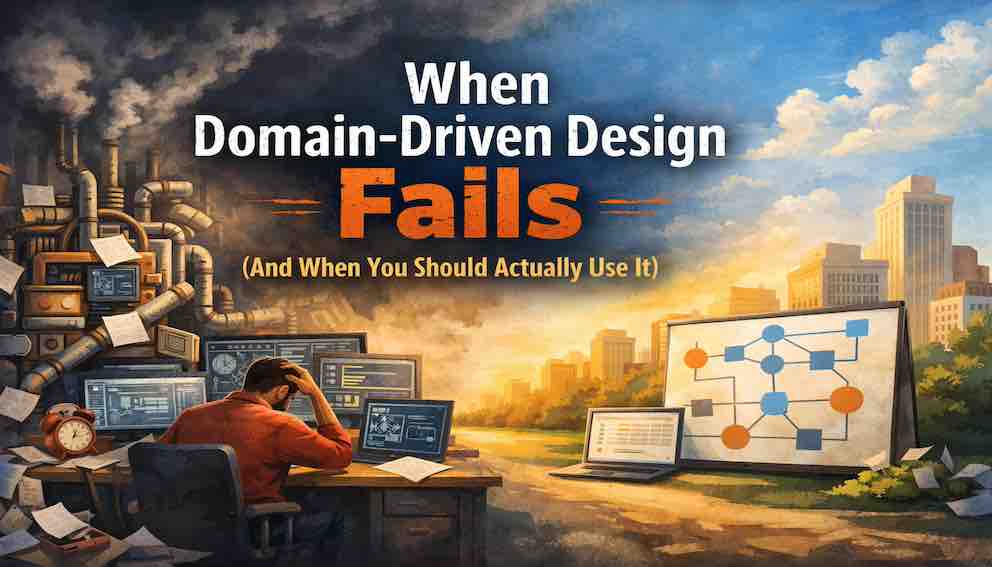
Let’s start with a simple truth: Domain-Driven Design, or DDD, is often spoken of with a kind of reverence in software circles. It’s presented as the mature, thoughtful approach—the path to building systems that are elegant, maintainable, and perfectly aligned with the business they serve.
And in the right context, that’s exactly what it can be.
But in many real-world projects, something else happens. The promise of DDD begins to fade. The elegant patterns start to feel like burdens. The team, once excited, finds itself stuck. And the system, instead of becoming easier to manage, becomes a source of quiet, persistent frustration.
This article is about that gap—the space between what DDD promises and what it actually delivers. It’s about understanding why this powerful tool so often goes wrong, how to recognize when it’s simply unnecessary overhead, and, most importantly, how to develop the judgment to know whether it’s the right fit for your system.
If you’ve ever found yourself wondering, “Is this DDD thing really worth all the trouble?” then this guide is for you. Let’s think it through together.
The Disillusionment with DDD
It almost always starts with the best of intentions.
Picture a team—maybe they’re experienced, maybe they’re just ambitious. They’ve seen what happens when a system grows without a plan. They’ve inherited codebases where business logic is scattered across a hundred different files, where the same concept has three different names, and where making a single, small change feels like a gamble. They’ve felt the pain. And they are determined to avoid it.
So they decide, this time, to do things properly.
And that’s when they discover Domain-Driven Design.
In the beginning, it’s exciting. There’s a whole new language to learn: aggregates, repositories, bounded contexts, domain events. It all sounds so sophisticated, so intentional. It feels like they’re finally moving beyond just “coding” and into the realm of true architecture. The team is energized.
But then, slowly, something shifts.
The work starts to slow down. A feature that should have taken a couple of days stretches into a week, then two. To add a simple field to a form, a developer has to touch a controller, an application service, a repository, an entity, and a value object. The team spends more time in meetings debating the boundaries of aggregates than they do writing code that delivers value to the user.
The system, which was supposed to become a model of clarity, is now a labyrinth of abstractions.
And eventually, someone asks the question that everyone has been thinking but no one wanted to say out loud:
“Is this actually helping us? Or is DDD the problem?”
This moment of disillusionment is far more common than anyone in the DDD community usually admits. And it’s important to name it right up front: Domain-Driven Design does fail. It fails not because the core ideas are flawed—they’re not—but because it is so easily misunderstood, so frequently misapplied, and so often used in places where it was never meant to be used.
To understand when DDD truly works, we first have to understand why it so often doesn’t.
Why Domain-Driven Design Fails in Real Projects
When you listen to teams talk about their failed experiences with DDD, you rarely hear about a single, catastrophic mistake. Instead, you start to notice a pattern—a gradual, subtle drift away from the original purpose of the approach.
Here’s the thing: at its heart, Domain-Driven Design is not a framework. It’s not a checklist. It’s not a set of mandatory patterns that must be pasted into every project.
And yet, that is exactly how it is often treated.
A team reads the famous “blue book” by Eric Evans or a few blog posts, and they start to implement things mechanically. They introduce repositories because “DDD uses repositories.” They create aggregates because “that’s what a proper domain model looks like.” They slice their system into layers that mimic the diagrams they’ve seen.
But they’ve missed the most critical step.
They haven’t started with the domain.
Instead of first spending time truly understanding the business—its subtle rules, its hidden constraints, the actual language its experts use—they jump straight to structure. They start building the solution before they’ve fully grasped the problem. The design becomes an imitation of a DDD example, not a reflection of their own reality.
This is where things begin to unravel.
Imagine trying to design a banking system without a deep understanding of how transactions behave on the last day of the month, or how different types of accounts interact with regulatory rules. Or picture building an e-commerce platform without truly grasping how promotions, inventory levels, and regional pricing all intertwine. If the domain itself remains a blur, no amount of architectural sophistication can fix that.
And then there’s the human side: communication.
DDD relies on a close, continuous collaboration between developers and what it calls “domain experts”—the people who actually understand the business rules. But in many organizations, this collaboration never really happens. Business knowledge is fragmented. It’s locked in the heads of a few people who are always too busy for meetings. Developers are left to guess, to infer from incomplete specifications, or to fill in the gaps with their own assumptions.
The result is a model that looks structured on the surface but is, underneath, disconnected from reality. Over time, these disconnects pile up. The system becomes harder to reason about, not easier. And the very approach that promised clarity begins to create confusion.
What failed here wasn’t just execution. It was a fundamental misunderstanding of what DDD is for.
The Overengineering Trap
There is a particular kind of pain that comes from overengineering, and it’s different from the chaos of a truly messy system. It’s quieter, more subtle. It’s a nagging sense that everything is technically correct, yet somehow, unnecessarily complicated.
You see this most clearly in small, simple applications that are forced to carry the weight of a massive architecture.
Consider a basic feature, like updating a user’s profile. In an over-engineered DDD system, this simple operation becomes a journey. The web request hits a controller. The controller calls an application service. The service fetches a user aggregate from a repository. It then loads that aggregate into memory, calls a method on it to update the name, and then uses the repository again to save it. The aggregate might even enforce a rule, like “a user’s name must be at least two characters,” which, while valid, didn’t need the full weight of an aggregate to enforce.
What could have been a single, readable line of code—UPDATE users SET name = ? WHERE id = ?—has become a complex chain of abstractions.
At first glance, someone might defend this as “clean architecture.” Responsibilities are separated. It’s “following the patterns.” It looks impressive.
But then the team has to live with it.
Every change to the user profile now requires touching multiple files. New developers spend days just tracing the flow of a simple request. The mental overhead for even trivial tasks starts to grow. And slowly, almost imperceptibly, the team begins to lose momentum.
The trap here isn’t complexity itself. Complex systems do need careful design. The trap is introducing complexity where it doesn’t yet exist.
Domain-Driven Design has a certain weight. It asks you to think deeply, to model carefully, to align your code with business meaning. These are valuable things, but they come with a cost. When you apply them to a system that doesn’t need that level of depth—where the rules are simple and the workflows are straightforward—that cost becomes a burden. And burdens, over time, slow everything down.
Key Idea: Overengineering isn’t just about writing too much code. It’s about introducing structure that solves problems you don’t have yet, at the expense of the agility you need right now.
When DDD Is Actually Overkill
It’s worth stating plainly: not every system is complex.
This might seem obvious, but it’s surprisingly easy to forget, especially when you’re in an environment that values “good architecture” and you’re eager to prove you can do it.
Think about a basic CRUD application. Maybe it’s an internal tool to manage employee vacation requests, or a simple task tracker for a small team. The rules are straightforward: a user can submit a request, a manager can approve or deny it. The workflows are minimal. The domain, at its core, is uncomplicated.
In these cases, the primary goal isn’t to model intricate business behavior. It’s to deliver a working solution quickly, reliably, and with as little friction as possible. The team’s focus should be on shipping value, not on constructing the perfect domain model.
Introducing DDD here is like using a sledgehammer to hang a picture. Instead of gaining clarity, you get ceremony. Instead of speed, you get process. Instead of simplicity, you get layers of abstraction that exist only because someone once read that they “should.”
This also applies to many internal tools. They’re often built to solve an immediate, practical problem. They evolve organically based on feedback from a small group of users. Their value lies in how quickly they can adapt, not in how elegantly they are modeled. Applying DDD too early in this context can create rigidity where flexibility is needed most.
And then there are early-stage products. In a startup, the problem itself is still being discovered. Assumptions are constantly tested and proven wrong. Features are added, removed, and redefined based on real-world feedback. In this environment, speed isn’t just important—it’s essential for survival.
A heavy modeling approach can become a straightjacket. It locks the team into structures that may soon become irrelevant as the company pivots or the market shifts.
In all these cases, a simple principle holds: if the domain is simple, or if it’s still evolving rapidly, DDD is usually unnecessary. Not because it’s a bad approach, but because it’s a premature one.
Startup Misuse of DDD
There’s a specific pattern that appears again and again in the startup world.
A small, technically talented team decides they’re going to do things right from day one. They’ve all worked at places where the codebase turned into a “big ball of mud,” and they’re determined to avoid that fate. They want a system that can scale—both technically and conceptually.
So they adopt Domain-Driven Design.
They spend the first few weeks, or even months, defining their bounded contexts. They carefully model aggregates and entities. They debate the nuances of value objects versus entities. They build a beautifully structured, sophisticated foundation before they’ve written a single line of production code that actually serves a customer.
At first, it feels like they’re building something solid, something that will last.
But then reality hits.
The business model changes. A feature they spent a week modeling gets scrapped because the CEO decided to go in a different direction. A new idea emerges that doesn’t fit neatly into any of the carefully defined bounded contexts. The “core domain” they identified in the beginning is now a secondary concern.
And the team finds themselves in a painful position: their beautiful, carefully crafted model no longer fits the business they’re actually building.
This isn’t a failure of discipline. It’s a fundamental mismatch between the approach and the context.
Domain-Driven Design works best when the core concepts of the business are relatively stable, even if they are complex. It’s designed for domains that are well-understood and unlikely to change radically overnight.
Startups, by their nature, operate in the opposite environment: extreme uncertainty. They are not just building software; they are discovering what the software should be. In that environment, flexibility is more valuable than precision. The ability to change direction quickly is a superpower; a rigid, heavily modeled architecture is a weakness.
This doesn’t mean startups should write terrible code. It means they should be very cautious about adopting any approach that introduces a significant upfront cost before the core value proposition has been proven.
Sometimes, the best design is the one that allows you to move forward without hesitation.
Key Idea: In uncertain environments, the ability to change direction matters more than the elegance of your initial structure.
Cost vs. Benefit of Domain-Driven Design
To truly understand when DDD makes sense, it helps to step back and think about it in simple economic terms: as a trade-off. Because that’s what it really is.
DDD is not simply “better design.” It is a choice that comes with a set of costs and a set of benefits.
The costs aren’t always obvious at the start.
First, there’s the time cost. Understanding a domain deeply isn’t a quick exercise. It requires hours of conversation with experts, wrestling with ambiguity, and constantly revisiting your assumptions. It demands patience.
Second, there’s the cognitive cost. Translating complex real-world concepts into a cohesive, executable model is genuinely hard. It demands clarity of thought and a willingness to throw away ideas and start over.
Third, there’s the alignment cost. DDD works best when the entire team—developers, product managers, domain experts—shares a common, ubiquitous language. Achieving and maintaining that alignment is a significant effort. It means constant communication and a shared commitment to using language precisely.
All of this represents a real investment of time, energy, and focus.
And like any investment, it only makes sense if the potential return is worth the cost.
So, what does DDD give you in return?
First, clarity. When done well, the system becomes a direct map of the business. Understanding the code is the same as understanding the business logic. There’s no translation layer.
Second, maintainability. Because the logic is organized around meaningful business boundaries, changes become more predictable. You know where to look, and you have more confidence that your change won’t have unintended consequences elsewhere.
Third, scalability of complexity. As systems grow, they naturally become more complex. DDD provides a structure that helps manage that growth, preventing it from collapsing into a tangled, fragile mess.
But here’s the crucial point: these benefits don’t appear automatically. They emerge over time, and only when the underlying domain truly requires them.
If your system is simple, the return on a DDD investment is minimal. You’ve spent a lot to gain very little.
If your domain is unclear or in flux, the return is delayed and uncertain. You’re building a structure on top of shifting sand.
If your team isn’t aligned, the return may never materialize at all. You end up with different people interpreting the “shared” model in different ways.
So, the real question isn’t “Is DDD a good thing?” The question is: “Is my system complex enough, and is my domain stable enough, to justify the investment?”
When You Should Use Domain-Driven Design
While DDD can be a burden for simple projects, there are situations where it’s not just useful—it becomes almost essential. These situations share one clear characteristic: the domain itself is genuinely, inherently complex.
Consider a banking system. It’s not just about storing account balances. There are intricate rules governing transactions, constraints to prevent overdrafts, regulatory requirements for reporting, fraud detection algorithms, and complex interactions between different financial products (like a checking account linked to a savings account for overdraft protection). This complexity isn’t accidental; it’s the very nature of the business.
Or think about a modern e-commerce platform. Pricing alone can be a nightmare of complexity. You have base prices, customer-specific discounts, promotional codes that can be percentage- or amount-based, “buy one get one free” offers, tiered discounts based on quantity, taxes that vary by region, and shipping rules that depend on weight, size, and destination. All of these rules interact in ways that are rarely simple. Without a well-structured model, this logic quickly scatters across the codebase, making it almost impossible to be sure you’re applying the correct price to a given order.
Healthcare systems provide another clear example. Patient data has strict privacy and compliance requirements. Treatment workflows can be long and involve multiple roles (doctors, nurses, specialists). Coordination between these roles is critical. In a domain where mistakes can have serious real-world consequences, having a clear, shared model is not just a nice-to-have; it’s a necessity.
This is where DDD shines. By creating a shared language between developers and clinicians, it reduces the gap between what the system does and what the clinical staff needs. By defining clear boundaries (like separate models for “scheduling” and “patient records”), it prevents logic from becoming entangled. It provides the tools to manage the complexity head-on, rather than letting it fester.
A final signal is when you have multiple teams working on the same system. Without clear boundaries (bounded contexts) and consistent models, coordination becomes a nightmare. A change in one team’s area can silently break a feature in another. DDD helps manage this coordination complexity by explicitly defining how different parts of the system interact.
A Simple Decision Framework
When you’re standing at the start of a new project or looking at an existing one, wondering if DDD is the right path, it helps to step away from the theory and ask yourself a few simple, grounded questions.
Don’t treat this as a rigid checklist. Just use it as a way to think clearly.
First, ask yourself about the complexity. Is your system mostly about simple operations on data? Are the business rules minimal? Can you easily reason about how a feature should work? If so, you likely do not need DDD. In this case, simplicity is your greatest asset. Your primary goal should be to preserve it.
But if the system feels different—if understanding it requires you to keep track of a dozen interacting concepts, if the rules for a simple feature are scattered across different files, if you find that a small, seemingly safe change has unexpected ripple effects—then something else is going on. The system is starting to exhibit genuine complexity. And complexity, if left unmanaged, only grows.
This is the point where DDD becomes worth considering. Not as a massive, all-or-nothing transformation, but as a way to introduce clarity. You might start by simply identifying the core concepts and agreeing on a ubiquitous language with the business experts. You might carve out one small part of the system as a clear bounded context to see how the approach feels.
Another powerful signal is communication friction. Do developers and business stakeholders struggle to understand each other? Does the same term (like “customer” or “order”) mean different things to different people? If so, your problem is not just technical—it’s conceptual. You’re suffering from a lack of shared understanding, which is exactly what DDD’s focus on language and modeling is designed to solve.
Ultimately, the decision isn’t binary. It’s not “DDD or chaos.” It’s about developing the judgment to recognize when the nature of your problem has changed and being willing to change your approach in response.
Key Idea: The question is not whether to “use DDD.” The question is whether your problem has reached a level of complexity where the investments DDD requires will pay off.
Connecting Back to the First Article
In our first piece, we talked about how software systems can slowly drift away from the business they’re meant to represent. We saw how logic gets scattered, how naming becomes inconsistent, and how systems become fragile and hard to change as they evolve.
But it’s crucial to recognize that not all systems reach that point. Some remain simple. Some exist in a state where a few well-placed SQL queries and a simple script are all that’s ever needed. And that’s perfectly fine.
Domain-Driven Design is not a universal solution. It’s a response to a specific kind of problem—the kind that emerges when complexity becomes so high that it starts to overwhelm your ability to reason about the system and change it safely.
If that problem isn’t present, then the solution is simply not needed. Trying to apply it anyway isn’t being “disciplined”; it’s being wasteful.
Understanding this distinction is everything. It shifts your focus away from a checklist of patterns and toward the much more important goal: solving the right problem in the right way.
Conclusion
Domain-Driven Design is a powerful set of ideas.
But power, without the wisdom to know when to use it, can be deeply misleading.
When you apply DDD in the right situations—where the domain is genuinely complex, where the core concepts are stable, and where the team is aligned and committed to collaboration—it can bring an incredible level of clarity and maintainability. It helps you build systems that are a true reflection of the business they serve.
When you apply it in the wrong situations—to a simple CRUD app, to an early-stage product in flux, or without first building a shared understanding—it becomes a source of friction. It introduces complexity where none existed, it slows your team down, and it obscures simple problems behind a facade of elegant architecture.
The difference is not in the technique itself. It’s in the judgment.
And this, perhaps, is the most important takeaway:
Your goal is not to use Domain-Driven Design. Your goal is to build software that fits the problem you’re solving.
Sometimes, that problem demands the deep, thoughtful modeling that DDD provides. It needs aggregates and bounded contexts to keep the complexity from overwhelming you.
And sometimes, it demands simplicity, speed, and the freedom to change your mind tomorrow.
Knowing the difference—and having the courage to choose the right approach for your context—is what separates thoughtful, pragmatic design from architecture that is merely complicated for its own sake.
About N Sharma
Lead Architect at StackAndSystemN Sharma is a technologist with over 28 years of experience in software engineering, system architecture, and technology consulting. He holds a Bachelor’s degree in Engineering, a DBF, and an MBA. His work focuses on research-driven technology education—explaining software architecture, system design, and development practices through structured tutorials designed to help engineers build reliable, scalable systems.
Disclaimer
This article is for educational purposes only. Assistance from AI-powered generative tools was taken to format and improve language flow. While we strive for accuracy, this content may contain errors or omissions and should be independently verified.