
Learning Paths
Last Updated: March 21, 2026 at 15:30
What Is Domain-Driven Design? A Beginner-Friendly Guide to Understanding and Modeling Software Around Business Domains
Learn how aligning software with real-world business concepts can transform the way you build and think about complex systems
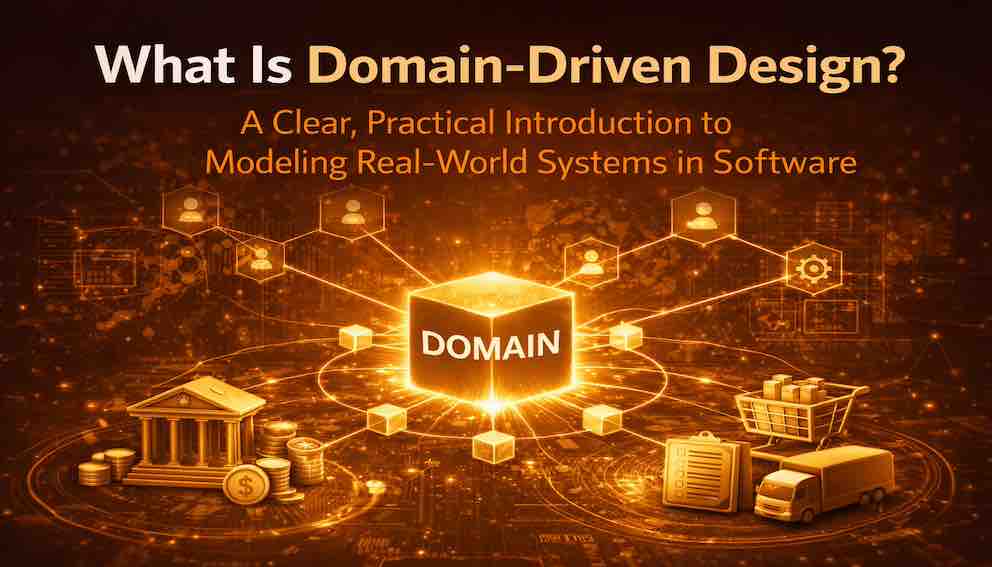
Domain-Driven Design is an approach to software development that focuses on modeling software based on real-world business concepts and rules. Instead of organizing code around technical layers like databases and APIs, it organizes it around the domain—the actual problem the business is trying to solve. This shift in thinking helps create systems that are easier to understand, change, and maintain over time. By aligning the language of code with the language of business experts, Domain-Driven Design bridges the gap between how stakeholders think and how software is built. In this guide, we'll explore what this means through relatable examples and practical explanations that anyone can follow.
The Moment Software Stops Making Sense
There's a feeling that almost every developer knows.
You're working on a system that's been around for a while. Maybe two years, maybe five. In the beginning, everything was clean and simple. You understood where things lived. Adding a feature meant touching one or two files, and you could explain the whole flow to a new teammate over coffee.
Then something changed.
Now, adding a simple field means hunting through fifteen files. A bug fix in one place breaks something completely unrelated somewhere else. When you ask "how does this feature actually work?" people give vague answers and point to different services. The code still runs. The tests still pass. But somehow, the system feels fragile. Like a tower of cards held together by hope and meeting notes.
Almost every development team has experienced this at some point.
This isn't a failure of skill. It's a failure of design. And it's exactly the kind of problem that Domain-Driven Design tries to solve.
Key Idea: Domain-Driven Design isn't about writing better code in the technical sense—it's about writing code that better represents the real world it serves.
So What Does "Domain" Actually Mean?
The word "domain" sounds academic and intimidating, but it's really just a way of saying "the thing your software is about."
Every piece of software exists to serve some real-world activity. That activity—that area of knowledge and work—is the domain.
Consider a few examples.
For banking software, the domain is banking. It's accounts and transactions and interest rates and the rules about when money can move from one place to another. These concepts existed long before anyone wrote a line of code. People deposited checks, took out loans, and asked about balances. The software just helps manage all of that.
For an e-commerce platform, the domain is online retail. It's products and shopping carts and orders and shipping addresses. It's the rule that says you can't ship something before it's paid for, or that a customer can't order more items than are in stock.
For a hospital system, the domain is healthcare. It's patients and appointments and prescriptions and the careful rules about who can access which records.
What all these domains have in common is that they existed before the software. They have their own language, their own rules, their own way of thinking. The software is simply a model of that reality.
And this is where things often go wrong.
When Code and Reality Drift Apart
Consider building that e-commerce system. You sit down with the business people—domain experts—and they explain how orders work.
"An order is confirmed only after payment is successful," they explain. "Until then, it's just a draft."
You nod, take notes, and start coding.
Months later, someone new joins the team and wants to understand how orders work. They open the codebase. What do they find?
They find an OrderService that does something. They find a PaymentController that handles webhooks from the payment provider. They find an OrderRepository with queries that update status fields. They find a database table called orders with a column called status that can be "draft", "paid", or "shipped".
The business rule—"an order is confirmed only after payment is successful"—is nowhere to be seen as a single, understandable thing. It's scattered across files. It's implied in the order of operations. It's hiding in plain sight.
This is the problem. The domain experts speak one language. The code speaks another. And every time these languages drift apart, the system becomes harder to understand and change.
The Slow Decay of Traditional Architectures
Most developers learn to build software with a layered approach. There's a presentation layer where user interfaces live, an application layer where services coordinate tasks, and a data layer where information gets stored. It's clean and organized. It makes sense.
And for simple systems, it works beautifully.
But complexity has a way of sneaking up.
The Rule That Lives Everywhere and Nowhere
Consider a banking system with a simple rule: "An account cannot be overdrawn beyond a certain limit."
Where does this rule live in a traditional system?
Perhaps there's a service that checks the balance before allowing a withdrawal. That seems reasonable. But what about automated transfers between accounts? That's handled by a different service. What about fees that get deducted automatically at the end of the month? That's a scheduled job running somewhere else. What about the API that lets customer service representatives manually adjust accounts? Someone added validation there too, just to be safe.
The rule is everywhere. Which means when the rule changes—when the bank decides to adjust overdraft limits—every single place where that rule was implemented must be found and updated. Miss one, and suddenly accounts can be overdrawn in ways they shouldn't be.
This is exhausting and error-prone. And it happens in every system that grows beyond a certain size.
Objects That Are Just Bags of Data
Another pattern emerges in traditional systems.
Classes that represent business concepts—Account, Order, Customer—become simple containers for data. They hold information like balances, addresses, and status codes, but they don't actually do anything. All the real logic lives somewhere else.
An Account becomes a simple package with a balance and an account number. And somewhere else, in a service, are the instructions for withdrawing money, depositing money, and calculating interest.
The objects are empty. They have no life of their own. They just sit there, passively holding data while services poke and prod them from the outside.
This might not seem like a problem at first. But over time, understanding what an Account actually does requires reading through dozens of service methods scattered across the codebase. The behavior is fragmented. The logic is duplicated in different places. And the system becomes harder to reason about because the truth about any business concept is spread across many files.
The Hidden Cost of Scattered Logic
Here's what happens when business rules are spread across a codebase with no single source of truth.
Each new feature doesn't just add its own complexity. It multiplies the complexity of everything that came before it. A new rule about discounts doesn't just live in one place—it has to coordinate with existing rules about inventory, about customer eligibility, about payment methods. Every addition creates new combinations. Every combination creates new edge cases.
Without a clear model of the domain—without a single, trusted place where rules live and can be understood—these interactions become unpredictable. Teams find themselves spending more time tracing through code than writing it. A simple change that should take an hour takes a day, because no one knows what else might break. Assumptions that seemed safe turn out to be wrong. Edge cases surface at the worst possible moments.
This isn't a gradual decline. It's an accelerating spiral. The more features you add without a coherent domain model, the harder every future feature becomes. And once you're in that spiral, getting out means untangling years of assumptions and scattered logic—often a more expensive proposition than anyone is willing to commit to.
This is the problem Domain-Driven Design sets out to solve.
The Simple But Transformative Idea of Domain-Driven Design
So what does Domain-Driven Design propose instead?
At its heart is a simple idea: model your software around the domain, not around technical structures.
Instead of starting with "what tables do I need in my database?" or "what APIs should I create?", you start with questions like:
What is an Order in this business? What does it mean for an Order to be confirmed? What rules must always be true for a Bank Account? What happens in the real world when a Customer places an Order?
The goal is to make your code a reflection of the real-world system it represents. Not just in terms of data, but in terms of behavior and rules and language. The software becomes a model of the business itself, not just a technical implementation of business requirements.
Speaking the Same Language
One of the most powerful ideas in Domain-Driven Design is something called the ubiquitous language. This is simply the practice of using the same language in code that everyone uses in conversation.
If the business people say "an order is shipped," the code should have a way to express that an order has been shipped. If they talk about "closing an account," the code should reflect that action directly. If they have a rule that "an order cannot be shipped before it's paid," that rule should live inside the order itself, clearly and visibly.
This might sound obvious. But consider how often code uses different terminology than the business. The business says "customer" but the database says "user." The business says "cancel order" but the service method is called updateStatus with a numeric code that requires looking up what that code means.
These mismatches seem small, but they add up. Every translation between business language and code language is a chance for misunderstanding. Every difference in terminology creates friction when discussing requirements or debugging issues. Every time a developer has to mentally map "what the business wants" to "what the code actually does," energy is lost and mistakes become more likely.
When the code speaks the same language as the business, communication improves. New team members understand things faster. Requirements become clearer because there's no translation layer between what the business says and what the code expresses. The system becomes more transparent—you can look at it and see the business rules, not just technical implementation details.
Bringing Behavior Back Where It Belongs
In Domain-Driven Design, the concepts in your software aren't just passive containers for data. They have behavior. They enforce rules. They protect their own integrity.
Think about a bank account in the real world. An account isn't just a number written in a ledger. It's something that does things. Money can be withdrawn from it, but only if there are sufficient funds or the withdrawal stays within an overdraft limit. Money can be deposited into it. Money can be transferred to another account. The account itself is the thing that makes these actions possible and enforces the rules around them.
Now imagine modeling that in software. Instead of having an Account that's just an ID and a balance, with services scattered everywhere handling withdrawals and transfers, you have an Account that knows how to handle withdrawals, deposits, and transfers. The rules live inside the account itself. To understand what happens when someone withdraws money, you look at the account. When the rules change, you change them in one place.
This is completely different from the anemic approach where objects are just data holders. Now, to understand what rules apply to an account, you look in one place. To change how transfers work, you change one class. The account controls its own destiny, just like in the real world.
A Different Perspective on a Familiar Scenario
Consider an e-commerce system. In a traditional approach, when a customer places an order, the mental model might look something like this: a controller receives a request, calls a service, the service validates the items, saves to the database, calls a payment service, updates the order status, and returns a response. The order is just a record being passed around and updated by various services along the way.
With Domain-Driven Design, you start with different questions entirely.
What is an order in this business? An order starts as something tentative—a draft. It contains items a customer wants to buy. It belongs to a customer. And it has rules: items can't be added after payment has started, the order can't be confirmed without successful payment, the total must always match the sum of the items.
In this design, the order becomes something active. It knows it can be in different states—draft, confirmed, shipped, delivered. It knows that items can only be added while it's in draft state. It knows that confirming requires payment to be complete. It knows that shipping can only happen after confirmation.
When a customer places an order, you're not just inserting a record. You're creating an order in draft state, adding items to it, and eventually confirming it. The behavior is part of the order itself, not scattered across services.
This shift in thinking might seem subtle, but it has profound effects. The code becomes more expressive—the business rules are visible right there in the order. The system becomes easier to change because the behavior is encapsulated. And when something goes wrong, you know where to look.
Key Takeaway: In Domain-Driven Design, business concepts are active participants in the system—they protect rules and ensure the model stays consistent, just like their real-world counterparts.
Why This Matters More Than Ever
Is this approach always necessary? For simple systems, certainly not. If you're building a basic application that just stores and retrieves data with straightforward rules, Domain-Driven Design is probably more than you need. It adds thoughtfulness and structure that might not be justified.
But modern systems are often not simple. They're large. They're distributed across services and teams. They need to change quickly as business requirements evolve. They have complex rules and interactions that can't be easily managed with a traditional layered approach where logic is spread thin across many files.
Without a strong domain model—without a clear, unified place where business concepts live and breathe—these systems become rigid. Changes that should be straightforward become risky and time-consuming. The business wants to move fast and adapt to new opportunities, but the software holds them back. Features take longer to deliver. Bugs become more common as changes in one place unexpectedly affect another. Teams spend more time fighting the code than serving the users.
Domain-Driven Design offers a way out of this trap. By anchoring the software in real-world meaning—by making the code a faithful model of the business domain—it creates systems that can evolve and scale without falling apart. When the business changes, you change the domain model, and the rest of the system follows.
Where Domain-Driven Design Fits: From Monoliths to Microservices
A common question that comes up when discussing Domain-Driven Design is how it fits with different architectural styles. Does it only work for certain types of systems? Is it meant for microservices, or does it belong in monoliths?
Domain-Driven Design is not tied to any particular architecture. It's a way of thinking about software that can be applied regardless of whether you're building a single deployment unit or a distributed system of hundreds of services. In fact, DDD provides valuable guidance for both ends of the spectrum.
Domain-Driven Design in Monoliths
When people hear "monolith," they often think of the kind of tangled, unmaintainable system described earlier—the one where rules are scattered and complexity spirals out of control. But a monolith is simply a software system deployed as a single unit. There's nothing inherently wrong with that. The problem is how the code is organized inside.
Domain-Driven Design brings discipline to monoliths by providing clear boundaries within the codebase. Even though everything deploys together, the domain can be divided into distinct areas—separate models that reflect different parts of the business. (We'll explore what these boundaries look like and how to identify them in upcoming articles. Terms like "bounded contexts" will become familiar as the series progresses.)
Consider an e-commerce monolith. Inside that single deployment, you might have clearly separated areas for:
- Product catalog management
- Shopping cart and orders
- Customer accounts
- Shipping and fulfillment
- Payments
Each of these areas has its own model, its own language, and its own rules. The product team might use terms like "SKU," "inventory," and "reorder point." The fulfillment team talks about "carriers," "tracking numbers," and "delivery windows." These are different worlds, and DDD helps keep them cleanly separated even within the same codebase.
The benefit? Teams can work on different areas without stepping on each other's toes. The order area doesn't need to know how the product area calculates reorder points. The shipping area doesn't need to understand payment authorization details. Each part of the system can evolve independently, even though they deploy together.
This approach gives you many of the benefits of service-oriented architectures. You get clear boundaries, independent evolvability, and maintainable code, all within a single deployment.
Key Takeaway: A monolith doesn't have to mean messy. With clear boundaries guided by domain thinking, even a single deployment can be organized, maintainable, and a pleasure to work with.
Domain-Driven Design as the Foundation for Microservices
Microservices have gained tremendous popularity, and for good reason. They promise independent deployability, team autonomy, and the ability to scale parts of the system independently. But microservices also introduce significant complexity—network latency, distributed transactions, eventual consistency, service discovery, and operational overhead.
Here's where Domain-Driven Design becomes essential. The most successful microservice architectures are not built by randomly splitting a system into small services. They are built by identifying bounded contexts and letting those become service boundaries.
A bounded context, in DDD, is exactly what a microservice should be: a cohesive set of functionality around a specific business capability, with its own domain model, its own language, and clear boundaries that define what belongs inside and what lives outside.
When bounded contexts become service boundaries, you get:
Clear ownership. Each service aligns with a business capability, making it obvious which team should own it. There's no ambiguity about whether the product service or the order service should handle a particular piece of logic.
Autonomous models. Each service can model its domain in whatever way makes sense for that part of the business. The order service doesn't need to know how the product service structures its data. This autonomy allows teams to choose the right tools, databases, and approaches for their specific context.
Natural interfaces. Instead of arbitrary APIs designed around technical concerns, services expose interfaces that reflect business operations. The order service doesn't expose a generic updateOrder endpoint—it exposes cancel, addItem, applyDiscount, and submit. These operations mean something to the business.
Controlled dependencies. Bounded contexts have explicit relationships with each other. They communicate through well-defined contracts, and changes in one context don't ripple unpredictably into others.
Without Domain-Driven Design, microservices can become "distributed monoliths"—a collection of small services that are still tightly coupled, still require coordinated deployments, and still suffer from the same problems as a poorly structured monolith, but with the added pain of network calls and distributed complexity.
Finding the Right Balance
It's worth noting that the relationship between DDD and architecture is not one-size-fits-all. Some teams successfully apply DDD within modular monoliths, enjoying the simplicity of deployment while maintaining clean boundaries. Others leverage bounded contexts to design microservices with clear ownership and autonomy. Still others start with a monolith, use DDD to maintain clean boundaries, and then extract services when the boundaries prove stable and the operational benefits become worthwhile.
What matters is not whether you deploy as one service or many. What matters is that your software reflects the domain it serves, that the language in your code matches the language of the business, and that the complexity of the domain is managed through clear, intentional boundaries.
Key Takeaway: Domain-Driven Design provides the blueprint for organizing software around business capabilities. Whether that blueprint becomes a single codebase with well-defined modules or a distributed system of independent services is a separate decision—one that can be made based on operational needs without compromising the integrity of the domain model.
A Different Way of Thinking
Domain-Driven Design is not a framework that can be downloaded. It's not a set of patterns that can be plugged into a project. It's not something that can be bought or installed from a package manager.
It's a way of thinking about software.
It's the shift from asking "how do I implement this feature technically?" to asking "what is the real-world concept behind this feature, and how can my code reflect it clearly?"
It's the decision to make code speak the same language as the business it serves, so that conversations between developers and domain experts become conversations about the same thing, not translations between different worlds.
It's the understanding that complexity is not something to be feared, but something to be managed through careful modeling and clear boundaries. When the domain is modeled well, complexity becomes manageable because it's organized around the way the business actually thinks.
Final Thought: When code and business speak the same language, everything becomes easier—understanding, communication, and change. That's the promise of Domain-Driven Design. Not technical perfection, but clarity. Not magic, but meaning.
In the next part of this series, we'll look at why Domain-Driven Design sometimes fails in real projects, and how to recognize when it's the right approach for a particular situation. But for now, this simple idea is worth holding onto: software is at its best when it's a faithful reflection of the reality it represents. When you can look at code and see the business, you've built something that will serve its users well for years to come.
About N Sharma
Lead Architect at StackAndSystemN Sharma is a technologist with over 28 years of experience in software engineering, system architecture, and technology consulting. He holds a Bachelor’s degree in Engineering, a DBF, and an MBA. His work focuses on research-driven technology education—explaining software architecture, system design, and development practices through structured tutorials designed to help engineers build reliable, scalable systems.
Disclaimer
This article is for educational purposes only. Assistance from AI-powered generative tools was taken to format and improve language flow. While we strive for accuracy, this content may contain errors or omissions and should be independently verified.