
Learning Paths
Last Updated: May 14, 2026 at 16:00
Search Engines Explained: When You Need a Search Engine for Your Application (and When You Don’t)
A practical engineering guide to search engines, full-text search, and relevance ranking — and how to decide when a database is no longer enough for your application
Most applications start with a database that handles search well enough — until users begin expecting smarter, more flexible ways to find information. At that point, simple queries and filters are no longer sufficient, and relevance, ranking, and fuzzy matching become essential. This article explains what search engines actually do, how they differ from databases, and how full-text and semantic search work in practice. It also helps you decide when to introduce a search engine like Elasticsearch or OpenSearch, and when a database is still the right choice.
Every application eventually reaches a point where users need to find things. At first, the database handles it fine. Then the dataset grows, queries get more expressive, and users start expecting search to feel less like a filter and more like a conversation. That's the moment your architecture needs a decision.
This article is about making that decision deliberately — understanding what a search engine actually is, what problem it solves, and how to recognise when your architecture is ready for one.
Search Engine vs. Database: Built for Different Jobs
These two systems are often used together, but conflating them creates architectural problems that are expensive to untangle later.
A database is designed to store data reliably and retrieve it precisely. Its core guarantee is consistency: write a record, read it back exactly as written. Its core capability is structured querying: find all orders where status = 'shipped' and created_at > '2024-01-01'. Relational databases are optimised for this, and they do it extremely well.
A search engine is designed to retrieve the most relevant content for a given query, at speed, across a large and often unstructured body of text. Systems like Elasticsearch, OpenSearch, and Meilisearch are built specifically for this problem. Their core guarantee is relevance: the top result should be the most useful one for the person who asked.
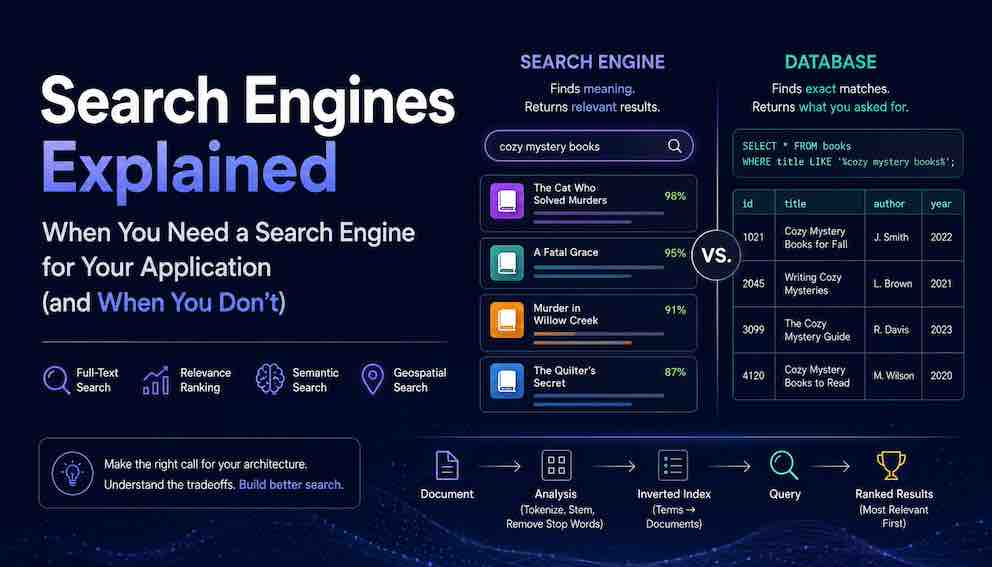
The differences compound quickly in practice. A database query for "login" finds records where that exact word appears in an indexed column. A search engine query for "login" finds articles about authentication, account access, sign-in flows, and credential management — because it understands these concepts are related. It also handles "lgoin" gracefully, because it knows you probably meant "login."
Put simply: databases store and retrieve facts; search engines find meaning.
How Full-Text Search Actually Works
Full-text search is the ability to search across the content of documents, not just structured fields — finding relevant results even when the query doesn't exactly match any stored value.
When a document enters a search engine, it doesn't get stored as raw text. It passes through an analysis pipeline:
- The text is broken into tokens — "Running shoes for flat feet" becomes ["running", "shoes", "flat", "feet"].
- Noise words like "for", "the", and "and" are discarded.
- Each remaining token is reduced to its root form through stemming — "running" becomes "run", "shoes" becomes "shoe" — so variations of the same word resolve to the same index entry.
- Synonyms can be mapped together, so a query for "automobile" also surfaces results about "cars".
The output is stored in an inverted index: a data structure mapping every term to the list of documents containing it — like the index at the back of a textbook. When a user submits a query, their input passes through the same pipeline, and the search engine looks up the resulting terms to retrieve matching documents.
This separation between index time and query time is why search engines are fast. The expensive work of understanding content happens once. Queries are fast because they're lookups against a precomputed structure, not scans through raw data.
Relevance Ranking: The Central Idea
Databases retrieve matching rows. Search engines retrieve ranked possibilities.
When a database returns results, the order is whatever the query optimizer decided — not what is most useful to the user. A search engine is different. It deliberately places the most useful result first.
How does it decide what is "most useful"? It looks at several signals:
How often do the search words appear? A document that mentions "machine learning" twelve times is probably more about that topic than one that mentions it once.
Where do they appear? A match in the title matters more than a match buried in a footnote.
How rare are the words? A rare word like "Goosebumps" tells you more than a common word like "the."
How close are the words to each other? A document where "machine" and "learning" appear side by side is more relevant than one where they appear paragraphs apart.
More advanced systems add behavioral signals too — which results users actually click on, and whether they come back to search again.
The key insight is this: relevance is a score, not a binary match. There is rarely one correct answer. There is a ranked list of candidates. The quality of a search system lives entirely in how good that ranking feels to a real human.
Measuring Search Quality
Relevance is subjective, but measuring it rigorously is possible — and necessary for teams that want to improve search deliberately rather than by instinct.
Two metrics are widely used. Mean Reciprocal Rank (MRR) measures how high the first relevant result appears in the list. If users consistently scroll past irrelevant results, MRR captures that. Normalised Discounted Cumulative Gain (NDCG) is richer — it accounts for the relevance of every result in the list and weights top positions more heavily.
For teams earlier in their search journey, simpler signals are a practical starting point: click-through rate on results, the rate of zero-result searches, and the rate of searches where users immediately refine their query or abandon the session. These behavioural signals often reveal relevance problems faster than any algorithmic metric.
The goal isn't to track all of these from day one. It's to treat search quality as something measurable — which means it can be improved deliberately.
Search vs. Filtering
These two capabilities are closely related but serve distinct purposes.
Filtering is exact and binary. A filter for price < 100 either matches a record or it doesn't. Databases are excellent at this.
Search is probabilistic and ranked. A search for "affordable running shoes" has no single correct answer. The search engine must interpret the query, match it against content, and rank results by relevance — not just whether they technically qualify.
Modern search engines do both simultaneously. A user doesn't just search — they search for "running shoes" and filter by size, brand, and price range, all in the same interaction. Search engines index both text content and structured metadata together, so text search and attribute filtering compose naturally in a single query. This is one of the key capabilities that makes a search engine worth the operational investment once both requirements exist at scale.
Semantic Search and Vector Search
Traditional full-text search operates on the surface form of language — the actual words in a query and a document. This means it can miss results that are conceptually relevant but expressed differently.
Semantic search addresses this by operating on meaning rather than words. A semantic search for "how do I reset my account credentials" can surface a help article titled "Recovering access to your profile" even though none of the query's words appear in the title, because both describe the same idea.
This works through vector embeddings — numerical representations of text that capture semantic meaning. Documents and queries are both converted into high-dimensional vectors using a language model, and similarity is measured mathematically. Results closest in meaning surface first, regardless of shared vocabulary.
In practice, production search architectures in 2026 rarely choose between keyword search and semantic search — they use both. Hybrid retrieval combines traditional full-text matching (fast, precise, excellent for known-item searches and exact terminology) with vector-based semantic search (handles paraphrasing, conceptual queries, and exploratory search). Results from both are merged and re-ranked into a single list.
The rule of thumb: keyword search gives you typo tolerance and exact matching; vector search gives you meaning and intent. You need both. Relying entirely on vector search will fail on product SKUs, error codes, and exact phrases.
Geospatial Search
Search isn't just text. Geospatial search answers questions like "restaurants within one kilometre of my location" or "all incidents reported within this polygon." Modern search engines support geospatial indexing — Elasticsearch and OpenSearch use GeoJSON shapes and bounding boxes; Meilisearch has basic geosearch.
A database can store latitude and longitude, but ranking by distance efficiently at scale across millions of points is a search engine problem. If your application involves maps, delivery, local discovery, or any location-based ranking, geospatial search is relevant to you.
When a Database Is Enough
Search engines add real complexity: a new service to deploy, a data store to keep synchronised with your source of truth, and an additional operational surface to monitor. Not every application needs that.
A database is the right tool when users are looking for exact, structured things. An admin panel where staff search by invoice number or customer email doesn't require fuzzy matching or relevance ranking — a well-indexed database query handles this perfectly.
When the dataset is small — tens of thousands of records rather than millions — most modern databases offer built-in full-text search that performs adequately. PostgreSQL's full-text search covers the basics: tokenisation, stemming, and ranked results. For modest scale and modest requirements, this is a sensible starting point that avoids introducing a separate system prematurely.
Signals That You Need a Search Engine
Beyond general principles, here are specific signals that indicate a dedicated search engine will return its investment.
Users search with incomplete or inexact phrases. Queries like "how do I" or "stine book" instead of exact titles mean your users are describing intent, not supplying keys. That's a search problem.
Typos cause zero results. If your analytics show common typos returning nothing — typos obvious to any human — your current system is failing its users. Search engines handle this natively.
Ranking affects business metrics. For e-commerce, the wrong product at the top directly affects revenue. For documentation, the wrong page affects developer productivity. When result order matters to your metrics, you need a system designed to optimise that order.
Filtering and faceting matter alongside search. If users search and then narrow by category, brand, price, or date, a search engine's faceted filtering will save enormous engineering effort compared to hand-rolling the same features on top of a database.
Note: Faceted search is a way of filtering results by applying multiple, simultaneous constraints—or "facets"—such as category, price, brand, or rating, allowing users to narrow down without losing the ability to remove or adjust individual filters independently.
Zero-result queries are common. Each one is a user telling you exactly what your search is missing. Log them, review them, fix them.
Users describe concepts rather than keywords. "Cozy mystery books with a female detective" will fail pure keyword search. You need vector search or a hybrid approach.
The Limits of Search Engines
Understanding the limits of a tool is as important as understanding its strengths.
Search engines are not transactional systems. They don't provide the ACID guarantees of a relational database. A search index is the wrong place to enforce referential integrity or handle operations that must atomically succeed or fail.
They are not perfectly consistent. Most search engines offer near-real-time indexing — a document becomes searchable within seconds of being indexed, not milliseconds. Applications where a record must be immediately discoverable the instant it's created require intentional design around this propagation window.
They are not analytical databases. Search engines can aggregate and facet data usefully, but complex analytical queries — multi-dimensional aggregations, time-series analysis, large-scale data exploration — are better served by tools designed explicitly for that purpose.
The clearest allocation of responsibility: the database owns writes and authoritative reads requiring consistency; the search engine owns reads requiring relevance, speed, and tolerance.
Common Misconceptions About Search Engines
"A database LIKE query is basically search."
It is not. LIKE '%query%' performs a full table scan on every request, does not rank results by relevance, ignores typos completely, and does not understand synonyms. It shows you want search functionality — but it is not a search engine, and it will not scale.
"Adding a search engine will automatically fix search quality."
A search engine provides the capability for great search. But the capability is not the outcome. Relevance comes from thoughtful decisions: which fields to index, how to weight them, how to handle typos and synonyms, and ongoing tuning based on what users actually click. The engine is the tool. The configuration is where quality lives.
"Search engines can replace my database."
They cannot. Search engines are not transactional systems. They do not provide ACID guarantees, they are eventually consistent, and they are not designed to be the source of truth. The pattern is always: database owns writes, search engine serves reads. Using a search engine as your primary database will lead to data loss and consistency nightmares.
Hidden Operational Costs
Reindexing is painful. When you change how documents are indexed — adding a field, changing tokenisation, fixing a synonym mapping — you must reindex all documents. For large datasets, this takes hours or days, during which search quality may be inconsistent.
Relevance tuning is famously difficult. The hardest part of search is almost never the infrastructure. It's making results feel right. You'll ask "why is this irrelevant result appearing above this relevant one?" and spend hours digging through scoring explanations. There's no SQL query to debug — only logged scores, intuition, and experimentation. And it never fully stops: ranking logic that works at ten thousand documents may break at ten million.
Infrastructure costs add up. A production search cluster with replication and high availability isn't cheap. Small teams have accidentally built expensive Elasticsearch clusters that cost more than their application database.
Keeping the Search Index in Sync
The database remains the source of truth. The search engine is a derived, read-optimised view of that data. When a record is created, updated, or deleted, that change needs to propagate to the search index. This synchronisation isn't automatic.
The simplest approach is to update the search index from application code at the moment data changes — a direct write to both the database and the index in sequence. This works, but it introduces coupling between the application and the search engine.
More resilient architectures decouple synchronisation through event streams or change-data-capture pipelines that detect database changes and propagate them downstream. This adds infrastructure but makes the synchronisation process independently observable, retryable, and easier to reason about as the system grows.
Search Is an Experience, Not a Feature
The quality of search shapes how users perceive the entire product.
A user who can't find a product doesn't conclude that search is imperfect — they conclude the product doesn't carry what they need, and they leave. A user who finds the right answer in seconds feels like the product understands them. Search is one of the few places where the gap between a good experience and a poor one is measured in seconds and directly determines whether a user completes their goal.
This is why proper search infrastructure isn't purely a technical investment. It's a product decision with measurable consequences for retention, conversion, and satisfaction.
The Mental Model Worth Keeping
A search engine is a specialised read layer. It analyses content deeply at index time — tokenising, stemming, building inverted indexes, and in modern systems generating vector embeddings — and retrieves the most relevant pieces of that content at query time, with speed and relevance no general-purpose database is designed to deliver.
The decision of whether to introduce one comes down to the distance between what users mean and what a database can match. When that distance is small, the database is enough. When that distance is the central challenge of the user experience, a search engine is the right tool.
Quick Checklist
Run through these before adding a search engine to your architecture:
- Can users mistype a word and still find what they need?
- Can they use a synonym you never configured and still get relevant results?
- Can they describe intent ("cozy mystery with a female detective") rather than a keyword and still find matches?
- Does the right result appear at the top, consistently, for your most important queries?
- Are you seeing zero-result queries that a human would immediately know how to answer?
- Does ranking quality directly affect a metric you care about — revenue, engagement, support deflection, retention?
If you answered no to any of these, you have a job for a search engine. Not every problem needs one — but when yours does, you now have the vocabulary, the signals, and the tradeoffs to make the decision deliberately.
Build search that feels like a patient librarian who understands what you meant, not just what you typed.
About N Sharma
Lead Architect at StackAndSystemN Sharma is a technologist with over 28 years of experience in software engineering, system architecture, and technology consulting. He holds a Bachelor’s degree in Engineering, a DBF, and an MBA. His work focuses on research-driven technology education—explaining software architecture, system design, and development practices through structured tutorials designed to help engineers build reliable, scalable systems.
Disclaimer
This article is for educational purposes only. Assistance from AI-powered generative tools was taken to format and improve language flow. While we strive for accuracy, this content may contain errors or omissions and should be independently verified.