
Learning Paths
Last Updated: March 14, 2026 at 17:30
Architecture vs Design vs Implementation: Understanding the Boundaries That Shape Software Systems
How to recognize architectural decisions, distinguish them from detailed design, and preserve architectural intent during coding
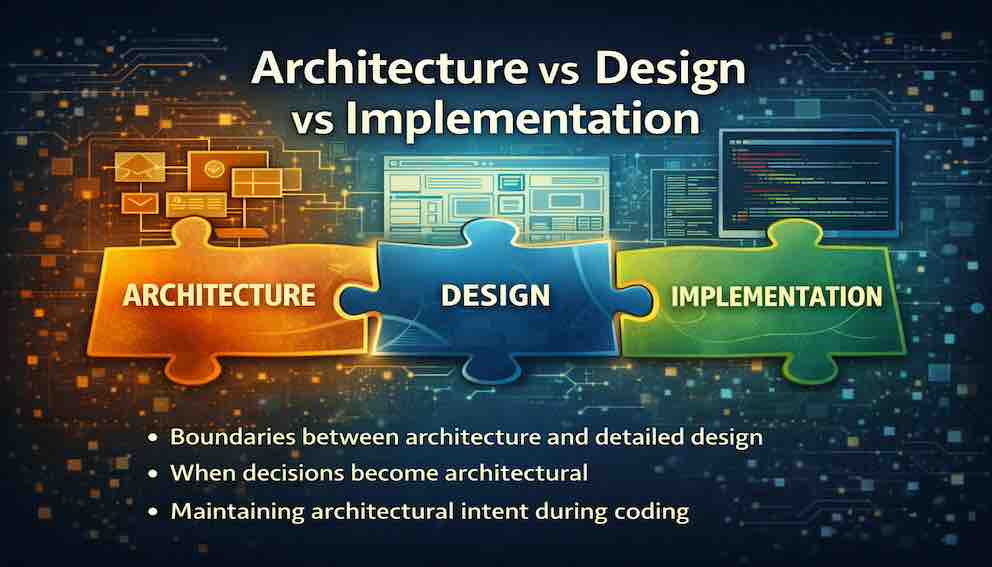
In software development, architecture, design, and implementation are often used interchangeably, but they operate at different levels. Architecture sets the overall structure and rules that shape the system's future. Design translates those rules into concrete patterns and interactions between components. Implementation turns the design into working code. This article clarifies the boundaries between these layers, helps you spot truly architectural decisions, and shows how to keep architectural intent alive during coding — so your system stays coherent and adaptable as it grows.
A Conversation You've Probably Had
Picture this: Your team is huddled around a whiteboard. Someone suggests using microservices. Another person argues for keeping things simple with a monolith. A developer asks whether to use REST or GraphQL for a new API. Someone else wants to know which sorting algorithm to use for a data processing module.
All valid questions. But here's the thing — they're not the same kind of question.
Mix them up, and you'll find yourself arguing about the wrong things at the wrong time. Decisions that should shape your entire system get treated like minor details. Small choices start causing big problems across your codebase.
Let's clear up the confusion.
The Three Layers, Made Simple
Think of building software like building a house. You have three distinct levels of decision-making.
Architecture is the blueprint. It decides whether you're building a two-story home or a ranch, where the kitchen and bedrooms go, and how electricity and plumbing flow through the walls. Change these later? You're basically rebuilding.
Design is choosing the details within that blueprint. What kind of windows? Hardwood or carpet? Where exactly do you place the light switches? These choices matter, but you can change them without knocking down walls.
Implementation is the actual construction. The carpentry, the wiring, the plumbing. Even with perfect blueprints and great material choices, shoddy workmanship gives you a house that falls apart.
What This Looks Like in Software
Let's walk through each layer with concrete examples so you can see exactly where one ends and the next begins.
Architecture: The Big Picture Decisions
Architecture decides how your entire application is structured at the highest level. Think of it as the skeleton that holds everything together.
When you make architectural decisions, you're answering questions like:
How will the system be split into pieces? Will you build one large application (a monolith) or many small services that work together (microservices)? This decision affects everything that follows. With microservices, each piece can be developed and deployed independently, but you now have to handle network communication, service discovery, and distributed data. With a monolith, development starts simpler, but scaling means scaling everything, not just the parts under load.
How will these pieces talk to each other? Will they make direct API calls and wait for responses? Or will they send events and continue working, letting other pieces pick up those events when they're ready? This choice changes how your system behaves when things go wrong. With direct calls, a failure anywhere can cause failures everywhere. With events, failures can be isolated and retried.
Where will data live? Will you have one shared database that every part of the system uses? Or will each piece have its own database? Shared data makes it easy to join information across features, but creates a central point of failure and a bottleneck. Separate databases give you independence, but now you have to figure out how to keep data consistent across them.
What technology foundations will you build on? Will you run on your own servers or in the cloud? Will you use containers? What programming language will most of the system use? These choices create constraints that ripple through every feature you build later.
How will the system be built, deployed, and operated? Will you use containers and orchestration like Kubernetes? Will you build a continuous deployment pipeline that automatically ships code to production? How will you monitor system health and debug issues when they arise? These DevOps decisions are architectural because they affect every team, every deployment, and the entire operational life of the system. Choose a deployment approach today, and it shapes how developers work, how operations responds to incidents, and how quickly you can deliver features for years to come.
Here's what makes these decisions architectural: they're nearly impossible to reverse. Choose a shared database today, decide you want separate databases next year? That's migrating every single feature, rewriting data access code across the entire company, and retraining every team. It's a multi-month or multi-year effort. Choose a deployment platform today, migrate to something else later? That's rebuilding pipelines, retraining teams, and potentially rearchitecting applications.
Design: The Component-Level Choices
Design operates within the boundaries set by architecture. Once architecture decides you'll have microservices with separate databases and container-based deployment, design figures out how each individual service will work and how each team will build and test their code.
When you make design decisions, you're answering questions like:
How will this service be organized internally? Will you use a clean architecture with separate layers for web handling, business logic, and data access? Will you organize code around features instead of technical layers? These patterns make the code easier to work with, but they only affect this one service.
What patterns will you use for common problems? Will you use a repository pattern to abstract database access? Will you use dependency injection to make testing easier? Will you use factories, strategies, or observers where they make sense? These are proven solutions to recurring problems, applied locally.
How will this service handle errors? Will you retry failed operations? How many times? Will you show users friendly error messages or technical details? These decisions affect user experience and reliability, but they're contained within the service.
What data structures make sense here? Will you use a list, a set, a map, or something more specialized? This choice affects performance and memory usage, but only within this specific component.
How will this team build and test their service? Will you use unit tests, integration tests, or end-to-end tests? Will you run tests locally or in the pipeline? Will you use feature flags to control releases? These design decisions about the development process affect how the team works, but they're contained within the team's boundaries.
Here's what makes these decisions design-level: you can change your mind without widespread disruption. Decide halfway through that a hash map would work better than a tree for that caching layer? Change it. The rest of the service doesn't even notice as long as you maintain the same interface. Decide you want to switch testing frameworks or add more automation? The team can make that call without asking permission from every other team.
Implementation: The Daily Coding Decisions
Implementation is where design becomes actual code. It's the hundreds of small choices you make every day as you write functions and classes, and as you interact with your deployment pipelines and monitoring tools.
When you're implementing, you're answering questions like:
What should I name this variable? A name like customerList versus cl might seem trivial, but it determines whether someone six months from now can understand your code. Good names communicate intent. Bad names hide it.
How should I break this function into smaller pieces? A 200-line function that does everything might work, but breaking it into focused, testable pieces makes the code maintainable. Where you draw those boundaries is an implementation decision.
Should I add a comment here? Some code is self-explanatory. Some needs context. Explaining why you did something unusual, rather than what the code does, helps future developers understand your thinking.
How do I handle this edge case? What happens when a user passes null? When a network call times out? When a file doesn't exist? Your moment-by-moment choices determine whether the system fails gracefully or crashes mysteriously.
How do I debug this issue in production? What logs should I add? What metrics might help spot this problem before customers notice? How will I know if my fix actually worked? These implementation choices determine whether you can understand and operate the system day-to-day.
Here's what makes these decisions implementation-level: they're cheap to change and highly local. Pick a poor variable name? Rename it. Your editor can do that in seconds. Break a function poorly? Refactor it. The impact stays within the file you're editing. Add more logging? Deploy and see if it helps. These changes rarely need coordination beyond your immediate team.
A Quick Comparison
Let's put this all together with a concrete example. Imagine you're building a system that processes customer orders.
An architectural decision: Choosing to split the system into separate order processing, payment, and inventory services, each with its own database, deployed as containers on Kubernetes, with automated deployment pipelines for each service. This decision means you'll need to handle communication between services, maintain data consistency across databases, manage container orchestration, and support multiple deployment pipelines. Change it later, and you're restructuring the entire company's software and operations.
A design decision: Deciding that within the order service, you'll use the repository pattern to hide database details from the business logic. You'll have an OrderRepository interface with methods like findById and save, and a concrete implementation that works with your actual database. Also deciding that your team will use integration tests that spin up a test container instead of mocking the database. Change it later, and you're updating one service and one team's practices, not the whole system.
An implementation decision: Naming a variable pendingOrders instead of ordersList in a specific function. Choosing to write a helper method to calculate tax instead of inlining the calculation. Adding structured logs with order IDs so you can trace requests. Adding a metric to track order processing time. Change these anytime without anyone outside your current file or service caring.
Spot the Difference: A Simple Test
Not sure if a decision is architectural? Ask yourself three questions.
First, does this affect multiple parts of the system or multiple teams? If yes, you're probably in architectural territory. Choosing your database affects every feature that stores data. Choosing a deployment platform affects every team that ships code. Choosing a monitoring strategy affects everyone who responds to incidents.
Second, would changing this later require massive rewrites or retraining? If yes, it's likely architectural. Switching from a monolith to microservices takes months or years. Migrating from one cloud provider to another affects every application. Changing a sorting algorithm takes minutes and affects one module.
Third, does this impact system-wide qualities like speed, security, reliability, or operability? If yes, it's architectural. Moving from direct API calls to message queues changes how your whole system handles failures. Choosing a hashing algorithm for passwords affects security everywhere. Deciding on a logging aggregation tool affects how every team debugs problems.
How Each Layer is Created and Governed
Understanding the three layers is one thing. Understanding how they come into being and who watches over them is another. Each layer requires different mechanisms for creation, different forms of governance, and different audiences for review. DevOps and operations concerns appear at every layer, but in different ways.
Architecture: Creation and Governance
Architecture isn't created in a single moment. It emerges through a combination of intentional design decisions, strategic meetings, and sometimes, gradual evolution. Some architectural decisions are made up front during the initial system design. Others are made later when the system faces new demands — scaling challenges, security threats, or business pivots.
What makes architecture unique is who needs to be in the room when these decisions are made. Architectural decisions affect not just developers, but operations teams, platform engineers, security responders, and business stakeholders. When you choose a database, operations needs to know they'll be managing it and backing it up. When you decide on a container platform, the platform team needs to understand what they're supporting and how to troubleshoot it. When you decide on microservices, the business needs to understand the trade-off between independent scaling and increased complexity. When you choose a monitoring strategy, incident responders need to know what data they'll have available when things go wrong.
This is why architectural governance requires different scrutiny and a different presentation from the architect. The decision evaluators are different. A design decision about which sorting algorithm to use can be evaluated by the developer's immediate peers. But an architectural decision about moving to Kubernetes needs evaluation by operations engineers who understand cluster management, by security architects who understand container security, by developers who will write deployment configurations, and by business stakeholders who need to grasp the implications for delivery speed and operational costs.
The architect's role here is translation. They must present architectural options in language each group understands, making clear how the decision serves both technical and business goals. For operations, that means talking about observability and troubleshooting. For security, that means talking about attack surfaces and compliance. For business, that means talking about speed, cost, and risk. The scrutiny applied to architecture is cross-functional because the impact is cross-functional.
Architecture is maintained through regular reviews, often called architecture reviews or governance boards. These sessions examine whether the architecture still serves its purpose as the system evolves. Has a new business capability emerged that the current structure handles poorly? Has team growth made certain boundaries less effective? Have operational pain points revealed flaws in the original design? The architecture must adapt, but adapt deliberately rather than through unnoticed erosion.
Design: Creation and Governance
Design decisions happen much closer to the code. When a team plans a new feature, they make design choices about patterns, structures, algorithms, and their internal development practices. These decisions typically involve the developers working on that feature, sometimes with input from a tech lead or senior developer.
The governance of design is lighter and more localized. Code reviews serve as the primary mechanism. Does this design follow team conventions? Does it fit within the architectural boundaries? Is it maintainable and clear? Does the testing strategy make sense for this component? The evaluators here are fellow developers who understand the codebase and can spot potential issues.
Design decisions rarely need business stakeholder input. The business cares that the feature works and that the team can deliver it reliably, not whether you used a repository pattern or whether your integration tests use test containers. This is what makes design different from architecture — the audience for review is technical, not cross-functional. However, design decisions about how teams build and test their software do affect the team's ability to deliver predictably, which is something tech leads and engineering managers should track.
Implementation: Creation and Governance
Implementation is the daily work of writing code and operating the systems you've built. Developers make countless small decisions — variable names, function decomposition, comment placement, error handling approaches, log messages, metric names. These decisions happen in real-time as code is written and as systems run.
Governance at this level is largely automated and peer-based. Linters enforce style rules. Automated tests verify correctness. Pull request reviews catch mistakes and share knowledge. Monitoring alerts flag when something behaves unexpectedly in production. The evaluators are the immediate team and the automated systems they've built, often through asynchronous review processes and real-time observability.
Implementation decisions need no formal scrutiny beyond what the team already practices. They are reversible, local, and rarely have consequences beyond the current module or service. A poorly named variable confuses one developer for five minutes. A missing log makes one debugging session harder. These are fixed quickly and forgotten.
One Important Distinction
Here's something that trips up many teams. Just because these layers have different governance doesn't mean decisions should be taken in isolation or with different levels of seriousness.
A design decision that violates architectural boundaries needs the same scrutiny as the architecture itself. An implementation shortcut that undermines a security requirement needs immediate attention, not just a note to fix it later. A deployment practice that makes incidents harder to debug affects the entire team's ability to operate the system.
The governance mechanisms differ, but the principle is consistent: decisions should be evaluated at the level where their impact lands. Architecture decisions need cross-functional review because their impact is cross-functional. Design decisions need technical review because their impact is technical. Implementation decisions need team review and automated feedback because their impact is local and immediate.
The mistake is treating architectural decisions as purely technical or treating design decisions as needing executive sign-off. Match the governance to the impact, and match the audience to the consequences.
Where DevOps Lives: Across All Three Layers
DevOps isn't a separate layer alongside architecture, design, and implementation. It's a set of concerns that appears at every level, and recognizing this helps teams build systems that are not just functional but also operable.
At the architecture level, DevOps means making decisions about how systems will be built, deployed, and operated. What container platform will you use? How will services find and talk to each other? How will configuration be managed across environments? What does observability look like — logs, metrics, traces? How do you handle secrets and credentials? These decisions constrain every team's ability to deliver and operate software for the life of the system.
At the design level, DevOps means choosing patterns and practices that make systems operable. How will this service expose health check endpoints? What metrics should it emit? How will it behave during deployment — can it handle traffic during startup? What happens when it needs to be shut down gracefully? These decisions are local to each service but determine whether the system as a whole can be run reliably.
At the implementation level, DevOps means the daily work of writing code that can be operated. Adding the right log statements. Emitting useful metrics. Handling signals properly so the service can be stopped and started gracefully. Writing deployment scripts that work consistently. Debugging issues in production using the observability tools you've built. These are the countless small choices that determine whether a system is truly operable.
The key insight is this: you can't bolt operations onto a system at the end. Operability must be designed and implemented from day one, at every layer.
Real-World Examples
Clear Architectural Decisions
Microservices vs Monolith — This choice affects everything. How you deploy, how you scale, how you organize teams, how you handle data. Switching later means rebuilding from scratch. When this decision is made, operations needs to prepare for distributed system management, and business needs to understand the investment required.
Container Platform Choice — Kubernetes, Nomad, or something else? This affects every team's deployment experience, every incident response, every scaling event. Operations and platform teams must be deeply involved in this choice.
Observability Strategy — Will you use logs, metrics, and traces? What tools will aggregate them? How will you correlate data during incidents? This affects every developer's ability to debug and every operator's ability to respond.
Database Choice — Pick PostgreSQL now, decide to move to MongoDB later? That's migrating every query, every data model, every team's knowledge. It's a major undertaking. Database administrators and data engineers need to be part of this evaluation.
Synchronous vs Asynchronous Communication — Whether services wait for responses or just fire off events changes how your system behaves under load, how it fails, and how you debug problems. Operations and observability teams need to weigh in on monitoring capabilities.
Clear Design Decisions
Data Structure Choice — HashMap or TreeMap inside a single class? Change it tomorrow if performance improves. No other part of the system cares. The developer and their reviewer can handle this.
Algorithm Selection — Quicksort or mergesort for this specific component? Swap them out freely. The rest of your code doesn't even know. Team code review is sufficient.
Testing Strategy for a Service — Will you use unit tests, integration tests with test containers, or end-to-end tests? This affects the team's confidence and velocity but stays within the service boundary.
Health Check Implementation — What endpoint will you expose? What does it check? How quickly should it respond? This affects how the platform manages your service but is designed and implemented by the service team.
Implementation Decisions
Variable Names — Clear or confusing? Only affects readability of the current file.
Log Messages — Including request IDs or not? Affects debugging for this specific service.
Error Handling — Retry or fail fast? Affects reliability of this specific component.
Metric Emission — Tracking latency or not? Affects observability of this specific service.
The Tricky One: APIs
APIs sit in a gray area.
An internal API between your own services is usually design. You can version it and update callers gradually. The teams owning the services can coordinate changes.
But a public API for customers becomes architectural. Change it and you break everyone using your service. Customers won't update overnight. Now product managers, customer support, and documentation teams all need to be involved in the decision.
The rule of thumb is simple: who pays the cost of change?
How Good Decisions Flow
When everything works right, decisions cascade naturally.
Architecture says: "We'll use microservices deployed on Kubernetes. Each service owns its data. Services communicate through events, not direct calls. All services must expose health endpoints and emit structured logs."
Design says: "For the order service, we'll use a Repository pattern for database access. We'll emit metrics for order processing time. Our health check will verify database connectivity. We'll structure our logs with consistent correlation IDs."
Implementation says: "Here's the actual code — repositories with clean interfaces, metrics emitted at key points, logs that include request IDs, health checks that actually verify dependencies."
Each layer guides the next. Nothing gets lost in translation. The system is not just functional but operable.
The Silent Killer: How Good Architecture Dies
Architectural erosion doesn't happen in one dramatic moment. It's death by a thousand paper cuts.
A True Story
Month 1 — A team builds an e-commerce platform with clear microservices. Order service, payment service, inventory service — each with its own database, each deployed on Kubernetes, each with proper health checks and structured logging. Perfect.
Month 3 — A developer needs data from both order and inventory for a feature. The deadline is tight. Instead of calling the inventory API properly, they just query its database directly. "I'll fix it later," they think. The logs still work, the health checks still pass, but the boundary is broken.
Month 6 — Several developers, unaware of the original design, copy this pattern. Services are still deployed separately, but they're now tightly coupled through shared data. Deployments still work, but now order service deployments can fail if inventory schema changes unexpectedly.
Month 12 — The team tries to scale inventory independently. They can't — orders depend directly on its database. They try to debug an incident and find that without proper service boundaries, they can't tell which service is causing the problem. The logs are there, but without clear ownership, nobody knows where to look. They've built what some call a "distributed monolith" — all the complexity of microservices, none of the benefits, and all the operational debt.
What Went Wrong?
The architectural decision wasn't documented with its reasoning. Code reviews missed the violations. No automated checks prevented cross-database access. New team members didn't understand why boundaries mattered. And crucially, operations and platform teams weren't involved in monitoring boundary violations because the monitoring still showed green — the system was "up" but fundamentally broken.
Keeping Your Architecture Alive
Here's how to make sure your architecture survives contact with reality.
Document Decisions, Not Just Diagrams
Don't just write "We use microservices." Capture the reasoning behind the choice.
Write down the context: "We expect order volume to grow tenfold next year." State the decision clearly: "Microservices with per-service databases, deployed on Kubernetes, with structured logging and health checks required." List alternatives you considered and why you rejected them. Explain the consequences: "We must handle distributed data consistency and invest in observability tooling." And note when you might revisit this decision: "Reconsider if team size stays small and scaling needs don't materialize."
Most importantly, document who needs to be involved in revisiting this decision. The database choice affects DBAs. The deployment platform affects platform engineers. The observability strategy affects everyone who will debug incidents. Make that explicit so future governance includes the right voices.
Keep this documentation in your code repository, not a separate wiki. When developers are about to touch sensitive code, the reasoning should be right there beside it.
Match Governance to Impact
Establish clear forums for different types of decisions.
Architecture decisions go through a review board or working group that includes operations, platform, security, and business representation. The architect presents options in terms each group understands — translating technical trade-offs into business implications, operational burdens, security postures, and platform support requirements.
Design decisions stay within the team, reviewed through pull requests and team discussions. Tech leads ensure designs fit within architectural boundaries without needing broader sign-off. This includes design decisions about testing, logging, and metrics — as long as they follow architectural guidelines.
Implementation decisions are governed by automated tools and peer reviews. Linters enforce standards. Tests verify correctness. Monitoring alerts flag problems. Pair programming spreads knowledge.
Review Code With Architecture and Operability in Mind
Normal code review checks for bugs and style. Add two more lenses: does this change respect our architectural boundaries, and does it make the system more or less operable?
Here's a practical rule. If you're tempted to reach into another service's database directly during a review, stop and ask why that boundary exists first. If you see a change that adds a log but doesn't include a correlation ID, ask how someone will trace this request later. If you see error handling that swallows exceptions, ask how operations will know something went wrong.
Encode Constraints as Automated Tests
Some rules are too important to leave to memory. Enforce them with code.
For Java teams, tools like ArchUnit can specify that certain layers must not depend on others, failing the build when violations occur. Contract tests ensure that service APIs remain compatible as they evolve. Schema validation catches unintended changes to shared data structures. Performance tests alert you when response times drift outside acceptable bounds. Observability tests can verify that services emit expected metrics and logs.
Think of these as automated guards that make architectural and operational violations visible as quickly as any other kind of bug.
Make Architecture Visible in Your Codebase
Architecture is often invisible. You can't see component boundaries the way you see a function call. Making architecture visible helps teams internalize it.
Some teams maintain living architecture diagrams that evolve with the system. Others use code structure to enforce boundaries — separate modules, distinct packages, clearly named services that reflect their intended responsibilities. Some use continuous integration to generate dependency graphs, providing a regular view of whether boundaries are being respected or quietly eroded.
The same applies to operability. Make observability practices visible — consistent logging patterns, standardized metric names, documented health check behaviors. When these patterns are visible and consistent, they're more likely to be followed.
Build Shared Understanding
Everyone involved in building and running the system must understand the architecture and their role as its stewards. This doesn't mean everyone needs to become an architect. It means shared awareness of the system's structural boundaries, the reasoning behind key decisions, the cost of violating constraints, and how to operate what they build.
Operations teams must understand the architecture to run it effectively. Platform teams must understand it to support it. Security teams must understand it to protect it. Developers must understand it to build within it. Business stakeholders must understand enough to make informed trade-offs. This shared understanding is why architecture governance must include all these voices and why architects must translate technical decisions into language each group understands.
Here's an important point. Not all architectural decisions flow downward from architects to developers. Many significant patterns emerge bottom-up from developers making repeated local choices. The emergence of an event-driven pattern across a codebase often begins with individual developers solving problems and others following the lead. The same happens with operational patterns — a team figures out a great way to structure logs, and others adopt it. Treating architecture and operability as something only designated experts design misses this reality. Shared understanding means the whole team participates in recognizing, articulating, and evolving how systems are built and run.
Regular architecture reviews, incident post-mortems, and team discussions about past decisions reinforce this awareness. When architecture and operability are treated as living concerns that the whole team owns, they're far more likely to survive the pressures of delivery.
Practical Habits for Developers
If you want to think more architecturally and operationally in your day-to-day work, these habits build the skill over time.
Before coding, ask yourself what architectural decisions affect this work. What boundaries must you respect? What communication patterns are you expected to use? How will this code be deployed and monitored? Who else might care about how you implement this?
During design, ask whether you're making a localized choice or affecting system-wide properties. If it's the latter, does this need broader input from operations, platform, security, or business stakeholders? If you're designing a new component, how will it be observed and debugged?
During code review, look for coupling that crosses intended boundaries. Watch for data access patterns that violate ownership. Notice communication that bypasses designed channels. Check that logging includes useful context. Verify that errors aren't silently swallowed.
When you encounter a violation, ask why it happened. Was the architecture unclear? Was pressure too high? Was the developer unaware of operational requirements? Did the right people review the original decision? The answer tells you what to address — documentation, process, education, or governance.
When something breaks in production, ask what would have made it easier to detect and fix. Better logs? More metrics? Clearer ownership? Different architecture? Use incidents as learning opportunities for the whole system.
After completing work, reflect on whether your code respected the architecture and whether it will be operable. If not, what would have helped? Would different governance have caught it earlier? Would better observability have made the impact clearer?
These are small habits. Applied consistently, they accumulate into a meaningful shift in how you contribute to a system's long-term health.
Conclusion
Architecture, design, and implementation form a continuum in software development. Keeping that continuum coherent is one of the most demanding — and most important — responsibilities in building software. And weaving operability into every layer is what separates systems that just work from systems that can be understood, debugged, and evolved over time.
Architecture sets the stage with decisions that are expensive to change, affect multiple components, and constrain the system's future. These decisions require governance that includes operations, platform, security, and business voices. Architects must translate technical trade-offs into language each group understands, including how systems will be built, deployed, and operated.
Design translates architectural intentions into localized choices about components, algorithms, patterns, and team practices. These decisions need technical review but rarely require broader input — as long as they respect architectural boundaries and operational requirements.
Implementation brings designs to life in code and makes systems run day-to-day. Done poorly, it erodes the architecture through accumulated shortcuts and makes systems impossible to operate. Done well, it honors both the architecture and the reality that software must be understood and fixed by humans.
DevOps isn't a separate layer. It's the recognition that operability must be designed and implemented at every level. Architecture chooses the observability tools. Design chooses how each component will be observed. Implementation writes the logs and metrics that make systems understandable. Ignore operability at any layer, and you build systems that cannot be run.
Recognizing which decisions are architectural, understanding where the boundaries between layers lie, matching governance to impact, and actively preserving architectural and operational intent during coding are skills that develop through deliberate practice. The tools are well-established. Decision records that survive in the codebase. Code reviews that include architectural and operational lenses. Automated checks that make violations visible. Shared understanding that the whole team is responsible for the system's integrity — both its structure and its runnability.
One final consideration worth internalizing. Architecture is not purely a technical concern. The teams and communication structures surrounding a system shape it just as surely as the design documents. Building architecture that endures means attending to both dimensions — the technical and the human.
As you work on your projects, reflect on recent decisions. Which ones truly constrain the future of the system? Which decisions might ripple unexpectedly across modules or teams? Who should have been in the room when those decisions were made? How will this code be understood and fixed when it breaks at 3 AM? How can you embed practices that ensure implementation continues to honor the architecture and that systems remain operable over time?
Developing this awareness is a critical step toward building software systems that are robust, adaptable, and sustainable — not just at launch, but over the full arc of their lives.
Key Takeaways
Architecture sets expensive-to-change constraints that affect multiple components and system-wide qualities. The cost of change is the clearest indicator of whether a decision is architectural.
Design operates within architectural boundaries, making localized choices about algorithms, patterns, and structures that can be changed without broader coordination.
Implementation realizes the design and, done poorly, erodes architecture incrementally through small compromises rather than single catastrophic failures.
DevOps spans all three layers. Deployment strategies and infrastructure choices are architectural decisions requiring operations and platform input. Build and test automation lives at the design level. Logging, metrics, and debugging happen in implementation every day.
Architecture decisions need governance that includes operations, platform, security, and business stakeholders. The architect must translate technical trade-offs for these different audiences.
Design decisions need technical review from peers who understand the codebase and can ensure consistency with architectural and operational guidelines.
Implementation decisions are governed through automated tools and code review, with operability as a first-class concern.
The structure of your team and how people communicate shapes your system architecture as much as any design document. Architecture is about people as much as technology.
Architectural erosion follows predictable patterns. Preventing it requires deliberate practices. Document decisions with their reasoning. Review code with architectural and operational awareness. Automate boundary enforcement. Build shared ownership of system integrity — both structure and runnability.
Significant architectural and operational patterns often emerge from developers solving problems, not just from designated experts. Recognizing and articulating these emergent decisions is part of the whole team's collective responsibility.
About N Sharma
Lead Architect at StackAndSystemN Sharma is a technologist with over 28 years of experience in software engineering, system architecture, and technology consulting. He holds a Bachelor’s degree in Engineering, a DBF, and an MBA. His work focuses on research-driven technology education—explaining software architecture, system design, and development practices through structured tutorials designed to help engineers build reliable, scalable systems.
Disclaimer
This article is for educational purposes only. Assistance from AI-powered generative tools was taken to format and improve language flow. While we strive for accuracy, this content may contain errors or omissions and should be independently verified.