
Learning Paths
Last Updated: March 14, 2026 at 17:30
Understanding Stakeholders in Software Architecture
Aligning People, Priorities, and Principles to Build Systems That Actually Survive Contact with Reality.
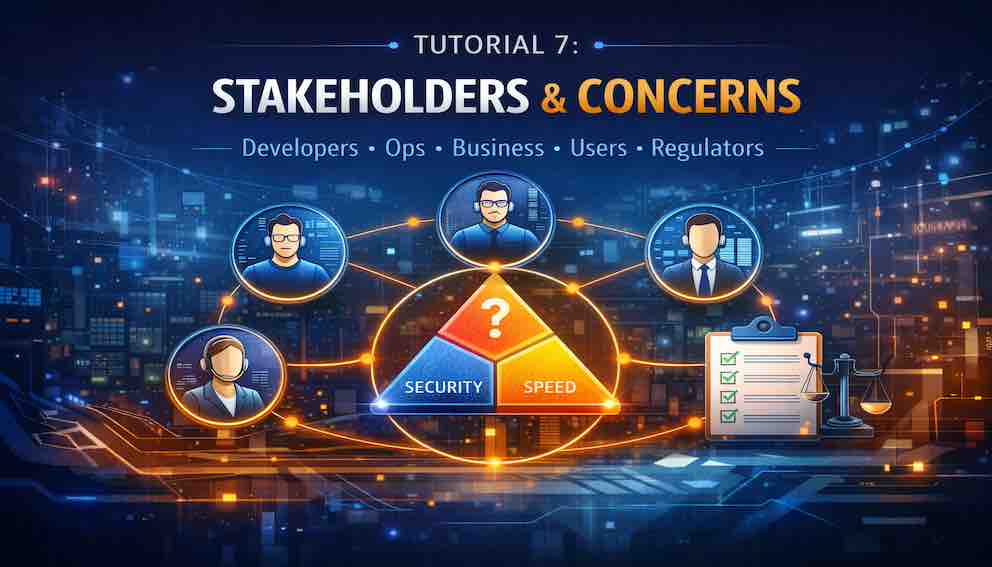
In this tutorial, we explore the human side of software architecture — identifying stakeholders, understanding their concerns, and communicating decisions effectively. You will learn practical techniques like visual diagrams, Architecture Decision Records (ADRs), and narrative storytelling to align developers, operations teams, business sponsors, users, and regulators.
When Architecture Fails Without Stakeholder Awareness
Let me tell you about a project I will call Stratus.
Stratus was a large-scale cloud migration for a financial services company. The architects were excellent — experienced, principled, and technically sound. They designed for scalability, security, and modularity. On paper, Stratus was a model of modern architecture. But it never delivered on its promise.
The migration was delayed by six months and overran its budget by millions. When it finally launched, it was met with quiet resistance from the very people who were supposed to use it.
Developers found the platform alien — unfamiliar patterns, different tooling, no ownership. Operations discovered the elegant deployment pipeline had no rollback mechanism. Compliance officers, brought in late, found audit logging gaps that took weeks to fix. Stratus worked technically. It failed where it mattered most: in the hands of the people who had to live with it.
What the architects could have done differently required no extra budget — only the belief that talking to developers, operations, and compliance early was part of the architect's job.
This is the lesson. Architecture does not exist in a vacuum. Ignoring the people in it is not just a social mistake. It is an architectural mistake.
Who Are Stakeholders, Really?
Stakeholders are people with hopes, fears, incentives, and histories. They will shape your architecture whether you engage with them or not. The only question is whether that shaping will be collaborative or adversarial.
Developers say they care about maintainability and tooling. Beneath that, they care about agency — understanding why decisions are made, not just executing them. An architecture imposed without explanation creates resentment, and resentment surfaces as workarounds, shortcuts, and quiet erosion of integrity.
Operations teams say they care about reliability and observability. Beneath that, they carry the weight of production — the pain of systems that cannot be debugged, deployments that cannot be rolled back. They have long memories and will resist future changes from architects who caused their sleepless nights.
Business sponsors say they care about timelines and ROI. Beneath that, they carry accountability — explaining to executives why projects are late. When architects dismiss business concerns as "not technical," that pressure does not disappear. It returns as budget cuts and scope reductions.
Users say they care about usability and performance. Beneath that, they have jobs to do. Software that adds friction is threatening. Users who cannot work because of your architecture will find ways around it: shadow IT, spreadsheets, manual workarounds that undermine everything you designed.
Regulators and compliance teams say they care about data privacy and auditability. Beneath that, they carry risk — their names appear in audit reports, they face the fines. Treat compliance as a checkbox and they will push back hard, with the power to stop releases entirely.
Technique: When a stakeholder states a concern, ask why it matters, then why that matters — repeat until you reach a human need: safety, recognition, control, rest, career preservation. Your architecture may be able to address that need directly.
The Map of Power and Influence
Stakeholders are not equal. Understanding their power is essential to navigating it.
- Formal authority — can say yes or no, control budgets, kill projects. Typically business sponsors and executives.
- Implementation power — cannot stop a project but determine whether it succeeds through daily work. Developers and operations teams. You cannot force them to build something well; you can only earn their commitment.
- Blocking power — cannot make things happen but can prevent them. Compliance and security teams.
- Influence without authority — cannot decide or block, but shape opinions. Senior engineers and trusted analysts whose support or skepticism ripples through the organisation.
A common mistake is focusing on formal authority — getting the right signature — while underestimating implementation power. A business sponsor can approve an architecture that developers quietly undermine over eighteen months. Getting sign-off is not the same as building commitment.
The Invisible Stakeholders
Some stakeholders are not in the room when decisions are made. They may not know the project exists.
The developer who joins in two years and inherits your decisions. The operations person on call during the holiday weekend when something fails. The customer who cannot attend your workshops but can take their business elsewhere. The downstream service whose API contract depends on choices you make today.
Invisible stakeholders are easy to ignore because they are not pushing back. But ignoring them creates architectural debt that someone else pays.
Good architects ask: who is not in this conversation? In practice, this means reviewing decisions through the lens of the on-call engineer at 3 a.m., the developer hired eighteen months from now, and the customer who simply needs the system to work.
The Architect as Stakeholder
There is one stakeholder who rarely appears in stakeholder analyses: you.
Architects have their own incentives, career pressures, and blind spots. Watch for these patterns:
- Resume-driven architecture — choosing technologies because they look good on a CV, not because they serve the system.
- Avoidance of the difficult stakeholder — not engaging the compliance officer or skeptical developer because those conversations are uncomfortable.
- Premature closure — reaching a conclusion and then consulting stakeholders, rather than genuinely involving them.
- Asymmetric candour — being honest with technical peers while softening the picture for business sponsors.
The antidote is not self-criticism but self-awareness. Ask a trusted colleague to name your architectural blind spot. Their answer will be uncomfortable and useful.
Discovering Stakeholders You Don't Know You Have
Ask about escalation paths. Ask each stakeholder: who do you escalate to, and who escalates to you? The answers reveal real organisational power that does not appear on org charts.
Trace your data flows. Every destination is a stakeholder. Every source is a stakeholder. Data flows reveal dependencies, and dependencies reveal people.
Ask what could go wrong. Imagine a serious incident eighteen months from now. Who is on the call? Whose name comes up? That cast of characters is your stakeholder list.
Surface blind spots proactively. A compliance officer may not realise a microservices architecture multiplies audit surface area. A business sponsor may not know a tight deadline means cutting monitoring infrastructure. Bringing a problem to a stakeholder before it becomes a crisis is one of the most trust-building things an architect can do.
Stakeholder Alignment Across the Lifecycle
Stakeholder engagement is not a phase — it is a practice. Treating it otherwise means your architecture accumulates social debt alongside technical debt.
At project initiation — identify stakeholders, map their power, build relationships, and agree on the architectural principles that will serve as neutral ground when conflicts arise.
During design and build — share decisions before they are final. ADRs should record who was consulted and what they said, not just who was notified. Revisit your stakeholder map when scope changes or new people join.
At launch and after — the post-launch period is when invisible stakeholders become visible. Treat the first few months in production as an extended stakeholder discovery exercise.
On stakeholder fatigue — over-consulting is a real failure mode. The goal is not consensus on every decision but the right people consulted at the right moments. A stakeholder consulted on everything eventually stops engaging.
Communicating Architecture to Stakeholders
Different stakeholders need different views of the same architecture.
- Developers — component and sequence diagrams showing boundaries, interfaces, and data flows.
- Operations — deployment and infrastructure diagrams showing what runs where and what happens when it fails.
- Business sponsors — system overviews and capability maps showing what business value the system enables.
- Regulators — data flow and security diagrams showing where sensitive data lives and how it is protected.
Architecture Decision Records are a gift to future stakeholders. An ADR captures not just what was decided, but why — context, options considered, rationale, and consequences. A useful structure: Title, Status, Context, Options considered, Decision, Consequences, Stakeholders consulted, and — critically — Dissent recorded. When a stakeholder's concern was heard but overruled, documenting that prevents the same argument resurfacing two years later and signals that input is taken seriously even when it does not determine the outcome.
Narrative explanations build trust. A story of how you arrived at a decision — the constraints, the trade-offs, the concerns addressed — makes stakeholders more likely to support an outcome even when it was not their preferred option.
When Stakeholders Conflict
Conflicts are inevitable. The skill is navigating them constructively rather than suppressing them.
When a developer wants an elegant new framework and an operations lead fears the on-call burden, both are right. The resolution is not declaring one side wrong but finding a path that addresses both — a monitoring investment first, a pilot service, a slower adoption curve. The key is making the trade-off explicit and shared.
When a business sponsor needs a market deadline and a compliance officer needs more time for a security audit, resolution might mean a partial launch, temporary controls, or escalating it explicitly as a documented business risk decision.
Principles as neutral ground. When stakeholders conflict, architectural principles provide a framework beyond whose power is greater. If the agreed principle is "Security is non-negotiable," the market deadline cannot override compliance. Principles make the decision about shared values, not personal preferences — and that makes it significantly easier for stakeholders to accept outcomes they dislike.
A Story of Stakeholder Alignment
A healthcare company needed to build a patient portal. The architects started not with diagrams, but with conversations — developers on past frustrations, operations on what kept them up at night, compliance on what auditors actually asked for in practice, business sponsors on what success meant to them personally.
They built a stakeholder map as a living document, revisited throughout the project. When the compliance lead was replaced three months in, they ran fresh conversations rather than assuming the new person shared the same concerns. ADRs were shared before decisions were finalised. Overruled concerns were documented and communicated directly.
When the system launched, it worked — not just technically, but organisationally. And eighteen months later, when a developer who had never attended a stakeholder meeting asked why a design choice had been made, there was an ADR that told the whole story.
Practical Exercise: Mapping Your Stakeholders
This takes about an hour. It will change how you see your project.
- List every stakeholder — who builds it, runs it, pays for it, uses it, regulates it, and inherits it. Include the systems integrating with yours.
- Map power and concerns — formal authority, implementation power, blocking power, or influence. Surface concerns and underlying concerns.
- Trace escalation paths — who does each stakeholder escalate to, and who escalates to them? This reveals hidden power.
- Identify invisible stakeholders — who is affected but not in the room? Who is on call over the holidays? Who joins the team in year two?
- Apply the lens to yourself — add yourself to the map. Ask a trusted colleague about your blind spots.
- Plan one engagement — pick a stakeholder you have under-engaged. Have a conversation, not a presentation. Listen. Update your map.
Stakeholder Engagement Checklist
- All stakeholder groups identified, including invisible ones
- Power type and underlying concerns mapped for each
- Escalation paths traced to surface hidden stakeholders
- Architect's own motivations and blind spots acknowledged
- ADRs written for significant decisions, with stakeholders consulted and dissent recorded
- Stakeholder map reviewed when scope or personnel changes
- Communication tailored to each stakeholder audience
- Conflict resolution references shared principles, not personal authority
Conclusion: Architecture Is Human Work
We began with Stratus — a project that failed not because of bad technology, but because of neglected people.
Architecture is technical work. But it is also human work. It requires understanding who will build the system, who will run it, who will pay for it, who will use it, and who will inherit it. Stakeholders are not obstacles to be managed. They are partners with knowledge you do not have, concerns you cannot anticipate from a conference room, and power that will shape your architecture whether you engage with it or not.
The architect who cannot bring people with them is not an architect. They are a theorist.
About N Sharma
Lead Architect at StackAndSystemN Sharma is a technologist with over 28 years of experience in software engineering, system architecture, and technology consulting. He holds a Bachelor’s degree in Engineering, a DBF, and an MBA. His work focuses on research-driven technology education—explaining software architecture, system design, and development practices through structured tutorials designed to help engineers build reliable, scalable systems.
Disclaimer
This article is for educational purposes only. Assistance from AI-powered generative tools was taken to format and improve language flow. While we strive for accuracy, this content may contain errors or omissions and should be independently verified.