
Learning Paths
Last Updated: March 19, 2026 at 17:30
Clean Architecture: Designing Software Around What Actually Matters
Understanding how to organize software around business rules and use cases while ensuring that dependencies always point inward toward the domain
Clean Architecture is a software design approach that organizes applications around core business rules while ensuring that dependencies always point inward toward the domain logic. Introduced by Robert C. Martin, this architecture emphasizes the Dependency Rule, which prevents business logic from depending on frameworks, databases, or external systems. Instead, applications are structured around use cases that represent real user behavior. This separation makes systems easier to maintain, easier to test, and more resilient to technology changes. In this tutorial, we explore how Clean Architecture works, why the dependency rule is so powerful, how it relates to other architectures like Hexagonal and Onion, and the practical implementation considerations, testing strategies, and common pitfalls that architects must understand to apply this pattern effectively
Why Software Systems Become Fragile
Most software starts life feeling clean and manageable. There are sensible folders, clear separation between components, and a team that knows where everything lives. Adding new features feels natural. The codebase makes sense.
Then, slowly, it doesn't.
Business logic starts appearing in places it was never supposed to live. Controllers that were meant to handle incoming requests begin accumulating decision-making code. Database queries surface inside display layers. Framework-specific annotations — decorators that tie your objects to a particular library or tool — spread across the codebase like ivy. External services become woven into the core logic so deeply that you can't test one without invoking the other.
None of this happens because developers are careless. It happens because software systems, left without strong structural rules, naturally drift toward entanglement. Every shortcut taken under deadline pressure, every "I'll tidy this up later" decision, every convenience method that reaches across a boundary — these accumulate into something that resists change.
The cost shows up in familiar ways. Changing your database technology requires rewriting dozens of classes. Replacing a web framework forces you to touch business logic that should have nothing to do with HTTP. Testing core rules becomes an ordeal involving spinning up databases and configuring network calls, so developers test less thoroughly than they should. Adding a new feature means archaeologically digging through layers of intertwined concerns to find where the new code should go.
Architects eventually recognized that the root problem wasn't complexity itself — it was the direction of dependencies. The most important parts of a system — the business rules — were depending on the least stable parts — the infrastructure, the frameworks, the external tools. The stable was being held hostage by the volatile. Clean Architecture, introduced by Robert C. Martin, was designed to correct exactly this.
The Core Idea: What Should Depend on What
Before getting into the structure of Clean Architecture, it's worth sitting with the fundamental insight that makes it work.
In most traditional systems, the business logic depends on the database, the web framework, and the external services. If you want to test whether an order can be placed, you have to connect to a real (or realistic fake) database, configure a payment service, and spin up enough infrastructure to make the test possible. The business logic — the most important thing — can't stand on its own.
Clean Architecture inverts this. The business rules sit at the center, and they depend on nothing external. Instead, everything else depends on them. Databases, frameworks, and external services are all treated as implementation details — useful, necessary, but replaceable.
Robert Martin puts it memorably: the domain should be able to run without a database, without a web server, without any external system. You should be able to verify your entire business logic using nothing but plain objects in memory.
This independence is the whole point. It's what makes the system clean.
The Dependency Rule
The single rule that holds Clean Architecture together is known as the Dependency Rule:
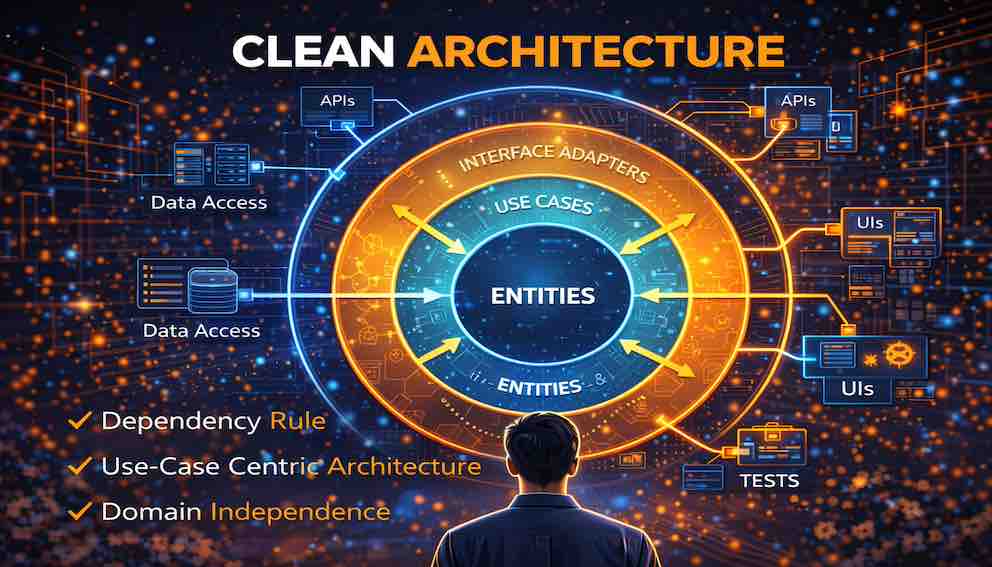
Source code dependencies must always point inward.
Nothing in an inner layer can know anything about an outer layer. Inner layers are completely unaware that outer layers exist. The flow of dependency always moves toward the center — toward the domain.
What this means in practice:
- The core business rules know nothing about databases, frameworks, or external services.
- The application use cases know nothing about web controllers or UI components.
- The components that translate between the core and the outside world know nothing about the specific technologies used at the outermost layer.
The outer layers, however, can freely depend on the inner ones. A web controller can call a use case. A use case can invoke an entity. A database adapter can implement an interface defined by the core.
This sounds like a small rule. The consequences are profound.
Because the domain never reaches outward, it never becomes tangled with things that change frequently. Frameworks are upgraded; the domain is untouched. The database schema evolves; the domain is untouched. The UI is redesigned; the domain is untouched. The business rules — which represent the actual value of the system — remain stable while everything else can shift around them.
The Four Layers
Clean Architecture is typically visualized as concentric circles, like rings around a core. Each ring represents a layer with specific responsibilities. Moving from the center outward, the layers are: Entities, Use Cases, Interface Adapters, and Frameworks and Drivers.
Entities: The Heart of the System
At the very center are Entities — the fundamental business objects and the rules that govern them. These are the most stable things in the entire system, the things that would still be true about your business even if you replaced every line of code.
In a banking system, an entity might represent an account, and it would contain the rules governing that account: how interest is calculated, what constitutes an invalid transaction, the conditions under which an account can be closed. In an e-commerce system, an order entity would know things like: an order cannot be submitted without items, the total must reflect the sum of its parts, a shipped order cannot be cancelled.
These rules exist at the level of business reality. They don't belong to a particular technology, and they don't change when you upgrade your framework. The math behind compound interest is centuries old. The rules for what constitutes a valid order are stable across years.
Crucially, entities are not just data containers. They are not objects with only getters and setters sitting passively until something else acts on them. They contain behavior — the enforcement of business invariants, the protection of their own consistency. An entity should be able to protect itself from being put into an invalid state.
Entities should have zero knowledge of how they're stored, how they're displayed, or what frameworks are used around them.
Use Cases: Application Behavior
The next layer outward contains Use Cases — also sometimes called interactors or application services. If entities define the fundamental truths of the business, use cases define what the application actually does.
A use case represents a specific, meaningful action the system can perform: placing an order, transferring funds, registering a new user, generating an invoice, cancelling a subscription.
Each use case orchestrates entities and coordinates with external systems (through interfaces) to accomplish a task. A "place order" use case might validate a customer's cart, calculate the order total, create the order, reserve inventory, initiate payment, and send confirmation — all as a single coherent flow.
What makes use cases work architecturally is what they don't do: they don't touch a specific database, they don't call a specific payment gateway, they don't know what web framework is being used. Instead, they define what they need — a way to store orders, a way to process payments, a way to send notifications — through interfaces. Those interfaces belong to the use case layer. The implementations live further out.
This is dependency inversion in action. The use case defines the contract; the outer layers fulfil it. The use case never reaches outward to find what it needs. What it needs comes to it, from outside, through the interfaces it defines.
Interface Adapters: The Translation Layer
The next layer outward is the Interface Adapters layer. This layer acts as a translator between the outside world and the application core.
External systems communicate in formats and protocols that don't necessarily match the internal structure of the application. A web request arrives as JSON. A database returns rows. A third-party API responds with its own data structures. None of these formats belong in the core. The interface adapter layer handles the conversion.
This layer includes:
Controllers — which receive incoming requests (from users, from APIs, from message queues), extract the relevant data, convert it into a format the use case understands, and invoke the appropriate use case. After the use case completes, the controller takes the result and converts it back into whatever format the caller expects.
Repository implementations — which implement the data access interfaces defined by the use cases. The use case says "I need to find an order by ID." The repository implementation in the adapter layer handles the actual SQL, or ORM call, or API request to a storage service.
Gateway implementations — which implement interfaces for external services. The payment gateway interface is defined in the use case layer; the Stripe or PayPal implementation lives here.
Presenters — which take the output from use cases and format it for display, converting domain objects into view models appropriate for the UI.
Because all external communication is mediated by this layer, swapping technologies becomes isolated. Moving from REST to GraphQL? Update the controllers. Changing databases? Update the repository implementations. The use cases and entities are never involved.
Frameworks and Drivers: The Outermost Layer
The outermost layer contains the actual technologies: web frameworks, database systems, messaging platforms, UI libraries, external APIs. This is where all the tools live.
In traditional architectures, these technologies form the foundation. Everything is built on top of them, and they shape everything above them. Clean Architecture deliberately reverses this relationship.
Frameworks and drivers become replaceable details rather than central pillars. They sit at the edge of the system, implementing interfaces defined by inner layers, adapting to the needs of the core rather than dictating to it.
This doesn't mean these technologies are unimportant — they're essential for the system to run. It means they don't get to influence the business rules. The domain owns its own shape.
Use-Case Centric Design
One of the most practical ideas in Clean Architecture is organizing code around use cases rather than around technical patterns.
The typical project structure groups code by what kind of thing it is: controllers together, services together, repositories together. This is familiar and feels organized — but it hides what the system actually does. Looking at a folder called "services" tells you nothing about the application's purpose.
Clean Architecture encourages a different organization: group code around what the system does. A "place order" folder contains everything needed for placing an order. A "cancel subscription" folder contains everything for that operation. The structure of the code reveals the behavior of the system.
This approach has real benefits. A new developer can understand what the system does by reading use case names. When a business requirement changes, it's usually clear which use case is affected. Testing a specific capability means testing a specific use case in isolation. The architecture itself becomes a form of documentation.
How This Transforms Testing
The testability benefits of Clean Architecture deserve particular attention because they're so tangible and immediate.
In a system where business logic is tangled with infrastructure, testing core rules is hard. You need a database, possibly a running server, network connectivity, configured external services. Tests are slow, brittle, and expensive to write. Developers test less than they should, and when they do test, the tests are testing infrastructure behavior as much as business behavior.
Clean Architecture changes this completely. Because the core depends only on interfaces — not on concrete implementations — you can substitute any external dependency with a simple in-memory version for testing. A fake repository that stores orders in a list. A fake payment gateway that returns whatever result the test needs. A fake email service that just records what messages were sent.
With these substitutes in place, you can test every business scenario — including edge cases that are painful to reproduce with real infrastructure — in milliseconds. No database setup. No network calls. No flaky tests due to external service behavior.
The result is a test suite that runs fast, fails for the right reasons, covers edge cases thoroughly, and gives developers genuine confidence. Teams working with Clean Architecture typically describe this as one of its most immediately valuable properties.
Relationship to Other Architectural Approaches
Clean Architecture didn't emerge from nowhere. It synthesized and clarified ideas that had been developing across the industry for years.
Hexagonal Architecture (Ports and Adapters), introduced by Alistair Cockburn, shares the same fundamental insight: the application core should be isolated from external systems through clearly defined interfaces (ports), with adapters translating between the core and the outside world. Clean Architecture and Hexagonal Architecture are close relatives. Clean Architecture gives more explicit attention to layers and to organizing around use cases; Hexagonal Architecture emphasizes the port-adapter metaphor more centrally. Many teams draw on both.
Onion Architecture, introduced by Jeffrey Palermo, is structurally very similar to Clean Architecture — concentric layers with dependencies pointing inward, domain at the center. The principles are largely the same; the terminology differs slightly. Teams sometimes use the names interchangeably.
Domain-Driven Design (DDD) is highly compatible with Clean Architecture and the two are often used together. DDD provides rich tools for modeling complex business domains — entities, value objects, aggregates, domain events, bounded contexts. Clean Architecture provides the structural container that keeps those domain models isolated and protected. The entities layer in Clean Architecture is the natural home for a DDD domain model.
Traditional Layered Architecture — with presentation at the top, then application logic, then domain, then infrastructure at the base — sounds similar but has a critical difference: the domain layer depends on the infrastructure layer below it. Business logic depends on database technology. Clean Architecture inverts this, making the domain the independent center rather than the dependent middle.
The Real Advantages
When applied consistently, the benefits of Clean Architecture compound over the lifetime of a system.
Technology independence is perhaps the most valuable property. Because business logic doesn't depend on frameworks, databases, or external services, those technologies can be upgraded, replaced, or augmented without touching the core. This matters most over years, as technologies evolve and new options emerge.
Testability, as discussed, is dramatically improved. The whole business logic becomes verifiable in isolation, quickly and reliably.
Long-term maintainability follows from both of the above. The most important code — the business rules — lives in a protected, stable layer. New developers can learn the system by studying use cases rather than reverse-engineering tangled concerns. Changes to one part of the system don't ripple unpredictably into others.
Parallel development becomes easier. With clear interfaces between layers, different team members can work independently. Frontend developers can build UI adapters against agreed interfaces while backend developers build use cases. Infrastructure work doesn't block domain work.
Delayed technology decisions are also possible. You can develop and test substantial amounts of business logic before committing to a specific database or framework. The interfaces define what you need; you choose concrete implementations when you're ready.
The Real Trade-Offs
Clean Architecture is not universally appropriate, and being honest about its costs matters.
More code. The architecture introduces layers and interfaces that don't exist in simpler approaches. Every external dependency needs an interface. Data crossing layer boundaries often needs to be converted. For simple operations, this can feel like a lot of ceremony.
Learning curve. Concepts like dependency inversion and interface-based design require genuine understanding to apply well. Teams unfamiliar with these ideas will find the architecture confusing before they find it useful.
Slower initial development. In the early stages of a project, you're building abstractions before you're sure you need them. This is deliberate — the architecture trades short-term speed for long-term resilience — but it's a real cost, especially when validating a new idea.
Discipline is required to maintain it. The architecture only works if developers consistently respect the dependency rule. Shortcuts — a use case that imports a framework class, an entity with database annotations, a controller with business logic — are easy to justify in the moment and corrosive over time. Without ongoing attention and code review, the boundaries erode.
Risk of anemic domain models. It's possible to build all the correct layers and still have a weak, unhealthy core. If entities become passive data containers and use cases contain all the logic, you've created what's called an anemic domain model — data without behavior. The architecture's protective structure is there, but the valuable thing being protected is hollow. Real business rules should live in entities, enforced by those objects themselves.
When to Use It (and When Not To)
Clean Architecture fits best in systems with long lives, complex business rules, and teams committed to maintaining architectural boundaries. Enterprise applications, financial systems, platforms that will evolve across many years — these are natural candidates. If you're applying Domain-Driven Design, Clean Architecture provides an ideal structural container.
It fits less well in small or simple applications where the complexity of the architecture exceeds the complexity of the problem. Prototypes and MVPs, where the goal is fast learning rather than sustainable structure, don't benefit from the overhead. Teams early in their software development journey may find the concepts overwhelming before they find them useful.
The honest answer is that most applications start simpler than they end up, and many systems that begin as "small" grow into something where architectural discipline would have paid off. The judgment call — when to invest in structure and when to stay simple — is one of the core skills of software architecture.
Avoiding Common Pitfalls
Several failure modes appear repeatedly when teams try to adopt Clean Architecture.
Letting infrastructure into the core. This is the most common violation. Database annotations appearing on domain objects, use cases throwing framework-specific exceptions, core classes importing adapter libraries. The fix is to enforce that the core has no dependencies on external libraries, and to automate that enforcement with architectural testing tools that run as part of the build.
Anemic domain models. All the logic ends up in use cases; entities are just data bags. The architecture's shape is correct but its content is wrong. Business rules should live in domain objects, enforced by those objects. Use cases should orchestrate; entities should defend their own integrity.
Over-abstracting simple things. Not every operation needs a full use case with formal interfaces. Simple read operations might not benefit from the ceremony. The architecture should serve the software, not the other way around. Pragmatism matters.
Boundary violations under pressure. Shortcuts accumulate into structural debt. When the deadline looms and the clean solution takes longer, the temptation to violate a boundary is real. Treat boundary violations as technical debt: acknowledge them explicitly, document them, and plan to address them. Don't let them become invisible.
Organizing around technology rather than behavior. Structuring code by layer type (all controllers together, all services together) rather than by use case makes it harder to understand what the system does and easier for concerns to bleed across boundaries.
The Enduring Principle
Clean Architecture is ultimately an expression of a simple value: the most important parts of a system — the business rules — should be protected from the things most likely to change.
Frameworks rise and fall. Databases evolve. External services come and go. UI paradigms shift. What remains relatively stable, what represents the actual value of a software system, is the business logic — the rules and decisions and calculations that reflect how the business actually works.
Architecture is about protecting that. Every boundary you draw, every dependency you redirect, every interface you define is a small act of protection. The goal is a system where the core business rules can be understood, tested, and evolved independently of the technological infrastructure that surrounds them.
In a world where technology changes faster than ever, that kind of structural protection isn't just good architecture. For systems that need to survive and grow over many years, it's essential.
Key Takeaways
- Clean Architecture organizes software into concentric layers with the domain at the center and all dependencies pointing inward.
- The Dependency Rule is the foundational principle: source code dependencies must always point inward. Inner layers are completely unaware of outer layers.
- Entities contain core business rules that apply across the entire system. They are the most stable, long-lived parts of the application and should contain real behavior — not just data.
- Use Cases contain application-specific logic, orchestrating entities to fulfill meaningful user actions. They define interfaces for what they need; outer layers provide the implementations.
- Interface Adapters translate between the application core and external systems. Changing a technology means changing an adapter, not the core.
- Frameworks and Drivers sit at the outermost layer and are treated as replaceable implementation details rather than foundational components.
- Use-case centric design structures the codebase around what the system does, making it discoverable, focused, and easier to change.
- Testability is dramatically improved because the core can be exercised entirely in memory, without databases or external services.
- The architecture is closely related to Hexagonal Architecture (Ports and Adapters) and Onion Architecture, sharing the same core dependency-inversion principle.
- Real trade-offs include additional abstraction, a learning curve, and the ongoing discipline required to maintain boundaries.
- Best suited to complex, long-lived systems with valuable business logic. Less suited to small applications, prototypes, or teams new to these concepts.
- Common pitfalls include infrastructure leaking into the core, anemic domain models, over-abstraction, and boundary violations under deadline pressure.
- The architecture can be adopted incrementally in existing systems using patterns like the strangler approach.
- Architecture is ultimately an expression of values: Clean Architecture values the business domain above all else, and provides the structural means to protect it.
About N Sharma
Lead Architect at StackAndSystemN Sharma is a technologist with over 28 years of experience in software engineering, system architecture, and technology consulting. He holds a Bachelor’s degree in Engineering, a DBF, and an MBA. His work focuses on research-driven technology education—explaining software architecture, system design, and development practices through structured tutorials designed to help engineers build reliable, scalable systems.
Disclaimer
This article is for educational purposes only. Assistance from AI-powered generative tools was taken to format and improve language flow. While we strive for accuracy, this content may contain errors or omissions and should be independently verified.