Learning Paths
Last Updated: March 17, 2026 at 17:30
Service-Oriented Architecture (SOA): Reusable Services, Enterprise Integration, and Business Capabilities
Understanding how large organizations integrate disparate systems by exposing business functions as reusable services
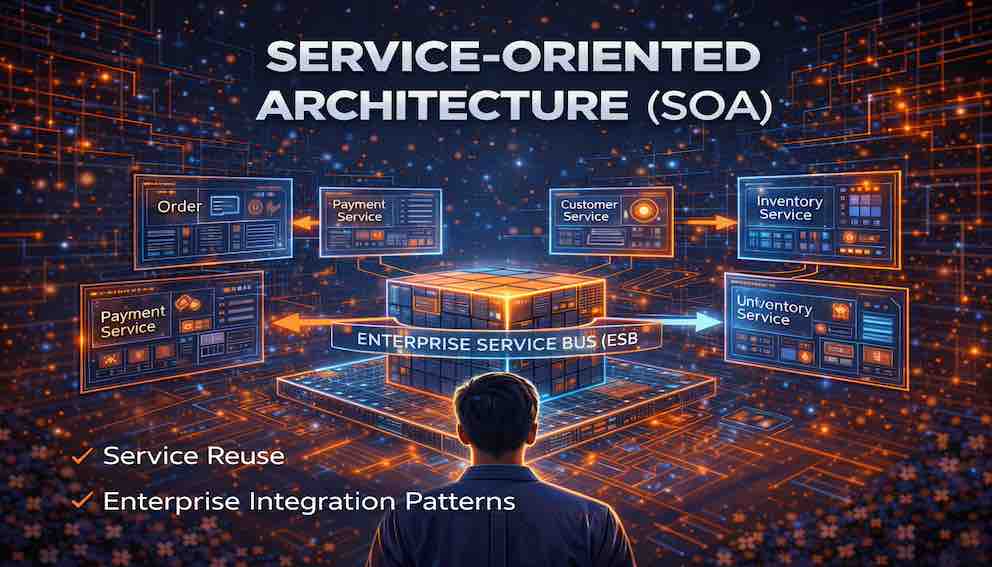
Service-Oriented Architecture, or SOA, is a way of designing software so that different applications across a large company can work together smoothly. Its core idea is to organize business tasks—like managing customers or processing payments—into shared, reusable services with clear contracts. While traditional SOA was often associated with a central hub called an Enterprise Service Bus (ESB), the principles of SOA are more important than any single technology. Today, organizations can achieve service-orientation using lighter tools, proving that the architectural style has outlasted the specific products once built to support it
The Enterprise Integration Problem
When developers first learn about software architecture, they often imagine a system as a single, contained application—perhaps a web server backed by a database. In small systems, this model works well. However, large enterprises rarely have the luxury of a single application. They accumulate systems over many years, built by different teams, in different eras, and using different technologies. A typical enterprise environment is a patchwork of CRM platforms, ERP systems, billing software, custom-built legacy applications, and more.
Despite their differences, these disparate systems must still work together. Consider a customer placing an order on an e-commerce website. This single action may require coordination across multiple systems: the order system records the purchase, the inventory system checks stock, the billing system processes the payment, and the shipping system schedules delivery. Each system owns a different piece of the same business process.
Without a structured integration strategy, these systems often become connected through ad-hoc, point-to-point integrations. System A calls System B, which sends data to System C, which then queries System D. Over time, this creates a complex, tangled web of dependencies that architects often call "spaghetti integration." Every new connection adds complexity, and changing one system risks breaking several others. Service-Oriented Architecture was designed specifically to untangle this mess.
What Is Service-Oriented Architecture?
At its core, SOA is an architectural style that structures an enterprise's software landscape around services. A service is a discrete unit of functionality that represents a specific business capability—such as managing customers, processing orders, or handling payments. Instead of applications directly accessing each other's databases or internal functions, they interact only through these well-defined, standardized interfaces.
This approach introduces a few key concepts. First, services are aligned with the business. A service is named and designed in terms that a business analyst would understand, such as "Customer Service" or "Payment Service," rather than technical terms like "Data Access Layer." This alignment makes the architecture more intuitive and closely tied to the company's actual operations.
Second, and perhaps most importantly, services are designed to be reusable. Instead of every new application building its own logic for finding a customer or processing a payment, that capability is built once and exposed as a shared service. The company's website, mobile app, internal reporting tool, and partner portal can all use the same, single Customer Service. This reduces duplication, ensures consistency, and guarantees that every part of the business works with the same data and follows the same rules.
The Pillars of SOA: Contracts and Data
For this vision of reusable services to work in practice, SOA relies on several critical components that go beyond simply creating an API.
The Service Contract
For a service to be truly reusable, it needs more than just a URL; it needs a formal agreement known as a service contract. Think of it as a legally binding promise between the service provider and its consumers, but in technical form. This contract is the foundation upon which all successful SOA implementations are built.
So, what exactly does a service contract specify? It typically covers several key areas. It defines the operations available—for example, a Payment Service might offer processPayment, refundPayment, and getTransactionStatus. It specifies the data formats expected for requests and responses, such as the structure of a JSON object or an XML document. It outlines the communication protocols that must be used, like HTTP, HTTPS, or AMQP. Finally, it may also detail the quality of service guarantees, such as expected response times, availability, or security requirements like authentication.
In traditional SOA, these contracts were often defined using verbose, machine-readable languages like WSDL (Web Services Description Language) for SOAP-based services. WSDL files were complex, but they allowed developer tools to automatically generate client code to talk to a service, ensuring strict adherence to the contract.
Today, the concept of a service contract is more important than ever, but the implementation has become much lighter. In modern architectures, an OpenAPI specification (formerly known as Swagger) serves a similar purpose for RESTful APIs. It is a human-readable and machine-readable document that describes every aspect of an API: available endpoints, operation parameters, authentication methods, and data models. Similarly, GraphQL uses a schema to define the types and queries a client can request, acting as a contract between the client and the server. Even asynchronous, event-driven architectures use contract formats like AsyncAPI to document events and message structures.
The contract serves a crucial purpose regardless of the format: it decouples the consumer from the provider's internal implementation. As long as the service continues to honor its contract, the team maintaining it is free to change the underlying code, upgrade the database, or fix bugs without breaking the applications that depend on it. This stability is the foundation of service reuse and independent evolution. The consumer only needs to know the contract, nothing more.
The Challenge of Different Data Formats
One of the biggest practical hurdles in enterprise integration is that different systems represent the same business concepts in completely different ways. One system might store a customer ID as custId, another as customer_number, and a legacy mainframe might use a fixed-width field called CUST-ID. Their address formats, date formats, and naming conventions will likely differ as well.
If you have ten systems, and each one needs to talk to the others, you end up writing dozens of one-off translations. System A has to learn how to translate its data for System B, then a different translation for System C, and so on. This approach does not scale. It creates a maintenance nightmare where every change to one system risks breaking its translations with many others.
A Practical Approach: Agreements, Not Mandates
To avoid this chaos, SOA introduces the idea of a shared understanding of data. The goal is to reduce the number of translations each system has to perform. Instead of every system translating to every other system, you aim for a situation where each system only needs to translate to and from a common format.
However, this does not have to mean a massive, company-wide data committee dictating a single model for everything. In practice, successful organizations take a more incremental and pragmatic approach. They start by establishing shared data agreements for the most critical business entities—Customer, Order, Product, Payment—only where integration is actually needed. Two teams building a new workflow might agree on a simple, shared JSON structure for the order data they exchange. Over time, as more integrations occur, these agreements can evolve and be reused.
The key insight is that the translation work has to happen somewhere. Either each consumer learns to speak the provider's language, or the provider learns to speak a common language, or a middleware layer handles the translation. The canonical data model is simply the concept of having a shared target language. How strictly you enforce it, and how broadly you apply it, depends on the organization's needs and its willingness to coordinate. The most successful approaches start small, focus on high-value integrations, and let the shared model grow organically as trust and collaboration between teams develop.
Connecting Services: Modern Integration Approaches
Once you have services with clear contracts, you need a way for them to find and communicate with each other. This is the integration layer, and how you build it determines the flexibility, reliability, and complexity of your entire system. Today, organizations mix and match several integration patterns depending on what they are trying to achieve.
Direct Synchronous Calls (Request-Response)
The simplest approach is for services to call each other directly over HTTP. This is common for request-response interactions where an answer is needed immediately.
Example: A web application needs to display a user's profile. It calls the CustomerService directly at GET /customers/{id} and waits for the JSON response. This is simple, easy to debug, and works well for many scenarios. However, it creates a synchronous dependency. If the CustomerService is slow or down, the web application is affected immediately.
Asynchronous Messaging
For operations that do not require an immediate response, or where reliability and decoupling are priorities, services can communicate asynchronously by sending messages through a broker. The sender does not wait for a reply, allowing both systems to operate independently. This pattern takes two common forms.
Queues (Point-to-Point): A message is placed into a queue and consumed by a single receiver. This is useful for distributing work or ensuring reliable processing.
Example: When a user places an order, the OrderService sends an "order placed" message to a queue. The FulfillmentService consumes the message, processes it, and marks it as done. If the FulfillmentService is temporarily down, the message waits safely in the queue until it recovers. No data is lost.
Publish-Subscribe (Broadcast): A message is published to a topic, and any number of interested services can subscribe to receive it. The publisher does not know or care who is listening.
Example: The CustomerService publishes a CustomerUpdated event whenever a user changes their address. The BillingService and MarketingService both subscribe to this topic. When the event fires, they update their own data independently. The CustomerService does not need to know about the billing or marketing systems at all.
API Gateways for Cross-Cutting Concerns
As the number of services grows, managing concerns like authentication, rate limiting, logging, and request routing becomes difficult if every client has to handle them individually. An API gateway sits at the edge of your system, acting as a single entry point for external clients. It routes requests to the appropriate internal services and applies cross-cutting policies consistently.
Example: A mobile app needs to fetch a user's order history and product recommendations. Instead of making two separate calls, it calls the API gateway once. The gateway calls the OrderService and RecommendationService in parallel, aggregates the results, and sends a single response back to the app. It also handles authentication for both services so they do not have to.
Service Mesh for Internal Communication
In more advanced deployments, particularly with microservices running in containers, a service mesh provides a dedicated infrastructure layer for handling service-to-service communication. It manages traffic, enforces policies, and collects telemetry without requiring changes to the service code.
Example: In a Kubernetes environment, a service mesh like Istio can enforce that all communication between the PaymentService and LedgerService is encrypted. It can also automatically retry failed requests and gradually shift traffic between versions during a deployment, all without touching the application code.
A Brief Note on the Enterprise Service Bus
During the height of SOA's popularity, a centralized integration product called the Enterprise Service Bus (ESB) became widely adopted. It was designed to handle routing, translation, and orchestration between services in one place. However, ESBs often became monolithic bottlenecks that concentrated too much logic and slowed down development. For this reason, modern architectures favor the decentralized patterns described above, reserving centralized components only for specific cross-cutting concerns like those handled by an API gateway.
Coordinating Services: Orchestration vs. Choreography
When multiple services need to collaborate on a business process, there are two primary ways to coordinate them, and the choice between them has a profound impact on the system's design.
Orchestration relies on a central coordinator(which could be implemented as a service) to explicitly control the workflow. The orchestrator tells each service what to do and when. "First, call the Inventory Service. When it responds, call the Payment Service. If that succeeds, call the Shipping Service." This approach is analogous to a conductor leading an orchestra. The logic for the entire process lives in one place, making it relatively easy to understand, manage, and monitor. However, the central orchestrator can become a bottleneck and a point of failure, and the orchestration logic can grow into a complex, hard-to-maintain tangle.
Choreography, on the other hand, takes a decentralized approach. There is no central conductor. Instead, services react to events. The Order Service publishes an OrderCreated event. The Inventory Service, which subscribes to that event, receives it, reserves the stock, and publishes an InventoryReserved event. The Payment Service, listening for that event, then processes the payment. Each service is like a dancer who knows their part and simply reacts to the music and the other dancers around them. This approach is highly decentralized and avoids a single point of failure, but the overall business process becomes harder to see and debug, as it is now implicit in the chain of events flowing between independent services.
SOA in Practice: Principles, Pitfalls, and Practical Use
Having explored what SOA is, the natural question becomes: how do you actually use it? A common point of confusion is thinking of SOA as a specific technology, like SOAP web services or an ESB. In reality, SOA is an architectural philosophy—a way of thinking about how to structure software around business capabilities. The specific implementation can vary widely. SOAP, REST, gRPC, GraphQL, and message queues are all different ways of building service-oriented architectures. SOAP with its strict WSDL contracts represents the traditional, heavyweight approach. REST with OpenAPI offers a lighter, more web-friendly style. gRPC provides high-performance RPC for internal communication. Each is a valid implementation of the core SOA ideas: services, contracts, and reusability. Understanding this helps clarify that when we talk about SOA, we are talking about enduring principles, not obsolete technology.
Core Principles to Keep in Mind
If you are considering an SOA approach, these are the fundamental guidelines that separate a functional architecture from a chaotic one.
1. Standardized Service Contracts. This is the non-negotiable foundation of SOA. Services must adhere to a common set of design standards and communicate through a formal contract. This contract is a promise to the consumer about what the service does, what data it expects, and what will be returned. Whether you express that contract using WSDL for SOAP, OpenAPI for REST, or a Protocol Buffer definition for gRPC, the principle is the same. Without this, you do not have services; you simply have a collection of point-to-point integrations with different designs, making reuse nearly impossible.
2. Loose Coupling. Services should be designed to know as little as possible about each other. A consumer should only need to know the service contract—not where the service runs, what database it uses, or what programming language it was written in. This independence is what allows services to be changed, upgraded, or even replaced without triggering a cascade of changes across the enterprise.
3. Service Abstraction. Closely related to loose coupling is abstraction. A service hides its internal logic from the outside world. The outside world sees only the contract. This means you can fundamentally rewrite a service—fixing bugs, optimizing performance, or migrating to a new platform—as long as you continue to honor your existing contracts.
4. Service Reusability. A service should be designed from the start with the intention of being used by multiple consumers. This is perhaps the most difficult principle to execute. It requires thinking beyond the needs of a single application and designing a capability that can serve the entire organization. A well-designed Customer Service, for example, should be useful to the sales website, the mobile app, and the internal support dashboard alike.
5. Interoperability. This is the practical outcome of using standards. Because services communicate through standardized protocols and data formats, a service written in Java on a Linux server can be seamlessly consumed by an application written in C# on Windows. This was one of SOA's primary value propositions in the heterogeneous world of large enterprises.
The Benefits: Why You Would Use SOA
When implemented with discipline, SOA provides powerful advantages that are difficult to achieve with more monolithic or ad-hoc approaches.
- Business-Aligned Flexibility. Because services represent discrete business capabilities, the IT landscape can be reconfigured to meet new business needs by re-orchestrating existing services. If the company launches a new "buy online, return in-store" policy, the necessary services (Inventory, Order, Customer) likely already exist and simply need to be connected in a new workflow.
- Reduced Redundancy. Centralizing core logic into shared services eliminates the need for every new project to "reinvent the wheel." This reduces development costs and, more importantly, eliminates the data inconsistencies that arise when five different systems each maintain their own, slightly different version of the customer database.
- Improved Consistency and Compliance. In regulated industries like finance and healthcare, this is critical. With SOA, security, auditing, and logging can be enforced consistently across all service interactions, without requiring each individual application to implement its own compliant logic.
- Leveraging Legacy Investments. SOA excels at extending the life of legacy systems. You cannot always rewrite a decades-old mainframe, but you can wrap it in a service layer. This gives modern applications a clean, standardized way to interact with the legacy system without needing to understand its archaic internal workings.
The Drawbacks: How Not to Use SOA
For every success story, there is a cautionary tale of an SOA initiative that collapsed under its own weight. These are the most common traps.
- The Centralized Monolith. This is the most frequent mistake. Architects, aiming to centralize integration, end up putting everything into a single piece of infrastructure—whether an ESB, an API gateway, or a custom integration layer. Routing, transformation, business logic, and orchestration all get baked into this one component. Over time, it becomes a new, centralized monolith: a single point of failure, a performance bottleneck, and a development nightmare because every change requires modifying this one massive system.
- Bureaucratic Governance. SOA requires governance, but it should not become a roadblock. When it takes longer to approve a service than to build it, the architecture has failed. Governance should enable reuse, not prevent progress.
- The Distributed Monolith. This is a subtle but deadly trap. You may deploy many separate services, but if they are all tightly coupled—meaning a change in one service requires a coordinated change in several others—you have built a monolith that is simply spread across many servers. You get all the complexity of a distributed system (network latency, partial failures) with none of the benefits of independent deployability.
- Granularity Confusion. How big should a service be? There is no single right answer, but getting it wrong causes problems. Services that are too coarse-grained (e.g., a single "ERP Service" that does everything) become monolithic and defeat the purpose of separation. Services that are too fine-grained (e.g., separate services for
GetCustomerFirstName,GetCustomerLastName) lead to "chatty" integrations with excessive network calls and poor performance. - Shared Database Coupling. This is a violation of loose coupling that happens all too often. Two services might expose separate interfaces, but if they read and write to the same shared database, they are fundamentally coupled at the data level. A schema change in that database now requires coordinating changes across both services, completely negating the independence that SOA was meant to provide.
The Legacy of SOA: What We Keep, What We Leave Behind
SOA taught the industry lessons that remain relevant regardless of which architectural style you work in today.
What we keep: services should represent business capabilities; clear contracts enable decoupling; reusable services reduce duplication; integration requires structured approaches at scale; and governance matters, even if its form should be lightweight.
What we leave behind: the assumption that SOA requires heavyweight, vendor-driven standards; the idea of a single centralized point of control (whether an ESB or something similar); bureaucratic governance that slows development; shared databases between services; and mandatory service discovery infrastructure that added complexity without proportional value.
Modern architectures have taken the core ideas of SOA and made them more accessible, lightweight, and developer-friendly. The vocabulary—services, contracts, interfaces, business capabilities—remains. The implementation choices have changed substantially.
Summary and Conclusion
Service-Oriented Architecture represents a pivotal chapter in the story of software design. It emerged as a direct response to the chaos of "spaghetti integration" in large enterprises, offering a structured way to organize systems around reusable business services connected through formal contracts. Its key innovations—the service contract and the canonical data model—provided the discipline needed to manage complexity at scale. However, SOA also taught the industry hard lessons about the dangers of over-centralization and bureaucratic governance that can grind development to a halt.
The true value of SOA today is twofold. First, for architects working in large, heterogeneous, or highly regulated enterprises, its principles remain a powerful toolkit for taming complexity and integrating legacy systems. Second, for the rest of the industry, SOA provides the essential conceptual foundation upon which modern architectures like REST, microservices, and API-led design are built. Understanding SOA means understanding not just a historical technology, but the enduring challenges of software architecture itself: how to structure systems—and the organizations that build them—so that complexity can be managed, flexibility can be preserved, and business capabilities can evolve independently as the world around them changes.
About N Sharma
Lead Architect at StackAndSystemN Sharma is a technologist with over 28 years of experience in software engineering, system architecture, and technology consulting. He holds a Bachelor’s degree in Engineering, a DBF, and an MBA. His work focuses on research-driven technology education—explaining software architecture, system design, and development practices through structured tutorials designed to help engineers build reliable, scalable systems.
Disclaimer
This article is for educational purposes only. Assistance from AI-powered generative tools was taken to format and improve language flow. While we strive for accuracy, this content may contain errors or omissions and should be independently verified.