
Learning Paths
Last Updated: March 16, 2026 at 17:30
Architecture Drivers in Software Systems: The Forces That Shape Every Design Decision
How functional requirements, non-functional requirements, constraints, business priorities, and regulatory factors guide software architecture
Every software system is shaped by a set of forces that determine how it should be structured, how it should perform, and how it should evolve. These forces — known as architecture drivers — include functional requirements, non-functional requirements, system constraints, business priorities, and regulatory or compliance mandates. Understanding them is essential for making architectural decisions that align with both technical and business realities. This tutorial explores each type of driver in depth, using a single running example to show how they interact in practice. By the end, you should be able to identify architecture drivers in your own projects, reason about how they conflict, and anticipate the impact they will have on a system as it matures
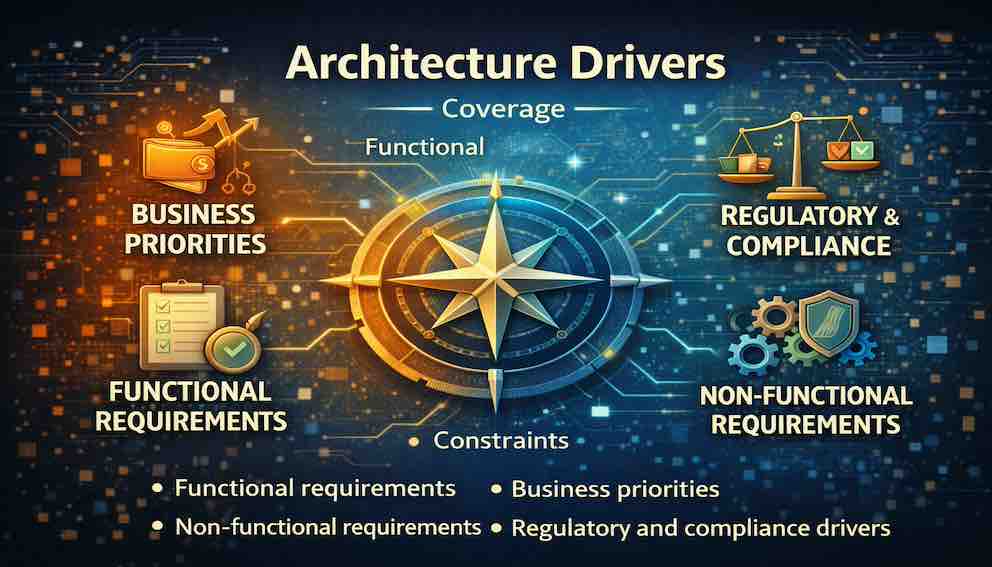
The Hidden Forces That Shape Every Software System
Before you choose a database, before you argue about microservices, before you write a single line of code—there's something more important you need to understand.
Every software system is shaped by invisible forces. They determine whether your architecture will flex or fracture as your system grows. They explain why two seemingly identical applications can end up looking completely different. And when ignored, they guarantee expensive rewrites and late nights you'll never get back.
Here's what nobody tells you about software architecture: it's not about technology at all.
The Mistake Almost Everyone Makes
Ask most teams how they start a project, and you'll hear the same thing: "We need to pick a database." "Should we use Kubernetes?" "Microservices or monolith?"
These are the wrong questions.
Technology is a solution. Architecture drivers—the actual forces shaping your system—are the problems those solutions must address. Pick technologies before understanding your drivers, and you're guessing. You might get lucky. You probably won't.
Think of it like city planning. A city built on a river develops differently than a city in a desert. A city facing rapid growth makes different infrastructure choices than one that's stable. The geography—the underlying forces—dictates everything that follows.
Your software has its own geography. Let's map it.
The Five Forces That Actually Matter
We're going to follow one example throughout: a company building a telemedicine platform. Patients see doctors online. Doctors manage schedules and prescriptions. Simple enough.
Except it's not simple at all. Every force below will push and pull this system in different directions. Watch how they interact.
Force 1: What the System Must Do
These are your functional requirements—the actual capabilities users need.
For telemedicine:
- Patients search for doctors by specialty and availability
- Patients book, reschedule, and cancel appointments
- Doctors conduct video consultations
- Doctors send electronic prescriptions to pharmacies
- Patients access their medical records
Each of these has structural implications. Search needs indexing. Booking needs concurrency control. Video needs low-latency streaming. Prescriptions need pharmacy integrations. Medical records need ironclad access controls.
Notice what we haven't mentioned yet: databases, frameworks, or deployment strategies. We're still understanding the problem.
Force 2: How the System Must Behave
Non-functional requirements (NFRs) describe quality attributes: performance, security, availability, scalability. This is where things get interesting.
For telemedicine:
- 99.9% availability—patients need care at any hour
- Under 200ms latency for video—poor quality undermines consultations
- Handle 10x current load within two years—telemedicine adoption is exploding
- All patient data encrypted at rest and in transit
- No double-booked appointments—ever
- Every medical record access logged for compliance
Here's the problem: these requirements fight each other. High availability conflicts with strong consistency. Performance optimization complicates audit logging. Security controls add latency.
Good architecture doesn't pretend these conflicts don't exist. It navigates them.
Force 3: The Boundaries You Cannot Cross
Constraints are non-negotiable limitations. Unlike requirements, you can't negotiate them away.
For telemedicine:
- Technical: Must integrate with a legacy EHR system that only speaks SOAP. Doctors use older devices with limited processing power. Patient data must stay within national borders.
- Organizational: Team expertise is Java. Budget is fixed—no expensive commercial components. Cloud provider is already chosen.
- Environmental: Rural patients have limited bandwidth. Mobile apps must work offline.
Constraints are walls. Ignore them, and your system will eventually crash into them.
The legacy EHR integration is particularly brutal. You can't replace it. You can't wish it away. You have to design around it—perhaps with caching layers and asynchronous synchronization that shield your modern system from its limitations.
Force 4: What the Business Actually Needs
Business priorities change what "good architecture" means.
For telemedicine:
- Launch in six months to capture market share
- Differentiate through seamless pharmacy integration
- Expand into new regions within two years
- Manage costs tightly—need profitability in 18 months
- Future insurance integrations must be possible without a rewrite
These priorities shift everything. The six-month launch might push you toward a modular monolith instead of microservices. The pharmacy integration—your differentiator—might deserve its own service from day one. The expansion plans mean building for internationalization now, not later.
Business priorities don't apply uniformly across your system. They tell you where to invest and where to accept simplicity.
Force 5: The Rules You Must Follow
Regulatory drivers are non-negotiable in a different way. Ignore them, and you risk fines, lawsuits, and your company's existence.
For telemedicine:
- HIPAA (US): Protect patient data, log all access, report breaches
- GDPR (Europe): Allow users to access, correct, and delete their data
- Local regulations: Digital signatures on prescriptions, minimum record retention periods
These have deep structural implications. Audit logs must be append-only—unchangeable even by administrators. Encryption key management must separate duties. Data residency must be enforced at the infrastructure level, not just by policy.
A business priority can be deprioritized. A compliance requirement cannot.
The Art of Trade-Offs
Here's where it gets real. These forces don't align neatly. They clash.
Speed vs. Compliance: Launch in six months, but HIPAA requires extensive security controls. The resolution? Choose a cloud provider pre-certified for HIPAA compliance. You satisfy the requirement without building everything from scratch.
Performance vs. Auditability: Low-latency video needs speed, but logging every access adds latency. The resolution? Synchronous logging for sensitive record accesses, asynchronous logging for session metadata that won't block the video stream.
Scalability vs. Legacy Integration: Your modern system needs to scale horizontally, but the legacy EHR cannot. The resolution? An abstraction layer with caching, treating the EHR as an eventually-consistent source rather than a real-time dependency.
Cost vs. Availability: Multi-region redundancy is expensive. Profitability pressure is real. The resolution? Tiered availability—critical functions (appointments, prescriptions) are fully redundant; less critical functions accept lower targets.
These aren't technical problems. They're business problems with technical implications. And they require conversations with stakeholders, not silent decisions in architecture documents.
The Truth About Change
Here's the hardest truth: your drivers will change.
A six-person startup has different drivers than a hundred-person company entering regulated markets. The modular monolith that made sense at launch may need decomposition as teams grow and independent deployability becomes valuable.
This is why documentation matters—not documentation for its own sake, but recording why decisions were made. When a future team revisits your architecture, they need to know: Was this decision made because it was the best possible design, or because it was the best given a six-month runway and a regulatory environment that has since changed?
Without that context, they'll either preserve decisions that should be revisited or discard ones that are still sound.
Putting It All Together
Let's see how these forces converge into an actual architecture for the telemedicine platform.
Functional requirements suggest modules for patients, doctors, appointments, video, prescriptions, and medical records.
Non-functional requirements push toward high availability, low-latency video, horizontal scalability, encryption throughout, and immutable audit logs.
Constraints include legacy SOAP integration, limited rural bandwidth, and Java expertise.
Business priorities demand six-month launch, excellent pharmacy integration, future expansion, and cost discipline.
Regulatory drivers require HIPAA compliance, GDPR readiness, and record retention.
Working through these together, here's what emerges:
- Modular monolith for rapid development, with clean boundaries that could become services later
- Prescription module as separate service from day one—it's your differentiator
- Event-driven communication between modules for loose coupling
- PostgreSQL for transactional data with encryption and row-level security
- Append-only audit logs that no one can modify
- WebRTC with adaptive bitrate for low-bandwidth users
- Abstraction layer around the legacy EHR with caching and async synchronization
- Single region with multiple availability zones now, multi-region designed for later
- Security and compliance built into development from the start
Each choice responds to multiple forces simultaneously. None is purely technical. They're responses to the actual environment your system operates within.
How to Start Using This Tomorrow
- Start before technology. Before discussing frameworks or databases, list your drivers. What must the system do? How must it behave? What constraints exist? What does the business need? What regulations apply?
- Talk to everyone. Product managers hold business priorities. Operations holds reliability concerns. Legal holds compliance requirements. No single person has the full picture.
- Separate drivers from solutions. When someone says "we need Kubernetes," ask what problem they're solving. The driver is likely scalability. Kubernetes is one possible solution. Keep them separate.
- Document drivers explicitly. Create a short document listing functional requirements, quality attributes, constraints, business priorities, and regulatory drivers. Update it quarterly. Share it with the team.
- Trace decisions back to drivers. When making an architectural decision, write down which drivers it serves and which trade-offs it accepts. Future teams will thank you.
- Surface conflicts directly. When legal, product, and operations pull in different directions, don't resolve it silently. Bring them together. Make the conflict explicit. Ensure the resolution reflects a deliberate business decision.
The Bottom Line
Architecture drivers are the invisible forces that shape every software system. They're the reasons behind every significant structural decision. They're what separate guessing from reasoning, intuition from intentionality.
By understanding them—by seeing how they conflict, how they evolve, how they constrain—you stop implementing software and start practicing architecture. You guide systems through complexity with intention and clarity.
And you can explain, not just to yourself but to every future team who inherits what you built, exactly why it is the way it is.
The next time you start a project, resist the urge to reach for a technology. Map your forces first. The architecture will emerge on its own.
Key insight in one sentence: Architecture isn't about choosing technologies—it's about responding to the functional, non-functional, business, regulatory, and constraint forces that shape what your system must become.
About N Sharma
Lead Architect at StackAndSystemN Sharma is a technologist with over 28 years of experience in software engineering, system architecture, and technology consulting. He holds a Bachelor’s degree in Engineering, a DBF, and an MBA. His work focuses on research-driven technology education—explaining software architecture, system design, and development practices through structured tutorials designed to help engineers build reliable, scalable systems.
Disclaimer
This article is for educational purposes only. Assistance from AI-powered generative tools was taken to format and improve language flow. While we strive for accuracy, this content may contain errors or omissions and should be independently verified.