
Learning Paths
Last Updated: March 25, 2026 at 15:30
Aggregates in Domain-Driven Design
Consistency Boundaries, Invariants, and the Aggregate Root
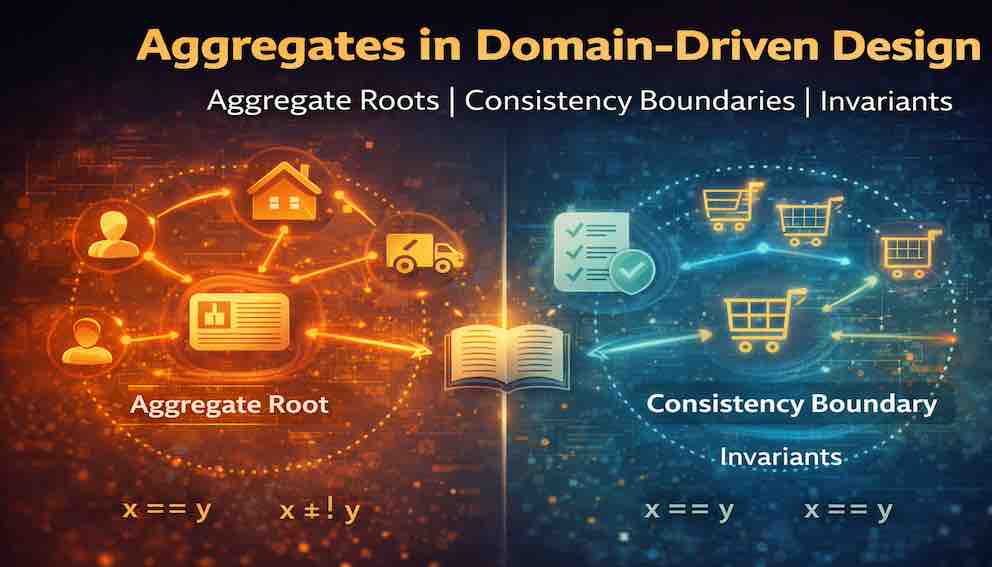
Aggregates group related entities and value objects into a single unit, ensuring that all changes within that unit remain consistent. The aggregate root acts as the gatekeeper—external code can only interact with the aggregate through the root, which enforces all business rules. By defining clear boundaries based on how the business actually operates, aggregates protect data integrity without creating unnecessary complexity. Mastering aggregates gives you a reliable way to manage complexity in domains where consistency truly matters
Introduction
In the previous articles of this series, we explored the foundational building blocks of Domain-Driven Design. We examined entities—objects defined by identity that change over time—and value objects—immutable objects defined entirely by their attributes. We saw how these two patterns form the core of any domain model.
But entities and value objects do not exist in isolation. They combine to form larger structures. And within those structures, a critical question arises: how do we maintain consistency?
In this context, consistency means that related data stays in a valid state according to the business rules. When one piece of data changes, any other data that depends on it must change as well—and no operation should leave the system in a temporarily invalid state that other parts of the system might see.
Consider an order in an e-commerce system. An order contains multiple order items, each with a product, a quantity, and a price. The order has a total amount, a status, and a shipping address. When a customer adds an item, several things must happen together: the item list must include the new item, the total must be recalculated to reflect the addition, and if the order was already shipped, the operation must be rejected entirely—no partial update is acceptable.
Ensuring that all these changes happen as a single, indivisible unit—and that no partial or inconsistent state ever becomes visible—is the responsibility of the aggregate.
This article explores aggregates in depth. We will examine what aggregates are, why they exist, how to identify them, and how to design them to protect the integrity of the domain. We will see the concept made concrete through examples—an order, a bank account, a calendar—and address the misconceptions that most commonly trip practitioners up.
Part One: What Is an Aggregate?
A Concrete Example First
Before defining what an aggregate is, let us look at one.
In an e-commerce system, consider an order. An order is not a single piece of data. It contains:
- The order itself, with an order number, a status, and a creation date
- Multiple order items, each with a product ID, quantity, and price
- A shipping address
- A total amount calculated from the items
When you retrieve an order from the database, you retrieve all of these things together. When you save an order after a customer adds an item, you save all of these changes together—the new item, the updated total, and the order itself—in a single operation.
This cluster of objects—the order entity, its collection of order item entities, and the shipping address value object—is an aggregate. The order entity serves as the aggregate root, the single entry point through which all changes to the cluster must pass.
The Problem Aggregates Solve
Now that we have seen what an aggregate looks like, we can understand the problem it solves.
In any non-trivial domain model, objects reference one another. An order contains items. A customer has multiple orders. A product belongs to a category. These relationships create a web of interconnected objects.
If every object could be modified independently, maintaining consistency would be nearly impossible. Consider what happens when a customer adds an item to an order. Several things must change together: the order's item list grows, the total amount recalculates, and the order's status may need to update. If these changes happen separately—if the item is added but the total is not updated—the order becomes inconsistent. The data no longer reflects reality.
Worse, if two different parts of the system try to modify related objects at the same time, data corruption can occur. One process adds an item while another processes payment. Without careful coordination, the order could end up in an impossible state.
Aggregates solve this by establishing clear boundaries around clusters like the order and its items. When you modify an aggregate, all changes to objects inside that boundary happen together. Either every change succeeds, or none of them do. Within the aggregate, consistency is guaranteed.
But Not Everything Belongs Together
Now consider something outside the order aggregate: inventory. When an order is placed, the inventory must eventually reflect that stock has been reserved. But does this need to happen in the same instant as the order is saved?
Often, the answer is no. The business can accept a brief delay—perhaps a few seconds—between the order being confirmed and the inventory being updated. During that delay, the inventory count may temporarily show more stock than is actually available. This is acceptable because the alternative—locking both the order and inventory together in a single transaction—would create performance bottlenecks and make the system harder to scale.
This is why inventory belongs to a separate aggregate. It has its own consistency boundaries and its own rules.
The Core Principle
This leads to a simple principle:
- Within an aggregate, changes must be strongly consistent. Everything updates together in one transaction. This is what we mean when we say the aggregate is treated as a single unit for data changes.
- Between aggregates, changes can be eventually consistent. They will synchronize in due course, but not necessarily immediately.
The art of aggregate design lies in deciding where to draw these boundaries. Group together what must stay perfectly consistent. Separate what can tolerate a brief delay.
In the order example, the order and its items must be perfectly consistent—they belong together. The order and the inventory can tolerate a brief delay—they belong apart.
Defining Characteristics
Every aggregate has three defining characteristics.
First, an aggregate has a boundary. The boundary defines what belongs inside the aggregate and what lies outside. Objects inside the boundary can reference each other directly. Objects outside the boundary can only reference the aggregate through its root.
Second, an aggregate has a root. The aggregate root is a single entity that serves as the entry point to the aggregate. All external access to objects inside the aggregate must go through the root. This ensures that no internal object can be modified without the root enforcing the necessary invariants.
Third, an aggregate guarantees consistency. Within the boundary of an aggregate, all changes must result in a consistent state. When a transaction completes, every invariant—every rule that must always hold true—must be satisfied.
A Simple Analogy
Think of an aggregate as a car. The car has many components: an engine, wheels, a transmission, brakes. These components are interconnected. You cannot change the transmission without considering how it affects the engine. You cannot replace the brakes without ensuring they work with the wheels.
The car itself serves as the aggregate root. When you interact with the car—pressing the accelerator, turning the steering wheel—you interact through its defined interfaces. The car ensures that all internal components work together correctly.
If you could directly modify the engine without going through the car, you might create an inconsistent state. The engine might rev while the car is in park. The aggregate prevents this by controlling all access.
Part Two: The Aggregate Root
What Is an Aggregate Root?
The aggregate root is the entity that sits at the top of an aggregate. It is the only object within the aggregate that external objects are allowed to reference directly.
When another part of the system needs to modify something inside the aggregate, it does so by calling methods on the aggregate root. The root then determines whether the requested change is valid, updates the necessary internal objects, and ensures that all invariants remain satisfied.
The aggregate root also carries the identity of the aggregate as a whole. If you need to retrieve an aggregate from a repository, you retrieve it by the root's identifier.
Responsibilities of the Aggregate Root
The aggregate root has several distinct responsibilities.
It enforces invariants. Any business rule that must hold true across the aggregate is checked and enforced by the root. For example, an order root might enforce that an item cannot be added after the order has shipped.
It controls access. Internal objects are not exposed directly. If external code needs information about internal objects, the root provides methods to retrieve that information in a controlled way—typically by returning value objects or copies, not references to internal entities.
It manages the lifecycle of internal objects. When an internal entity needs to be created, updated, or removed, these operations happen through methods on the root. The root ensures that changes occur in a coordinated manner.
It publishes domain events. When significant state changes occur within the aggregate, the root raises domain events that notify other parts of the system. This is how changes within one aggregate eventually propagate to others without crossing transactional boundaries.
Factories and Reconstitution
Creating a complex aggregate is often not as simple as calling a constructor. Business rules may need to be checked. Multiple internal objects may need to be set up in a specific initial state. When construction logic becomes complex, a dedicated factory—a method or class whose sole responsibility is creating a valid, complete aggregate—is often the right choice. The factory encapsulates that complexity and ensures the aggregate is always born in a consistent state.
Reconstitution is a distinct concern. When an aggregate is loaded back from persistence, the process is not construction—no invariants are being newly established. The aggregate already existed and is simply being restored to memory. Many implementations handle this through a separate reconstitution path (a private constructor, a static factory method, or an ORM-managed hydration mechanism) that bypasses the creation-time validation. Understanding this distinction prevents subtle bugs where loading an aggregate accidentally fires business logic that should only run when the aggregate is first created.
What Does Not Belong to the Root
A common mistake is to put too much responsibility in the aggregate root. The root should delegate behavior to internal objects when appropriate. If an internal entity has its own behavior, the root can call that behavior rather than implementing the logic itself.
For example, an order item might know how to calculate its subtotal. The order root does not need to implement this calculation. It simply calls the item's method and aggregates the results.
Part Three: Consistency Boundaries and Invariants
What Are Invariants?
Before discussing consistency boundaries, it helps to be precise about what drives them: invariants.
Invariants are rules that must always remain true for an aggregate to be valid. They are not technical constraints about database schemas or field lengths. They are business rules that matter to the organisation.
Examples of invariants include:
- A bank account balance cannot fall below the minimum allowed amount.
- An order total must equal the sum of its item prices multiplied by quantities.
- A meeting cannot be scheduled at the same time in the same room as another meeting.
- A withdrawal cannot exceed the available balance.
Invariants are enforced by the aggregate root. When a method on the root is called, the root checks all relevant invariants before making any changes. If an invariant would be violated, the operation is rejected—typically by throwing a domain exception. This enforcement happens at the domain level, not at the database level. Databases can provide some constraints, but the true enforcement of business invariants belongs in the domain model, ensuring they hold regardless of how the aggregate is accessed.
Strong Consistency vs. Eventual Consistency
Within an aggregate, changes must be strongly consistent. When a transaction commits, every invariant within the aggregate must hold true. This requires that all changes to objects within the aggregate are persisted together in a single database transaction.
A simple example: When a customer adds an item to an order, three things must happen together: the item is added to the order's item list, the total amount is recalculated, and if the order was empty before, its status may change from "draft" to "pending." These three changes must either all succeed or all fail. You cannot have the item added without the total updating. This is strong consistency, and because the order and its items belong to the same aggregate, it is enforced automatically.
This brings us to one of the most practical rules in aggregate design: one aggregate per transaction. When you find yourself wanting to modify two aggregates in the same database transaction, that is a signal that either your aggregate boundaries are drawn incorrectly, or that the relationship between those aggregates should be handled through eventual consistency.
Another simple example: Now consider an order and the inventory it draws from. When an order is placed, the inventory count for the purchased product must decrease. These two things belong to different aggregates—they have different invariants and are often managed by different parts of the business. If you try to update both in the same transaction, you create a distributed lock that slows down the system.
Instead, the system handles this with eventual consistency. The order is saved in one transaction. Immediately after, a domain event—OrderPlaced—is raised. A separate part of the system listens for this event and, in its own transaction, updates the inventory. For a brief moment—perhaps milliseconds—the inventory count may not yet reflect the recent order. The business accepts this small delay because the alternative would be a slower, more complex system.
Across aggregates, strong consistency is often unnecessary and sometimes harmful. Separate aggregates communicate through domain events. When the root of one aggregate raises an event, other aggregates—perhaps in a different part of the system—can react to that event and update themselves. The two aggregates may not be consistent at exactly the same instant, but they will be consistent eventually. The event-driven model makes that propagation explicit and auditable.
The rule of thumb: If two things must be perfectly consistent at all times, they belong in the same aggregate. If they can tolerate a brief delay, they can be separate aggregates that synchronize through events.
How to Identify Consistency Boundaries
Identifying the right consistency boundaries is perhaps the most challenging aspect of aggregate design. The guiding principle is to look at the business invariants.
An invariant is a rule that must always be true. For an order, invariants might include:
- The total amount must equal the sum of all item subtotals.
- An order cannot be shipped if it contains no items.
- A shipped order cannot have items added or removed.
These invariants define what must be consistent. Any objects involved in the same invariants should belong to the same aggregate. If two sets of objects have no invariants that span across them, they can be separate aggregates.
Common Pitfalls
One common pitfall is creating aggregates that are too large. A large aggregate with many objects becomes difficult to manage. Transactional boundaries widen, leading to performance problems and contention. The system becomes rigid because any change to any part of the aggregate requires locking the entire aggregate.
Another pitfall is creating aggregates that are too small. If an aggregate contains only a single entity but that entity has invariants that involve other objects, those invariants become impossible to enforce and the result is inconsistent data.
A practical note for teams using object-relational mappers: ORMs like Hibernate or Entity Framework will eagerly load associated objects if not carefully configured. An aggregate that seems small in the domain model can become expensive in practice if the ORM silently fetches its entire object graph on every load. Configuring lazy loading deliberately—and testing aggregate load behaviour explicitly—is worth doing early.
The ideal aggregate size is the smallest unit that can satisfy all invariants without including unnecessary objects.
Invariants Across Aggregates
When invariants span multiple aggregates, a design decision must be made.
One option is to reconsider the aggregate boundaries. If two aggregates share strict invariants that must be enforced immediately, they may actually belong together as a single aggregate.
Another option is to accept eventual consistency and handle the relationship through domain events. When an order is placed in a warehouse system, inventory might be a separate aggregate. Placing the order raises an event; the inventory aggregate reacts to that event and decrements stock. There is a brief window where the two are not perfectly consistent, but the business may accept this—and in distributed systems, it is often the only practical option.
The choice depends on the domain. Some businesses require strict, immediate consistency. Others can tolerate short delays. The aggregate design must honestly reflect the real requirements of the business, not the preferences of the technical team.
Part Four: Designing Aggregates
Start with Invariants
The best way to design an aggregate is to start with the invariants. Gather the business rules that must always hold true. Write them down explicitly. These invariants will reveal what must be consistent.
Once invariants are clear, identify the objects involved in each invariant. Objects that are involved in the same invariants likely belong together. Objects that are involved in separate invariants may belong to separate aggregates.
Choose the Aggregate Root
For each aggregate, choose a single entity to serve as the aggregate root. The root should be the object that is naturally used to access the aggregate. It should have a meaningful identity in the domain.
The root becomes the gateway to the aggregate. All external references to objects inside the aggregate go through the root. Repositories store and retrieve aggregates by the root's identifier.
Define Methods, Not Setters
Aggregates should expose behaviour, not data. Instead of providing public setters for every attribute, the aggregate should provide methods that represent domain operations.
For example, an order aggregate might have methods like addItem(product, quantity) and removeItem(itemId) rather than providing direct access to the items collection. This allows the aggregate to enforce invariants—such as not adding items to a shipped order—every time a change is attempted.
Keep Aggregates Small
Aim for small aggregates. Each aggregate should contain only the objects necessary to enforce its invariants. If an aggregate grows large, consider whether it can be split.
Small aggregates offer several advantages. They are easier to understand. They reduce transactional contention. They allow the system to scale more effectively. Concurrency conflicts become less frequent, and optimistic locking—a natural fit for aggregate-based systems—works well when conflicts are rare.
Reference by Identity, Not by Reference
When one aggregate needs to refer to another, use identity references rather than direct object references. Instead of holding a reference to another aggregate's root object, hold its identifier.
This practice reinforces the boundary between aggregates. It makes it clear that cross-aggregate operations are not transactional. And it prevents the system from inadvertently loading unnecessary object graphs.
Part Five: Practical Modeling Examples
Example One: Order Aggregate
Consider an e-commerce order. The order contains order items, each with a product ID, quantity, and price at the time of purchase. The order has a status, a total amount, and a shipping address.
Invariants:
- The total must equal the sum of all item subtotals.
- An order cannot have zero items.
- Items cannot be added after the order is shipped.
- Items cannot be removed after the order is shipped.
- The shipping address cannot be changed after the order is shipped.
These invariants define the consistency boundary. The order and its items must be consistent together. The shipping address is also part of the same consistency boundary because the invariants involve it.
The aggregate root is the Order entity. It controls access to order items. External code adds items by calling order.addItem(), not by directly manipulating the items collection. When the order ships, the root updates the status and thereafter rejects any mutation attempts.
Example Two: Bank Account Aggregate
Consider a bank account with a balance and a transaction history. Invariants include:
- Balance cannot fall below the minimum allowed amount.
- Withdrawals cannot exceed the available balance.
- Deposits must be for positive amounts.
- Transactions must be recorded in chronological order.
The Account entity serves as the aggregate root. It contains a collection of Transaction entities. When a withdrawal is requested, the account checks the balance against the withdrawal amount. If valid, it creates a transaction and updates the balance. Both operations happen together within the aggregate, within a single transaction.
Note that Transaction entities here are internal—they are not independently retrievable from a repository. If the business needs to query transactions separately (for audit or reporting purposes), that access goes through the account or through a dedicated read model, not by treating transactions as standalone aggregates.
Example Three: Calendar Aggregate
Consider a calendar system with meetings and rooms. Invariants include:
- No two meetings can occupy the same room at the same time.
- A meeting cannot be scheduled outside the allowed hours.
- A meeting must have at least one attendee.
A Room aggregate contains its schedule of meetings. The Room serves as the aggregate root. When a meeting is scheduled, the room checks for conflicts. If none exist, it adds the meeting to its schedule.
In this design, meetings are not independent aggregates. They belong to the room aggregate because the double-booking invariant requires consistency within the room's schedule. If meetings were treated as independent aggregates, there would be no way to enforce the no-overlap rule transactionally.
Part Six: Common Misconceptions
Every Entity Must Be an Aggregate Root
Not every entity is an aggregate root. Many entities exist only as part of a larger aggregate. An order item is an entity—it has identity within the order—but it is not an aggregate root. Its lifecycle is entirely managed by the order root.
Aggregate roots are the top-level entities that can be independently retrieved and persisted. Internal entities are accessed only through their root. Making every entity a root leads to an anemic model where invariants cannot be enforced because there is no single object responsible for coordination.
Aggregates Should Always Be Minimal
While small aggregates are generally preferable, correct size is determined by the invariants—not by a preference for minimalism. Some aggregates legitimately need to be larger because the invariants require it. A financial portfolio with complex cross-position constraints may need to contain many positions within a single aggregate to enforce those constraints transactionally.
The goal is not the smallest possible aggregate. The goal is the smallest aggregate that honestly satisfies all invariants.
All Relationships Must Go Through Roots
The rule is that external objects cannot hold references to internal objects. However, internal objects can reference each other freely. An order item can reference the order root. Value objects can be shared among multiple entities within the aggregate.
The boundary applies to access from outside the aggregate, not to internal references. Misapplying this rule leads to overly rigid designs where internal entities cannot naturally collaborate.
Part Seven: Aggregates and Persistence
Transaction Boundaries
Aggregates correspond to transaction boundaries. When an aggregate is modified, all changes are persisted together in a single transaction. If any part of the update fails, the entire operation rolls back, leaving the aggregate in its original consistent state.
This is why the one aggregate per transaction rule matters so much in practice. It is also why aggregates must be carefully sized: a transaction spanning too many objects causes performance and contention problems; a transaction spanning too few may fail to maintain consistency.
Repositories
Repositories work with aggregate roots. Each aggregate root has a repository that provides methods to retrieve and persist aggregates. The repository returns complete aggregates—the root along with all its internal objects—ready for use.
When an aggregate is saved, the repository ensures that all changes to the root and its internal objects are persisted together. The repository is also the natural place to handle reconstitution—ensuring that objects loaded from the database bypass creation-time validation and are restored faithfully to their persisted state.
Repositories will be covered in detail in a later tutorial.
Optimistic Concurrency
Because aggregates are transaction boundaries, they are also natural units for optimistic concurrency control. When an aggregate is retrieved, a version number or timestamp is captured. When the aggregate is saved, the repository checks that the aggregate has not been modified by another process. If it has, the save operation fails and the application retries.
This approach works well when aggregates are small and conflicts are rare—exactly the conditions that good aggregate design produces. It is simpler than distributed locking and scales more effectively.
Conclusion
Aggregates are one of the most powerful concepts in Domain-Driven Design. They provide a clear mechanism for maintaining consistency in complex domains. By defining boundaries around clusters of objects, they make explicit what must be transactionally consistent and what can be eventually consistent.
The aggregate root serves as the guardian of the aggregate. It enforces invariants, controls access, manages the lifecycle of internal objects, and publishes the domain events through which aggregates communicate with the rest of the system.
Designing aggregates well requires starting from the domain's invariants. What rules must always hold true? Which objects are involved in those rules? The answers to these questions determine where the boundaries should be drawn. When you find yourself wanting to modify two aggregates in the same transaction, treat it as a signal: either the boundary is wrong, or the relationship between them should be eventual.
When aggregates are designed correctly, the benefits are significant. Consistency is protected. Complexity is contained within clear boundaries. The domain model becomes more expressive. And the system becomes easier to evolve, test, and scale over time.
About N Sharma
Lead Architect at StackAndSystemN Sharma is a technologist with over 28 years of experience in software engineering, system architecture, and technology consulting. He holds a Bachelor’s degree in Engineering, a DBF, and an MBA. His work focuses on research-driven technology education—explaining software architecture, system design, and development practices through structured tutorials designed to help engineers build reliable, scalable systems.
Disclaimer
This article is for educational purposes only. Assistance from AI-powered generative tools was taken to format and improve language flow. While we strive for accuracy, this content may contain errors or omissions and should be independently verified.