Learning Paths
Last Updated: March 23, 2026 at 15:30
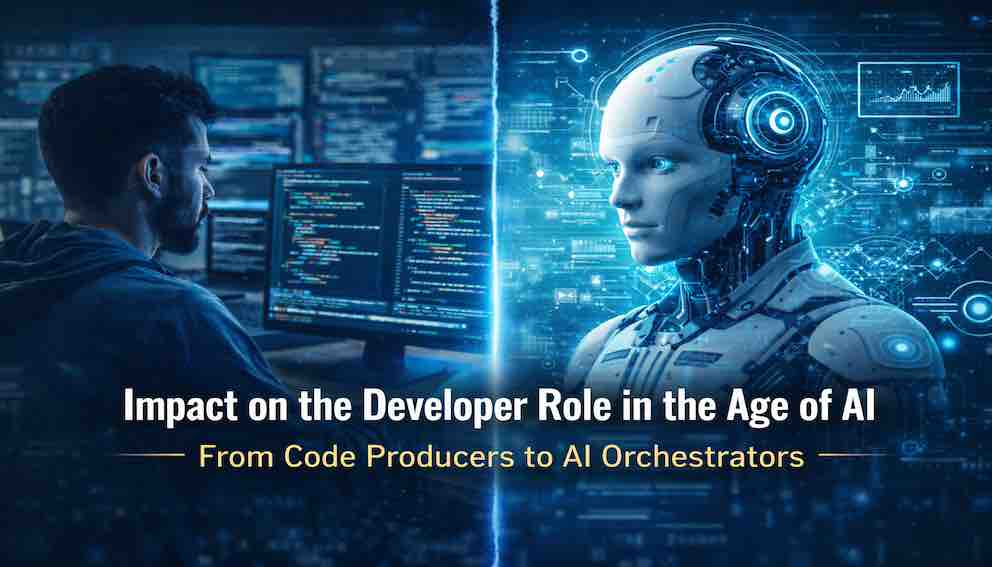
Impact on the Developer Role in the Age of AI
From Code Producers to AI Orchestrators
AI is fundamentally reshaping the developer role — not by replacing developers, but by shifting what they do and what skills matter most. The scarcity in software development is moving away from the ability to write code toward the ability to make good decisions: what to build, how to validate AI-generated outputs, and how to maintain coherence across complex systems. Developers who thrive will combine deep domain expertise with AI literacy, acting as critical safety nets who catch hallucinations, preserve architectural integrity, and sustain the glue work — mentorship, documentation, team culture — that AI cannot replicate. The future developer is not defined by how much code they write, but by how well they think, design, and validate. The responsibility of the craft, if anything, becomes heavier
Introduction: A New Era for Software Developers
For decades, developers have been the backbone of technology organisations — designing systems, writing code, debugging issues, and coordinating across teams. Their work has always been complex, iterative, and demanding, with significant time spent on repetitive tasks, troubleshooting, and maintaining legacy systems.
Today, artificial intelligence is changing that reality. AI is no longer a theoretical concept or a niche tool; it has become a practical part of software development workflows. From code generation to automated testing, from deployment to documentation, AI is stepping into tasks that were traditionally human-driven.
Yet the transformation is not instantaneous, and its full impact is still unfolding. Understanding how AI affects the developer role — and what skills will define success going forward — is essential for anyone who wants to remain effective and relevant in this new era.
How AI Is Changing Day-to-Day Development
Coding and Problem-Solving
The most immediate change is in coding efficiency. AI-assisted tools can suggest complete code snippets, identify potential errors, and align output with best practices — producing code that is often cleaner and more consistent at the point of creation. What previously took weeks may now take a fraction of the time.
But the reality is more nuanced. AI tends to produce code that is locally clean — well-structured at the function level — while remaining globally inconsistent with the broader system. As context windows grow and agentic tooling matures, this limitation is improving, but it remains a meaningful concern today. Without careful oversight, a codebase assembled from AI-generated fragments can become fragmented, with different components following different patterns and assumptions. The developer's role shifts from writing every line to validating that each generated piece fits coherently into the whole.
Multi-Layer Productivity
Historically, software development relied on specialised roles: frontend engineers, backend engineers, QA, DevOps, and integration teams. AI changes this dynamic. In many contexts — particularly smaller systems, prototypes, and fast-moving teams — a single AI-augmented developer can now cover multiple layers: writing frontend and backend code, creating automated tests, managing deployment pipelines, and enforcing standards.
This is not universal. In large-scale distributed systems, high-compliance environments, or complex DevOps infrastructure, specialisation remains essential. But for a growing range of development contexts, AI enables a level of cross-layer capability that was previously out of reach.
Coordination Overhead: Less in Some Places, More in Others
One of the most significant yet often overlooked gains is in coordination. In traditional development, a feature moving from concept to production might require handoffs between a frontend specialist, a backend engineer, a DevOps expert, and a QA analyst. Each handoff carries overhead: meetings to align expectations, documentation to transfer context, delays while waiting for availability. When a single AI-augmented developer can handle multiple layers of the stack, those handoffs disappear. Teams become smaller, but they also become simpler.
However, AI also introduces new coordination challenges. Teams must align on how they use AI tools, which prompts work best, and how to validate outputs consistently. When AI generates code that no single developer fully understands, debugging and knowledge transfer become more complex. The overall coordination burden shifts rather than disappears.
Research, Debugging, and Flow State
One of the clearest productivity gains is the reduction in time spent searching for solutions online, reading forums, and waiting for answers. AI can provide instant guidance, suggest solutions, and explain best practices — allowing developers to maintain focus and flow state rather than breaking concentration to chase information. This benefit is real, consistent, and widely reported.
Automated Standards and Testing
AI can enforce coding standards automatically, improving consistency across teams without depending on manual code reviews. AI-generated tests serve as a useful starting point, accelerating baseline coverage. However, they still require human validation to ensure no critical edge cases are missed, and should not be treated as a substitute for considered test design.
Automation of Routine Tasks
Beyond coding, AI can take over boilerplate, initial code reviews, deployment management, and dependency updates. These efficiencies are real — but they only deliver lasting value if the time saved is intentionally redirected toward design, architecture, and strategic problem-solving, rather than simply being absorbed into higher output volume.
The Hidden Crisis: Glue Work at Risk
In every successful development team, certain individuals do the invisible work that keeps everything functioning: mentoring junior developers, writing documentation, improving team processes, onboarding new hires, unblocking colleagues, and maintaining team culture. This is often called glue work — and it is at serious risk in the AI era.
The incentive problem is straightforward. When organisations measure productivity by features shipped and tickets closed, and AI makes it easier to generate enormous output, the incentive to invest in glue work diminishes. Why spend an hour mentoring a colleague when AI assistance could ship three features in that time?
The long-term consequences are serious: poorly documented systems, junior developers who never build deep skills, fragmented team culture, and accumulated technical debt from rushed, under-considered solutions. Organisations must explicitly value and reward glue work in the AI era — including it in performance metrics, creating roles focused on system coherence and team health, and using AI itself where it can help, for example with documentation drafts and onboarding materials.
Cumulative Impact: Productivity, Variance, and Risk
Considered individually, the changes above may seem incremental. Together, they reshape the economics of software development.
When efficiencies compound — faster coding, automated testing, reduced research time, streamlined coordination — the cumulative effect can be dramatic. A skilled AI-augmented developer can accomplish what previously required a larger team. This is not hype; it is already happening in the field.
AI Amplifies Variance, Not Just Productivity
Here is the critical nuance that is often missed: AI does not standardise performance. It amplifies existing capability.
Strong developers become dramatically more effective, using AI to handle routine work while directing their expertise toward architecture, validation, and complex problem-solving. Weak developers, however, can now generate larger volumes of code faster. Poor architectural decisions, security vulnerabilities, and inconsistent patterns can be produced at scale. The gap between the most effective developers and the rest may widen rather than narrow.
This has profound implications for teams. Simply giving everyone AI tools does not guarantee productivity gains — it may increase the cost of poor judgment.
The Scarcity Shift: From Code to Judgment
For decades, the bottleneck in software development has been the ability to write code. Good developers were valued because they could produce it efficiently and correctly. AI inverts this. Code is becoming abundant, even cheap. The new bottleneck is judgment: the ability to decide what should be built, how it should fit together, and whether AI-generated outputs are correct, secure, and aligned with real user needs.
This shift changes how developers are valued. The premium moves from implementation skill to decision-making skill, from syntax mastery to system thinking, from coding speed to validation capability.
The Spectrum of Quality: When AI-Generated Code Is Enough
Not every application needs to be built to the highest possible standards of quality and reliability. Recognising this spectrum is essential for understanding where AI can be most effectively deployed.
For support applications — internal tools, administrative dashboards, prototypes, experimental features, short-lived projects — the cost of rigorous testing and exhaustive quality assurance may exceed the value it provides. An internal expense reporting tool with an occasional minor bug is an inconvenience, not a crisis. For these classes of applications, AI-generated code with AI-generated tests may be entirely sufficient.
This is where AI can have its most immediate and transformative impact. A developer with AI tools can generate a functional internal tool in hours rather than weeks, complete with tests, and automated deployment pipelines can push it to production with appropriate guardrails. The entire lifecycle from idea to deployed software compresses dramatically.
However, this is not true for all applications. Safety-critical systems, financial transaction processing, healthcare applications, and infrastructure underpinning critical business operations demand a different standard. The same AI that can generate a functional internal tool can also generate code for these systems — but the risk profile, testing requirements, and human oversight needed are fundamentally different.
Organisations that understand this spectrum will deploy AI where it makes sense — accelerating development of low-risk, support-oriented applications — while maintaining appropriate caution where quality is paramount.
The Job Market Dynamic: Productivity, Demand, and the Time Gap
If AI makes developers significantly more productive, a natural question follows: will fewer developers be needed? The answer depends heavily on when we look.
In the short term, the arithmetic is straightforward. If a developer with AI tools can accomplish what previously required three developers, organisations can deliver the same output with fewer people. We are already seeing the effects: reduced hiring, slower replacement of departing developers, and a softening job market. This is a real and painful reality for many developers today.
But this is only half the story. When software development becomes dramatically cheaper, the total addressable market for software expands. Organisations that could not previously afford custom software can now justify the investment. Entire new categories of software become economically viable.
This creates a countervailing force. In the long term, the demand for software developers may increase as software becomes cheaper and more pervasive. More organisations will build software. More use cases will be addressed. More innovation will be funded.
The critical factor is timing. The productivity gains hit first. The market expansion takes longer — time for organisations to recognise that software has become cheaper, time to identify new opportunities, time to secure funding and build capability. This gap, which could span several years or more, is where the developer job market is currently caught. The precise duration is genuinely uncertain; the dynamics, however, are not.
For individual developers, this means navigating a period of uncertainty while positioning themselves for the eventual expansion. For organisations, it means balancing short-term efficiency with long-term capability. For policymakers, it means recognising that the disruption has broader economic implications that may require intervention.
Why the Full Transformation Hasn't Yet Arrived
AI coding tools have been widely available for over three years. Individual productivity gains are real and well-documented. What we have not yet seen is a full organisational or industry-wide transformation. Teams are structured largely as they were before. The economic structure of software development has not fundamentally shifted.
Several factors explain this gap: AI is still often used for ad-hoc code generation rather than fully integrated into workflows; many developers lack training in effective AI use, particularly for validation; traditional organisational structures and approval processes limit impact; tooling for deployment, architecture analysis, and cross-team reporting is still maturing; and trust in AI-generated outputs remains uneven.
The pieces are in place. The systemic transformation is still ahead.
Legal, Ethical, and Security Implications
As developers rely more heavily on AI, they must navigate a new set of non-technical challenges.
On intellectual property, AI models are trained on vast datasets that include open-source code with specific licences. The legal ownership of AI-generated code that incorporates patterns from GPL-licenced software remains unresolved — a fast-moving area that merits close attention.
On security, AI can inadvertently replicate known vulnerabilities or create novel attack surfaces — shifting the developer's responsibility from writing secure code to validating that AI-generated code is secure, which demands deep security knowledge.
On bias, AI models can perpetuate patterns present in their training data, and developers must act as ethical gatekeepers, auditing outputs before deployment.
AI Dependency Risk
As organisations integrate AI deeply into workflows, they become dependent on tools outside their control. What happens when an AI tool goes offline, changes its behaviour, shifts its pricing, or is discontinued? Managing this dependency — maintaining resilience and avoiding vendor lock-in — is a strategic concern that deserves attention now, not retrospectively.
The Future Developer: Skills That Will Matter
AI Literacy — and the Thinking Beneath It
Understanding how to use AI effectively for coding, testing, deployment, and documentation is foundational. However, the specific skill of prompting is likely transitional. As interfaces evolve, natural language interaction will give way to more integrated and intuitive tools.
The enduring skill beneath prompting is structured thinking: the ability to clearly express intent, decompose problems, and articulate constraints. Developers who think systematically and communicate clearly will adapt to whatever interface comes next.
Multi-Disciplinary and System-Level Thinking
Full-stack capabilities across frontend, backend, DevOps, and testing are increasingly valuable. Equally important is the ability to understand how components interact and scale, and to maintain security and compliance awareness across the entire stack. Breadth and integration, not just depth in one layer, become competitive advantages.
Strategic and Creative Judgment
Routine implementation is increasingly automated. The primary differentiator becomes problem-solving beyond the routine: designing architectures that are maintainable, scalable, and robust; deciding what to build and why; and identifying the places where AI guidance is subtly wrong. Human judgment in strategic and architectural decisions cannot be replaced — and this is where developers build lasting value.
Collaboration and Communication
Interacting effectively with AI-augmented teams requires new communication skills. Explaining complex technical concepts clearly remains essential, but so does the ability to orchestrate both human and AI collaborators toward shared goals. Developers increasingly function as directors and validators, not just contributors.
The Expertise Paradox
Perhaps the most important — and underappreciated — dynamic in the AI era is what might be called the expertise paradox.
A junior developer, supercharged by AI, can now produce code that looks like it was written by a seasoned architect. But when the AI generates a subtly wrong solution, introduces a security vulnerability, or makes an inappropriate architectural choice, a developer without deep knowledge may lack the ability to recognise the error. They become proficient at producing output without being capable of validating its correctness.
The expert, by contrast, uses AI to handle routine work, freeing mental bandwidth for high-level oversight. Their deep understanding allows them to catch hallucinations and guide the AI toward robust, secure solutions.
Deep domain expertise is not becoming obsolete. It is becoming the only durable differentiator. The future skill is not just prompting, but critical validation — acting as the responsible architect for an AI-assisted construction crew.
The Human Side of AI-Augmented Development
Identity and Meaning
Many developers derive deep satisfaction from the craft of coding — the elegance of a well-designed solution, the pride of building something from nothing. When AI handles more of the implementation, that source of identity is disrupted. Developers may need to find new meaning in architecture, in solving problems that AI cannot, in the quality of their judgment rather than the quantity of their output. The satisfaction shifts from writing code to orchestrating solutions — a transition that is real but requires conscious navigation.
Imposter Syndrome and Psychological Pressure
AI tools that generate instant solutions can amplify imposter syndrome. If AI can do this, what is my value? Organisations must address this through culture, and by reframing success away from lines of code toward higher-order contributions: system coherence, team health, architectural integrity, and strategic clarity.
Cognitive Load
While AI reduces certain kinds of drudgery, it introduces new cognitive overhead. Managing AI outputs, validating correctness, and maintaining a mental model of what AI has contributed across a project adds real cognitive burden. The most effective developers will treat AI as a junior partner whose work must be reviewed — not an oracle whose output can be trusted without scrutiny.
Burnout Risk
When AI makes everything faster, expectations often simply scale up. If one developer can now do the work of three, organisations may expect them to do the work of three. Without deliberate safeguards, productivity gains translate directly into burnout. Sustainable adoption requires rethinking workload expectations, not just celebrating higher output.
The Education and Training Gap
If the developer role is transforming, how do developers learn the new skills they need? The existing education infrastructure is not yet equipped.
University computer science curricula remain focused on coding fundamentals — precisely the skills AI is commoditising. Few programmes teach AI literacy, output validation, or the ethics of AI-augmented development. Coding bootcamps face an existential question: if AI can generate the code they teach, their value proposition requires fundamental rethinking.
Mid-career developers with solid but not exceptional skills face the greatest risk. Who bears the cost of their retraining? Employers have limited incentive to invest in workers. Governments have not yet developed programmes for this specific dislocation. Many developers are navigating the transition largely alone.
The traditional model of front-loaded education followed by a stable career of application is obsolete. Continuous, lifelong learning is the new baseline. Organisations that actively support this will attract and retain the talent they need; those that do not will fall behind.
Quality, Reliability, and Safety-Critical Systems
AI promises to improve code quality through automated testing and standards enforcement. But it also introduces new quality risks that are easy to overlook.
When AI enables faster shipping, the temptation is to prioritise speed over validation. Organisations may find themselves with more features and more incidents. Quality discipline becomes more important, not less, in an AI-augmented environment.
In safety-critical domains — medical devices, aerospace, financial infrastructure — the picture is particularly complex. Regulatory frameworks assume human authorship and traceable processes. Until certification frameworks evolve to address AI-generated code, these domains may remain areas where AI plays a supportive rather than generative role.
There is also a recursive validation risk: when both code and tests are AI-generated, human oversight can become too thin to catch compounding errors. The industry may need new frameworks — standards for human review requirements, validation processes, and audit trails — to ensure that AI-generated code meets the reliability expectations of high-stakes systems.
Generational Dynamics
The AI transformation affects different generations of developers differently, and managing these dynamics well matters for team health.
Developers new to the field are comfortable with AI tools and have little to unlearn. However, they may lack the deep system understanding that comes from years of debugging and building without AI assistance — making them especially vulnerable to the expertise paradox described above.
Mid-career developers with five to fifteen years of experience face the greatest disruption. They have invested heavily in skills that are being devalued, and the retraining path is neither clear nor well-supported.
Senior developers with deep expertise may find their value increasing. Their ability to validate AI outputs, catch subtle errors, and maintain architectural integrity becomes genuinely critical. Some will resist AI as a threat to the craft — and organisations should create space for honest dialogue about that tension rather than dismissing it.
The mentorship gap is real: when experienced developers leave, they take decades of contextual wisdom with them. Organisations that lose senior talent without capturing that expertise will find themselves with AI-generated codebases that no one truly understands.
Finally, there is a discrimination risk to watch carefully. As organisations seek AI-native talent, there is potential for age bias against developers presumed to be less adaptable. The most resilient teams will combine AI-native newcomers with AI-enhanced veterans — and recognise that both are essential.
What Is a Developer, Now?
As AI takes on more implementation work, the definition of a software developer is genuinely in flux.
If a developer spends more time prompting AI, reviewing outputs, and validating correctness than writing code, the traditional description of the role no longer quite fits. The shift from producer to orchestrator is real and significant. At the same time, the boundaries between developer, product manager, and operations engineer are blurring as AI handles implementation details that once required separate specialisations.
New titles and roles will emerge — AI-Assisted Software Engineer, Validation Engineer, System Architect, AI Orchestration Specialist — each emphasising different aspects of the evolving work. For many developers, being a coder has been central to their professional identity. That identity is under genuine pressure, and the profession will need to develop new sources of meaning and pride to replace it.
What endures is not a job title but a set of capabilities: understanding complex systems, making sound architectural trade-offs, solving novel problems, ensuring software is secure and ethical, and collaborating effectively with both humans and AI. These are the capabilities that will define the developer of the future — whatever they end up being called.
Conclusion
The software developer role is entering an era of unprecedented opportunity and genuine challenge. AI amplifies productivity, reduces routine burdens, and allows developers to focus on higher-value work. Those who embrace this shift, adapt their skills, and position themselves as architects and validators rather than simply coders will be well placed for what comes next.
But this future is not without serious risks. AI dependency, psychological strain, eroding glue work, inadequate education infrastructure, generational fractures, and the blurring of professional identity all threaten to undermine the gains AI promises. These are not edge cases — they are predictable consequences of poorly managed adoption.
The future developer is not defined by how much code they write, but by how well they think, design, and validate. AI changes the mechanics of development, but not the responsibility. That responsibility, if anything, becomes heavier.
Being an effective developer in the coming years will mean less time writing every line manually, and more time orchestrating AI, designing systems, validating outputs, maintaining team cohesion, and solving complex problems with intelligence, creativity, and strategic vision. The developers who master that combination will define the next era of software.
About N Sharma
Lead Architect at StackAndSystemN Sharma is a technologist with over 28 years of experience in software engineering, system architecture, and technology consulting. He holds a Bachelor’s degree in Engineering, a DBF, and an MBA. His work focuses on research-driven technology education—explaining software architecture, system design, and development practices through structured tutorials designed to help engineers build reliable, scalable systems.
Disclaimer
This article is for educational purposes only. Assistance from AI-powered generative tools was taken to format and improve language flow. While we strive for accuracy, this content may contain errors or omissions and should be independently verified.